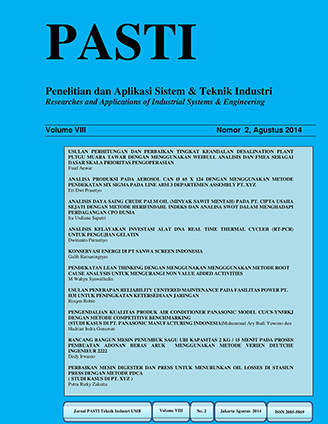
RANCANG BANGUN MESIN PENUMBUK SAGU UBI KAPASITAS 2 KG / 15 MENIT PADA PROSES PEMBUATAN ADONAN BERAS ARUK MENGGUNAKAN METODE VERIEN DEUTCHE INGENIEUR 2222
Abstract
Di Indonesia, ubi merupakan salah satu makanan yang banyak disukai oleh masyarakat. Selain itu, banyak pengolahan makanan yang berbahan dasar ubi seperti kue, keripik, dan lai-lain. Seiring dengan perkembangannya, beras aruk yang awalnya hanya dikonsumsi oleh masyarakat Tempilang untuk kebutuhan rumah tangga saja, kini telah berkembang sebagai makanan yang siap untuk diperjual-belikan oleh Kelompok Tani PKK Desa Tempilang. Semakin banyaknya permintaan dari dalam hingga luar daerah, membuat Tani PKK ini kewalahan untuk memproduksi beras aruk tersebut, mengingat setiap bulan mereka hanya bisa menghasilkan 15 kg per bulan, pada hal permintaan dari konsumen kadang-kadang bisa mencapai 50 kg per bulan. Hal ini yang membuat permintaan bahan baku ubi semakin meningkat karena banyaknya permintaan. Maka dari itu dirancanglah mesin penumbuk sagu ubi dengan kapasitas 2 kg / 15 menit untuk meningkatkan efisiensi waktu dalam proses pengerjaan / penumbukan. Metode yang digunakan dalam pengerjaan tugas akhir ini, yaitu dengan mengumpulkan beberapa data dan analisa kemudian melakukan perencanaan design serta perhitungan dengan menggunakan beberapa software diantaranya Autodesk Inventor Professional, dan AutoCAD. Maka dari itu dirancanglah mesin penumbuk sagu ubi dengan kapasitas 2 kg / 15 menit untuk meningkatkan efisiensi waktu dalam proses pengerjaan / penumbukan. Jika dikerjakan secara manual membutuhkan waktu 30 menit untuk menumbuk sagu ubi dengan kapasitas 2 kg. Dengan adanya pembuatan mesin ini diharapkan dapat meningkatkan kapasitas produksi beras aruk kelompok tani PKK Desa Tempilang.
Kata kunci : Ubi, Penumbukan, Mesin penumbuk, Beras Aruk
Downloads
Downloads
Published
How to Cite
Issue
Section
License
The copyright to this article is transferred to Universitas Mercu Buana (UMB) if and when the article is accepted for publication. The undersigned hereby transfers any and all rights in and to the paper including without limitation all copyrights to UMB. The undersigned hereby represents and warrants that the paper is original and that he/she is the author of the paper, except for material that is clearly identified as to its original source, with permission notices from the copyright owners where required. The undersigned represents that he/she has the power and authority to make and execute this assignment.
We declare that:
1. This paper has not been published in the same form elsewhere.
2. It will not be submitted anywhere else for publication prior to acceptance/rejection by this Journal.
3. A copyright permission is obtained for materials published elsewhere and which require this permission for reproduction.
Furthermore, I/We hereby transfer the unlimited rights of publication of the above mentioned paper in whole to UMB. The copyright transfer covers the exclusive right to reproduce and distribute the article, including reprints, translations, photographic reproductions, microform, electronic form (offline, online) or any other reproductions of similar nature.
The corresponding author signs for and accepts responsibility for releasing this material on behalf of any and all co-authors. This agreement is to be signed by at least one of the authors who have obtained the assent of the co-author(s) where applicable. After submission of this agreement signed by the corresponding author, changes of authorship or in the order of the authors listed will not be accepted.
Retained Rights/Terms and Conditions
1. Authors retain all proprietary rights in any process, procedure, or article of manufacture described in the Work.
2. Authors may reproduce or authorize others to reproduce the Work or derivative works for the authors personal use or for company use, provided that the source and the UMB copyright notice are indicated, the copies are not used in any way that implies UMB endorsement of a product or service of any employer, and the copies themselves are not offered for sale.
3. Although authors are permitted to re-use all or portions of the Work in other works, this does not include granting third-party requests for reprinting, republishing, or other types of re-use.