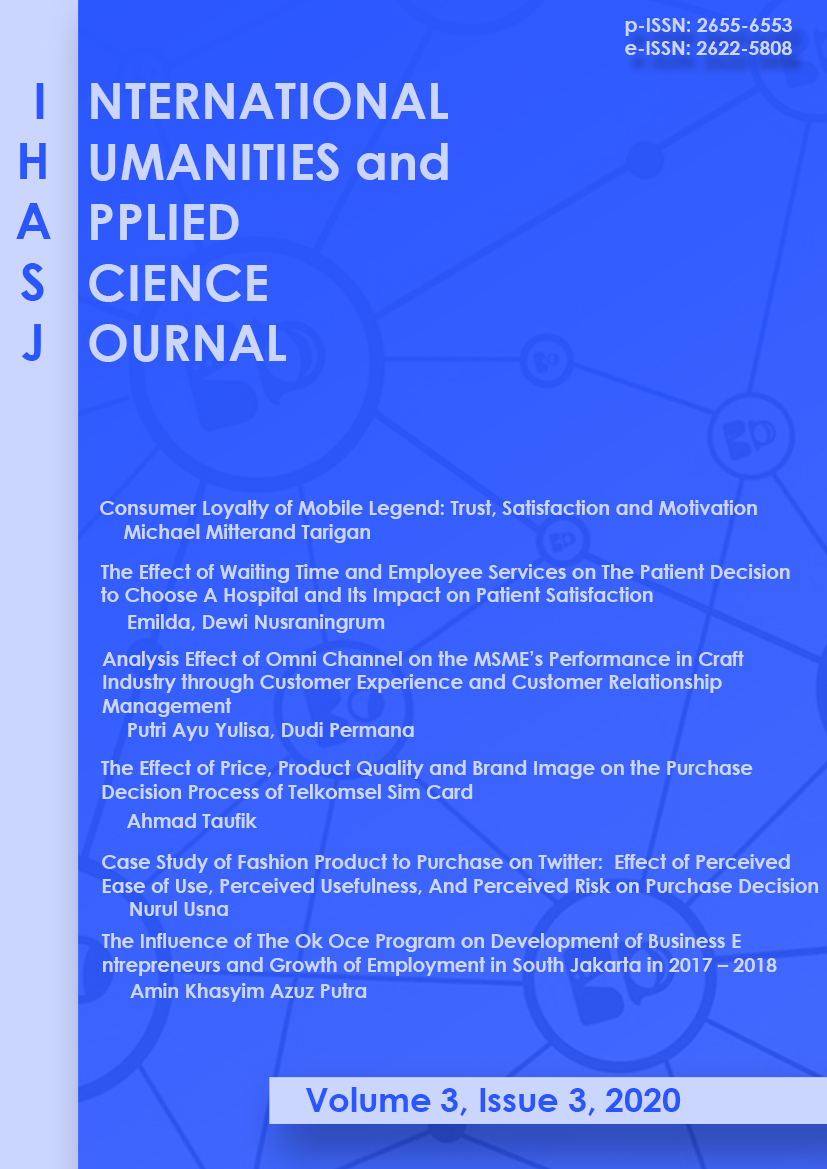
The Influence of The Ok Oce Program on Development of Business Entrepreneurs and Growth of Employment in South Jakarta in 2017 – 2018
DOI:
https://doi.org/10.22441/ihasj.2020.v3i3.06Abstract
The purpose of this study is to examine the influence of the development of entrepreneurs and job growth. The population of this study is a entrepreneurs from various background who join Program OK OCE as a new entrepreneurs. those data analyze by using simple regression equation from data statistic. The result is showen that in partial connection from Program OK OCE to the development of entrepreneurs is positive and significant 14 % with correlation between those are weak 0.377, partial connection from Program OK OCE to job growth the result is positive and significant 57% with correlation between those variabel are strong 0.758.Downloads
References
Arif, Rohman. (2009). Politik Ideologi Pendidikan. Yogyakarta: Laksbang Mediatama.
Arikunto, Suharsimi. (2006). Prosedur Penelitian Suatu Pendekatan Praktik. Jakarta: Rineka Cipta.
Basrowi. (2011). Kewirausahaan untuk Perguruan Tinggi. Bogor: Ghalia Indonesia.
Creswell, John W. (2010). Research Design, Pendekatan Kualitatif, Kuantitatif, dan Mixed. Yogyakarta: Pustaka Pelajar.
Franita, Riska. (2016). Analisa Pengangguran di Indonesia. Jurnal Ilmu Pengetahuan Sosial Volume 1.
Frinces, H.Z. (2010). Penting Profesi Wirausaha di Indonesia (Jurnal Volume. 7)
Ghozali, Imam. (2011). Aplikasi Analisis Multivariate Dengan Program SPSS. Semarang: Badan Penerbit Universitas Diponegoro.
Handoko, T. Hani. (2011). Manajemen Personalia dan Sumberdaya Manusia. BPFE: Yogyakarta.
Husein, Umar. (2011). Metode Penelitian Untuk Skripsi dan Tesis Bisnis. Edisi 11. Jakarta: PT Raja Grafindo Persada.
Islamy, Irfan. (2009). Prinsip- prinsip Perumusan Kebijaksanaan Negara. Bumi Aksara: Jakarta.
Ismawati. K & Pujiani. D. (2014) Entrepreunership Mahasiswa Fakultas Ekonomi.
Jakarta Badan Pusat Statistik. (2016). Jakarta Dalam Angka. (Katalog BPS: 1102001.31). Jakarta: Badan Pusat Statistik Indonesia.
Jakarta Badan Pusat Statistik. (2017) Keadaan Ketenagakerjaan, Agustus 2017 (Provinsi DKI Jakarta No. 55/11/31/Th. XIX) Jakarta: Badan Pusat Statistik Indonesia.
Kasmir. (2011). Kewirausahaan. (edisi revisi). Jakarta: Rajagrafindo Persada.
Kasmir. (2013). Kewirausahaan. Jakarta: Raja Grafindo Persada.
Manap, Abdul. (2018). Manajemen Kewirausahaan. Bogor: Mitra Wacana Media.
Manap, Abdul. (2018). Manajemen Kewirausahaan. Bogor: Mitra Wacana Media.
Muhyi. H.A. (2017). The Business Management Skill of Small Industries Entrepreneurs at Cibeurem District Sukabumi City. In Jurnal AdBispreneur Vol.2 No.1.
Nainggolan, Indra. (2009). Analisis Faktor Yang Mempengaruhi Kesempatan Kerja Pada Kabupaten Di Provinsi Sumatera Utara. Medan: Badan Penerbit Universitas Sumatera Utara Medan.
Octavionica. A; Rusman. T & Nurdin. (2016). Pengaruh Motivasi Berwirausaha Serta Linkungan Ekternal terhadap Minat Berwirausaha. Jurnal Ekonomi.
PGO (Perkumpulan OK OCE). 2017
Robbins, Sthephen P, Mary Coulter. (2000). Manajemen. Jakarta: Prehalindo.
R. Supomo dan Eti Nurhayati. (2018). Manajemen Sumber Daya Manusia, Yrama Widya. Bandung.
Simanjuntak, Payaman. (2001). Pengantar Ekonomi Sumber Daya Manusia. Jakarta: LPFEUI
Sutrisno, Edy. (2015). Manajemen Sumber Daya Manusia. Cetakan ke tujuh. Jakarta: Kencana Prenada Media Group.
Suryana. (2011). Kewirausahaan Pendoman Praktis: Kiat dan Proses Menuju Sukses. Jakarta: Salemba Empat.
Suharto. Edi. (2007). Kebijakan Sosial Sebagai Kebijakan Publik. Bandung: Alfabeta.
Suryana, Yuyus dan Kartib Bayu. (2011). Kewirausahaan Pendekatan Karakteristrik Wirausaha Sukses. Jakarta: Kencana.
Sumarsono, Sonny. (2009). Ekonomi Sumber Daya Manusia Teori dan Kebijakan Publik. Yogyakarta: Graha Ilmu.
Sugiyono. (2010). Metode Penelitian Pendidikan Pendekatan Kuantitatif, kualitatif, dan R&D. Bandung: Alfabeta.
Sugiyono. (2011). Metode Penelitian Kuantitatif, Kualitatif dan R&D. Bandung: Afabeta.
Sugiyono. (2012). Metode Penelitian Bisnis. Bandung: Alfabeta.
Sugiyono. (2015). Metode Penelitian Kombinasi (Mix Methods). Bandung: Alfabeta.
Sugiyono. (2018). Metode Penelitian Kuantitatif, Kualitatif, dan R&D. Bandung: Alfabeta, CV.
Suryana. (2009). Kewirausahaan, Pedoman Praktis, Kiat dan Proses Menuju Sukses. PT. Salemba Empat. Jakarta.
www.okoce.me
Downloads
Published
How to Cite
Issue
Section
License
The copyright to this article is transferred to Universitas Mercu Buana (UMB) if and when the article is accepted for publication. The undersigned hereby transfers any and all rights in and to the paper including without limitation all copyrights to UMB. The undersigned hereby represents and warrants that the paper is original and that he/she is the author of the paper, except for material that is clearly identified as to its original source, with permission notices from the copyright owners where required. The undersigned represents that he/she has the power and authority to make and execute this assignment.
We declare that:
1. This paper has not been published in the same form elsewhere.
2. It will not be submitted anywhere else for publication prior to acceptance/rejection by this Journal.
3. A copyright permission is obtained for materials published elsewhere and which require this permission for reproduction.
Furthermore, I/We hereby transfer the unlimited rights of publication of the above mentioned paper in whole to UMB. The copyright transfer covers the exclusive right to reproduce and distribute the article, including reprints, translations, photographic reproductions, microform, electronic form (offline, online) or any other reproductions of similar nature.
The corresponding author signs for and accepts responsibility for releasing this material on behalf of any and all co-authors. This agreement is to be signed by at least one of the authors who have obtained the assent of the co-author(s) where applicable. After submission of this agreement signed by the corresponding author, changes of authorship or in the order of the authors listed will not be accepted.
Retained Rights/Terms and Conditions
1. Authors retain all proprietary rights in any process, procedure, or article of manufacture described in the Work.
2. Authors may reproduce or authorize others to reproduce the Work or derivative works for the authors personal use or for company use, provided that the source and the UMB copyright notice are indicated, the copies are not used in any way that implies UMB endorsement of a product or service of any employer, and the copies themselves are not offered for sale.
3. Although authors are permitted to re-use all or portions of the Work in other works, this does not include granting third-party requests for reprinting, republishing, or other types of re-use.










