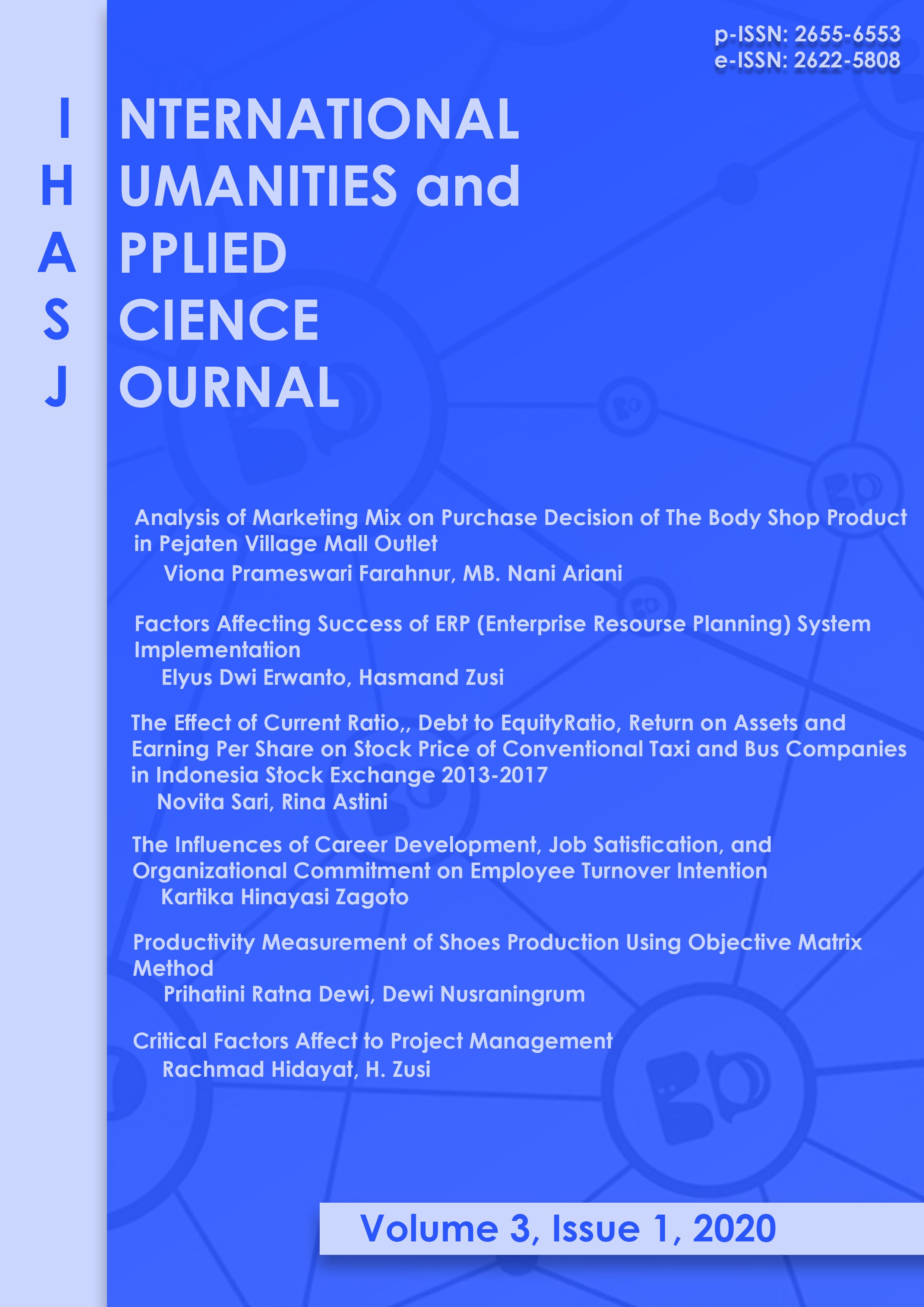
Factors Affecting Success of ERP (Enterprise Resource Planning) System Implementation
DOI:
https://doi.org/10.22441/ihasj.2020.v3i1.02Abstrak
This study aimed to determine the factors that influence the successful (critical success
factors) of ERP implementation in the company's client PT. Artsys Integrasi Solusindo. The data used are primary data using questionnaires from respondents. This research was conducted on 13 companies that have implemented ERP, with 80 respondents being used as samples. The sampling method in this study uses non-probability sampling with a quota sampling technique based on criteria. The analytical tool used in this study is regression analysis. The research hypothesis testing was completed using t-test, F-test and descriptive analysis. The results of this study indicate that Change Management, Project Management, Top Management Sponsorship, Realistic Scope Setting, and Adequate Budget are factors that influence the success of ERP implementation. While the factor of Education in an ERP project does not have a significant effect. But simultaneously, the six factors can explain the relation to the success of ERP implementation with the R-square value of 67.6%. With this research, it is expected that ERP consultants and implementers and the companies that are currently and will implement ERP to pay attention and prepare well the factors that determine the success of ERP implementation.
Unduhan
Referensi
Bingi, P., Sharma, M. K., & Godla, L. K. (1999). Critical Issues Affecting an ERP Implementation, Information Systems Management, 16 (3), 7-14.
Brady, Joseph A. (2001). Concepts in Enterprise Resource Planning. 3rd Edition.USA: Thomson Learning.
Buckhout, S., Frey, E. and Nemec, J.Jr (1999). Making ERP succeed : turning fear into promise. IEEE Engineering Management Review, pp 116-23.
Davenport, T.H, Prusak, L. (2000). Working Knowledge: How Organization Manage What They Know. Boston: Harvard Business School Press.
Falkowski, G., Pedigo, P., Smith, B. and Swanson, D. (1998). A recipe for ERP success. Beyond Computing, pp. 44-5.
Fitrah, M. (2010). Factors that Influence the Successful Implementation of Enterprise Resource Planning. Thesis. University of Indonesia, Jakarta. (Translate)
Haming, M., and Mahmud Nurnajamuddin. (2011). Modern Production Management of Production and Service Operations. Jakarta: Bumi Aksara. (Translate)
Hartono, Jogiyanto. (2007). Computer Based Accounting Information System. 2nd edition. BPFE, Yogyakarta. (Translate)
Jaluanto and Masita Fitri Devityani. (2015). Analysis of Critical Success Factors of Bank Accounting Information Systems in Semarang City. Untag Scientific Journal: Semarang. (Translate)
Kerzner, Harold .(2004). Advanced Project Management: Best Practices on Implementation. John Wiley & Sons, Canada.
Krigsman, M. (2010). ERP Failure: New Research and Statistics, February 3, 2010, accessed on 30/09/2018 at http://www.zdnet.com/blog/projectfailures/erp-failure-new-research-and-statistics/8253
Legare, Thomas. L. (2002). The Role of Organizational Factors in Realizing ERP Benefits. IS Management. 19. 21-42.
Martinsons, M.G. and Westwood, R.I. (1997). Management Information System in the Chinese Business Culture: an Explanatory Theory. Information & Management, 32, 215-228
Nah, F.F., Islam, Z., & Tan, M. (2007). Imperical Assessment of Factors Influencing Success of Enterprise Resource Planning Implementations. In journal of database management. IGI Global.
Nah, F and Lau, J. (2001). Critical Factors for Successful Implementation of Enterprise Systems, Business Process Management Journal, 7 (3), pp 285-296.
O’Brien JA, Marakas G. (2005). Management Information System. Ninth edition. Boston: Mc Graw Hill, Inc.
Rajasekar, J. (2014). Factors Affecting Effective Strategy Implementation in a Service Industry: A Study of Electricity Distribution Companies in the Sultanate of Oman. International Journal of Business and Social Science, 5, 169-183.
Rosario, J.G. (2000). On the Leading Edge: Critical Success Factor in ERP Implementation Projects. Business world Philippines.
Ross, J. W. (1999). Surprising Facts About Implementing ERP. IEEE IT Professional, 4, 65-68.
Sandy, Agata Aries. (2016). Analysis of Factors that Influence the Success of ERP Implementation in Banking Companies in Semarang. Essay. Diponegoro University, Semarang. (Translate)
See Pui Ng, Celeste, Chan, T., & Guy G. Gable. (2001). A Client-benefits Oriented Taxonomy of ERP Maintenance. proceedings of the IEEE international conference on software maintenance, 7-9 Nov. 2001, Florence, Italy. IEEE.
Shanks, G.; Parr, A.; Hu, B.; Corbitt, B.; Thanasankit, T.; and Seddon, P. (2000). Differences in Critical Success Factors in ERP Systems Implementation in Australia and China: A Cultural Analysis. ECIS 2000 Proceedings. 53.
Sum, C. C., J. S. K. Ang, and L. N. Yeo. (1997). Contextual Elements of Critical Success Factors in MRP Implementation. Production and Inventory Management Journal. 3: 77-83.
Summer, M. (1999). Critical Success Factor in enterprise wide information management system projects, Proceeding of the Americas Conference on Information Systems (AMCIS) pp 232-4.
Tarigan, Zeplin Jiwa Husada. (2013). Analyze the Implementation of Enterprise Resource Planning at the Company. Petra Christian University Surabaya. (Translate)
Tjakrawala and Lukita. (2012). Critical Success Factors Model in Implementing Enterprise Resource Planning Systems to Provide Net Benefit for Companies by Using Partial Least Square. Kopertis, Jakarta. (Translate)
Toruan, Dewi Margaret. (2013). Success and Failure to Implement Enterprise Resources Planning (ERP) and Examples of Case Studies of PT Semen Gresik & Fox Meyer. Bogor Agricultural Institute. (Translate)
Tripomo, Tedjo. (2005). Strategy Management. Engineering Science, Bandung. (Translate)
Wee, S. (2000). Juggling toward ERP success: Keep key success factors high. ERP News, February.
Wijaya, Santo F and Darudiato Suparto. (2009). ERP and Business Solutions, Yogyakarta: Graha Ilmu. (Translate)
Winahyu, T. R. (2005). Analysis of Determinants of Success in the Implementation of Enterprise Resource Planning (ERP) System Packages To achieve the Competitive Advantage of the Company, Tesis, Diponegoro University, Semarang. (Translate)
Unduhan
Diterbitkan
Cara Mengutip
Terbitan
Bagian
Lisensi
The copyright to this article is transferred to Universitas Mercu Buana (UMB) if and when the article is accepted for publication. The undersigned hereby transfers any and all rights in and to the paper including without limitation all copyrights to UMB. The undersigned hereby represents and warrants that the paper is original and that he/she is the author of the paper, except for material that is clearly identified as to its original source, with permission notices from the copyright owners where required. The undersigned represents that he/she has the power and authority to make and execute this assignment.
We declare that:
1. This paper has not been published in the same form elsewhere.
2. It will not be submitted anywhere else for publication prior to acceptance/rejection by this Journal.
3. A copyright permission is obtained for materials published elsewhere and which require this permission for reproduction.
Furthermore, I/We hereby transfer the unlimited rights of publication of the above mentioned paper in whole to UMB. The copyright transfer covers the exclusive right to reproduce and distribute the article, including reprints, translations, photographic reproductions, microform, electronic form (offline, online) or any other reproductions of similar nature.
The corresponding author signs for and accepts responsibility for releasing this material on behalf of any and all co-authors. This agreement is to be signed by at least one of the authors who have obtained the assent of the co-author(s) where applicable. After submission of this agreement signed by the corresponding author, changes of authorship or in the order of the authors listed will not be accepted.
Retained Rights/Terms and Conditions
1. Authors retain all proprietary rights in any process, procedure, or article of manufacture described in the Work.
2. Authors may reproduce or authorize others to reproduce the Work or derivative works for the authors personal use or for company use, provided that the source and the UMB copyright notice are indicated, the copies are not used in any way that implies UMB endorsement of a product or service of any employer, and the copies themselves are not offered for sale.
3. Although authors are permitted to re-use all or portions of the Work in other works, this does not include granting third-party requests for reprinting, republishing, or other types of re-use.