
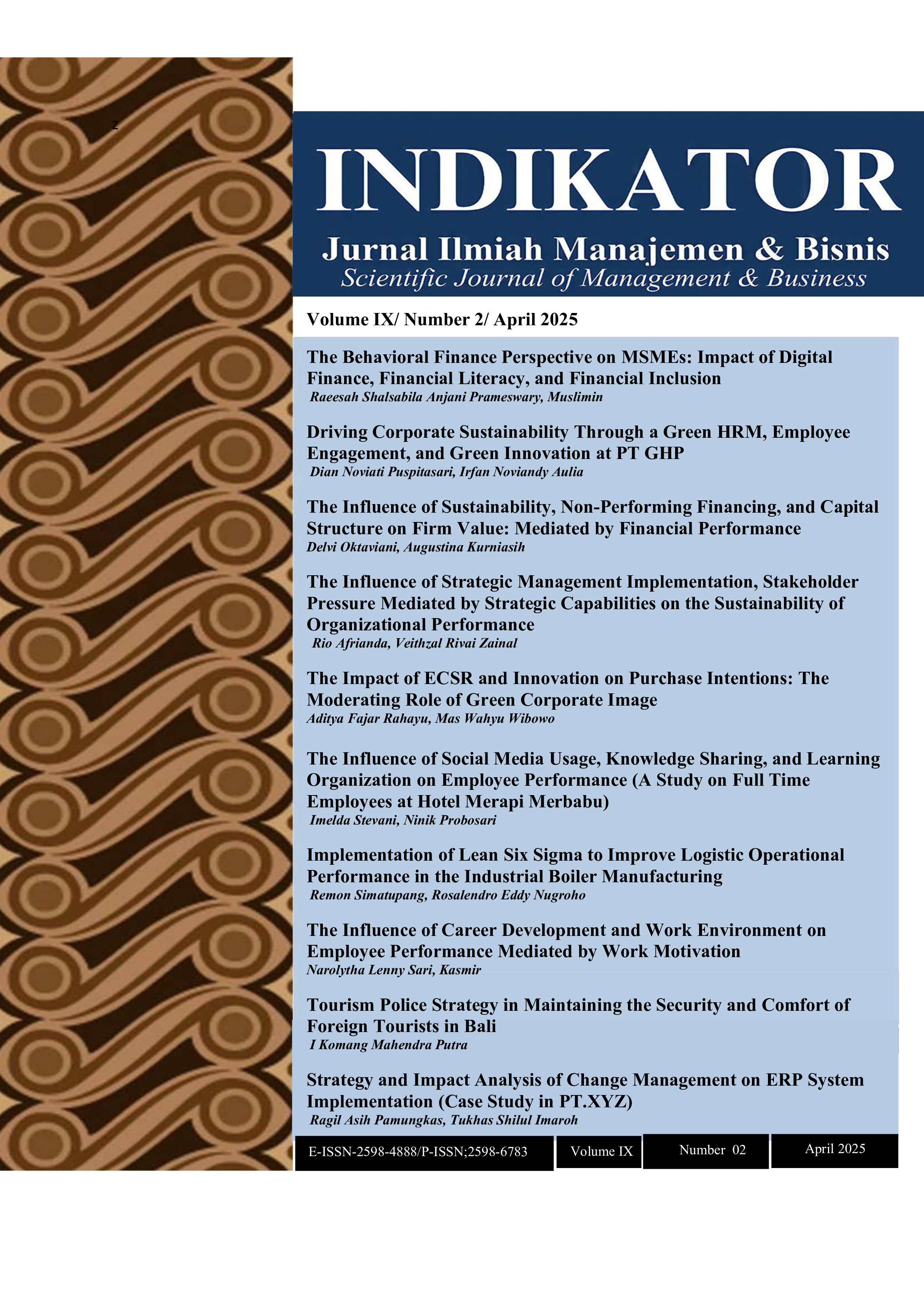
Tourism Police Strategy in Maintaining the Security and Comfort of Foreign Tourists in Bali
DOI:
https://doi.org/10.22441/indikator.v9i2.32787Abstract
Bali is one of Indonesia's top tourist destinations, attracting millions of visitors annually. However, the increasing number of tourists also leads to higher security risks, such as pickpocketing, fraud, and other criminal activities. To address these challenges, tourism police play a strategic role in maintaining security and providing services to foreign tourists. This study aims to analyze the effectiveness of tourism police in Bali and identify the challenges they face. The research employs a qualitative descriptive approach, utilizing in-depth interviews, observations, and document analysis.The findings indicate that tourism police play a crucial role in enhancing tourism security; however, several obstacles persist, including limited human resources, insufficient foreign language training, and ineffective coordination with the tourism industry stakeholders. In conclusion, improving police training, investing in surveillance technology, and fostering stronger collaboration between law enforcement and tourism stakeholders are essential to creating a safer and more comfortable tourism environment.
References
Polda, Bali. (2024). Laporan Keamanan Pariwisata di Bali 2022-2024. Bali.
Creswell, J. W. (2018). Research Design: Qualitative, Quantitative, and Mixed Methods Approaches. SAGE Publications.
Cronen, V., & Pearce, W. (1981). Coordinated Management of Meaning (CMM. SAGE Publications.
Ekonomi Kreatif, K. P. (2023). Laporan Tahunan Pariwisata Indonesia 2023. Kemenparekraf.
Goldstein, H. (1990). Problem-Oriented Policing. McGraw Hill.
Hirschi, T. (1969). Causes of Delinquency. University of California Press.
Hughes, K. (2018). Tourism, Crime, and International Security Issues. Routledge.
McEachern, A. (2000). Tourism, Security, and Safety: From Theory to Practice. Routledge.
Putra, W. K. (2021). Polisi Pariwisata di Bali: Tantangan dan Prospek. Jurnal Kepolisian dan Pariwisata, 5(2), 50–67.
Robbins, S. P. (2017). Fundamentals of Management: Essential Concepts and Applications. Pearson.
Sari, D., & Nurhadi, R. (2022). Keamanan Pariwisata di Bali: Perspektif Polisi Pariwisata. Jurnal Keamanan dan Sosial, 8(1), 112–129.
Downloads
Published
How to Cite
Issue
Section
License
The copyright to this article is transferred to Universitas Mercu Buana (UMB) if and when the article is accepted for publication. The undersigned hereby transfers any and all rights in and to the paper including without limitation all copyrights to UMB. The undersigned hereby represents and warrants that the paper is original and that he/she is the author of the paper, except for material that is clearly identified as to its original source, with permission notices from the copyright owners where required. The undersigned represents that he/she has the power and authority to make and execute this assignment.
We declare that:
1. This paper has not been published in the same form elsewhere.
2. It will not be submitted anywhere else for publication prior to acceptance/rejection by this Journal.
3. A copyright permission is obtained for materials published elsewhere and which require this permission for reproduction.
Furthermore, I/We hereby transfer the unlimited rights of publication of the above mentioned paper in whole to UMB. The copyright transfer covers the exclusive right to reproduce and distribute the article, including reprints, translations, photographic reproductions, microform, electronic form (offline, online) or any other reproductions of similar nature.
The corresponding author signs for and accepts responsibility for releasing this material on behalf of any and all co-authors. This agreement is to be signed by at least one of the authors who have obtained the assent of the co-author(s) where applicable. After submission of this agreement signed by the corresponding author, changes of authorship or in the order of the authors listed will not be accepted.
Retained Rights/Terms and Conditions
1. Authors retain all proprietary rights in any process, procedure, or article of manufacture described in the Work.
2. Authors may reproduce or authorize others to reproduce the Work or derivative works for the authors personal use or for company use, provided that the source and the UMB copyright notice are indicated, the copies are not used in any way that implies UMB endorsement of a product or service of any employer, and the copies themselves are not offered for sale.
3. Although authors are permitted to re-use all or portions of the Work in other works, this does not include granting third-party requests for reprinting, republishing, or other types of re-use.
This work is also licensed under a Creative Commons Attribution-NonCommercial 4.0 International License.









