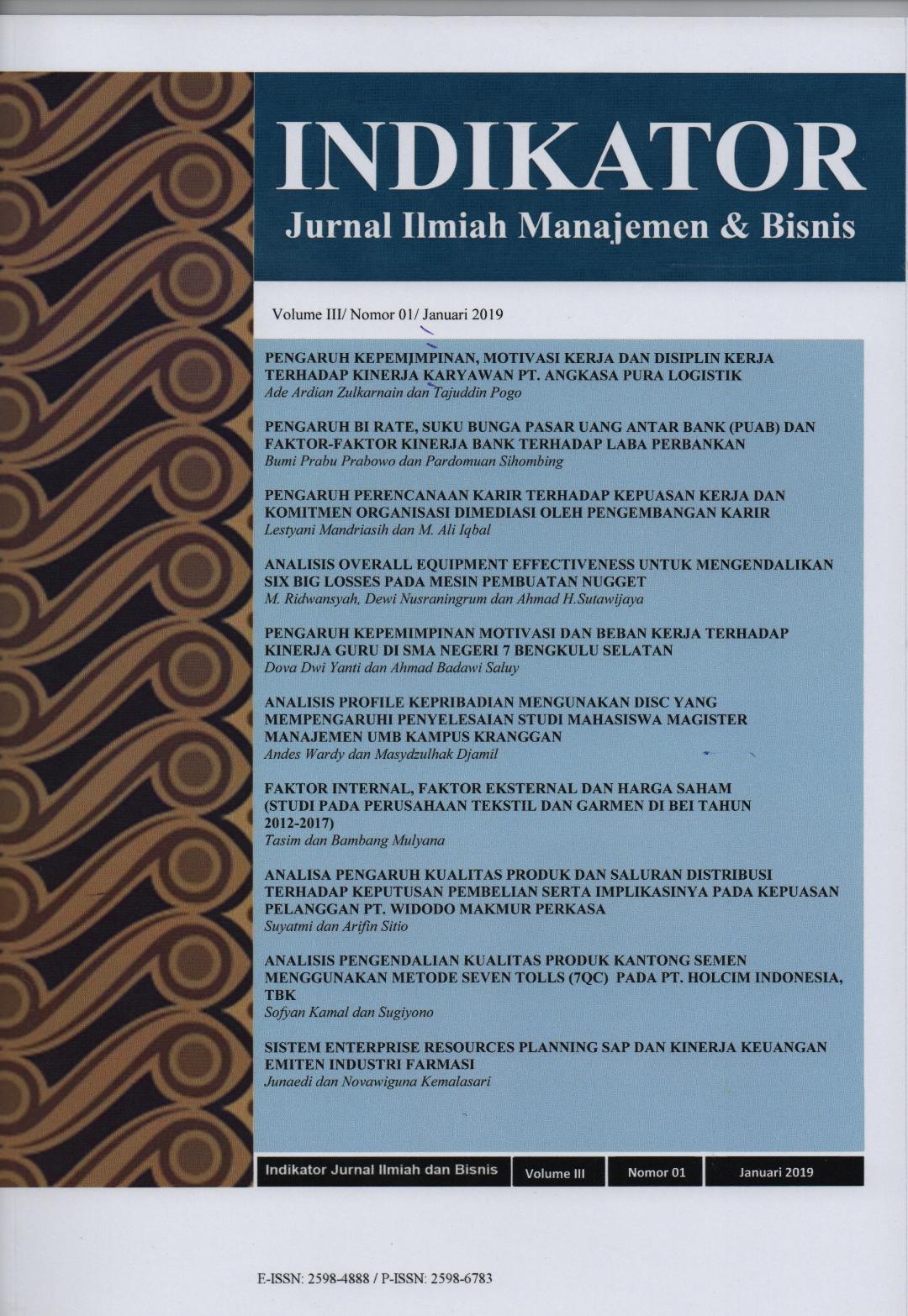
ANALISIS OVERALL EQUIPMENT EFFECTIVENESS UNTUK MENGENDALIKAN SIX BIG LOSSES PADA MESIN PEMBUATAN NUGGET
DOI:
https://doi.org/10.22441/indikator.v3i1.5166Keywords:
Overall Equipment Effectiveness (OEE), Six Big Losses (SBL), dan Fish bone diagramAbstract
Penelitian ini dilakukan untuk mengukur efektifitas penerapan Total Productive Maintenance (TPM) di PT. BI untuk memperbaiki pencapaian pengiriman produk. Penelitian menggunakan pendekatan deskriftif kuantitatif dengan analisa Overall Equipment Effectiveness (OEE). Nilai OEE di analisa menggunakan Metode Six Big Losses (SBL) untuk menemukan faktor kerugian dan analisa diagram fish bone untuk menemukan akar masalah dan membuat usulan untuk perbaikan. Hasil penelitian menemukan OEE 2017 mesin forming dan mesin frying adalah 43%, lebih rendah dibandingkan target perusahaan 60% dan standar OEE internasional 85%. Rendahnya kinerja mesin forming disebabkan faktor reduced speed losses 69% dan startup & adjustment losses 14% dan rendahnya kinerja mesin frying disebabkan faktor equipment failure 53% dan startup & adjustment 29%. Akar masalah yang ditemukan adalah pelaksanaan autonomous maintenance (AM) yang belum baik, ketiadaan spareparts management system (SM) and maintenance management system (MIS), dan rendahnya keterampilan karyawan.
References
Ahuja 2008. “Total Productive Maintenance; Literature Review and Direction. International Journal of Quality and Reliability Management”. Vol 25. No.7 pp 709-756
Afefy, I. H. 2013. “Implementation of Total Productive Maintenance (TPM) and Overall Equipment Effectiveness Evaluation”. Internal Journal of Mechanical and Mechatronic Engineering. Vol 13. No.01:69-75
Amalia A, Dewi Nusraningrum dan Ahmad H. Sunjaya (2017). “Kajian Pengendalian Kualitas Produk Dengan Menggunakan Metode Seven Tools dan Failure Mode and Effect Analysis (FMEA) di PT. PL. Jurnal Ilmiah dan Bisnis Indikator, Vol I/ no 2, pp 116-139
Djunaidi M, et all (2013). “Pengukuran Produktivitas Mesin Dengan Overall Equipment Effectivness (OEE). Jurusan Teknik Industri, Universitas Muhammadiah, Surakarta. Studi kasus di PT. Sinar Sosro
Garza-Reyes, J. A, et all 2010. “Overall Equipment Effectiveness (OEE) and Process Capacity (PC) Measures”. International Journal of Quality and Reliability Management. Vol. 27. No.1:48-62
Magar, V. M, Shinde V. B. 2014. “Aplication of 7 QC Tools for Continuoues Improvement of Manufacturing processes. Vol 2. Issue 4: 364-371
Rahmat, et all 2012. “Penerapan Overall Equipment Effectiveness (OEE) Dalam implementasi Total productive Maintenance (TPM). Jurnal Rekayasa Mesin Vol.3, No 3: 431-437
Downloads
Published
How to Cite
Issue
Section
License
The copyright to this article is transferred to Universitas Mercu Buana (UMB) if and when the article is accepted for publication. The undersigned hereby transfers any and all rights in and to the paper including without limitation all copyrights to UMB. The undersigned hereby represents and warrants that the paper is original and that he/she is the author of the paper, except for material that is clearly identified as to its original source, with permission notices from the copyright owners where required. The undersigned represents that he/she has the power and authority to make and execute this assignment.
We declare that:
1. This paper has not been published in the same form elsewhere.
2. It will not be submitted anywhere else for publication prior to acceptance/rejection by this Journal.
3. A copyright permission is obtained for materials published elsewhere and which require this permission for reproduction.
Furthermore, I/We hereby transfer the unlimited rights of publication of the above mentioned paper in whole to UMB. The copyright transfer covers the exclusive right to reproduce and distribute the article, including reprints, translations, photographic reproductions, microform, electronic form (offline, online) or any other reproductions of similar nature.
The corresponding author signs for and accepts responsibility for releasing this material on behalf of any and all co-authors. This agreement is to be signed by at least one of the authors who have obtained the assent of the co-author(s) where applicable. After submission of this agreement signed by the corresponding author, changes of authorship or in the order of the authors listed will not be accepted.
Retained Rights/Terms and Conditions
1. Authors retain all proprietary rights in any process, procedure, or article of manufacture described in the Work.
2. Authors may reproduce or authorize others to reproduce the Work or derivative works for the authors personal use or for company use, provided that the source and the UMB copyright notice are indicated, the copies are not used in any way that implies UMB endorsement of a product or service of any employer, and the copies themselves are not offered for sale.
3. Although authors are permitted to re-use all or portions of the Work in other works, this does not include granting third-party requests for reprinting, republishing, or other types of re-use.
This work is also licensed under a Creative Commons Attribution-NonCommercial 4.0 International License.









