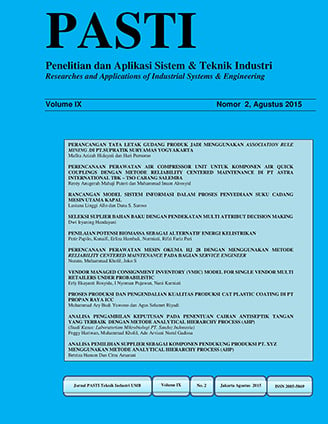
ANALISA PENGAMBILAN KEPUTUSAN PADA PENENTUAN CAIRAN ANTISEPTIK TANGAN YANG TERBAIK DENGAN METODE ANALYTICAL HIERARCHY PROCESS (AHP) (Studi Kasus: Laboratorium Mikrobiologi PT. Sandoz Indonesia)
Abstract
Antiseptik merupakan zat yang biasa digunakan untuk menghambat pertumbuhan atau membunuh mikroorganisme yang hidup di permukaan tubuh. Umumnya cuci tangan yang dilakukan di laboratorium mikrobiologi menggunakan sabun cair tangan lalu dilanjutkan dengan cairan antiseptik yang terpisah. Selama ini tidak ada standar khusus penggunaan sabun cuci tangan dan bahan antiseptik apa saja yang digunakan. Penentuan alternatif penggunaan bahan antiseptik dilakukan secara instan, hanya berdasarkan teknik coba-coba dan intuisi dari pengguna sehingga hasilnya bukan merupakan suatu penyelesaian yang terbaik. Hingga saat inii perusahaan sulit untuk menentukan jenis produk antiseptik tangan mana yang terbaik yang beredar di pasaran yang dapat digunakan di laboratorium mikrobiologi. Untuk mengatasi masalah pengambilan keputusan terutama masalah penentuan prioritas ini penulis memutuskan menggunakan metode Analytical Hierarchy Process (AHP) sebagai salah satu metode pengambilan keputusan yang memiliki potensi pengembangan dan metode yang dapat mengetahui kinerja dari produk alternatif. Hasil dari penelitian ini menunjukkan bahwa gel antiseptik yang terbaik dilihat dari segi efektifitas antimikroba, kekentalan, harga, ketersediaan serta wangi dan kelembutan yang di miliki oleh masing-masing antiseptik adalah antiseptik C.
Kata kunci: Pengambilan Keputusan, AHP, Alternatif, Antiseptik gel
Downloads
Downloads
Published
How to Cite
Issue
Section
License
The copyright to this article is transferred to Universitas Mercu Buana (UMB) if and when the article is accepted for publication. The undersigned hereby transfers any and all rights in and to the paper including without limitation all copyrights to UMB. The undersigned hereby represents and warrants that the paper is original and that he/she is the author of the paper, except for material that is clearly identified as to its original source, with permission notices from the copyright owners where required. The undersigned represents that he/she has the power and authority to make and execute this assignment.
We declare that:
1. This paper has not been published in the same form elsewhere.
2. It will not be submitted anywhere else for publication prior to acceptance/rejection by this Journal.
3. A copyright permission is obtained for materials published elsewhere and which require this permission for reproduction.
Furthermore, I/We hereby transfer the unlimited rights of publication of the above mentioned paper in whole to UMB. The copyright transfer covers the exclusive right to reproduce and distribute the article, including reprints, translations, photographic reproductions, microform, electronic form (offline, online) or any other reproductions of similar nature.
The corresponding author signs for and accepts responsibility for releasing this material on behalf of any and all co-authors. This agreement is to be signed by at least one of the authors who have obtained the assent of the co-author(s) where applicable. After submission of this agreement signed by the corresponding author, changes of authorship or in the order of the authors listed will not be accepted.
Retained Rights/Terms and Conditions
1. Authors retain all proprietary rights in any process, procedure, or article of manufacture described in the Work.
2. Authors may reproduce or authorize others to reproduce the Work or derivative works for the authors personal use or for company use, provided that the source and the UMB copyright notice are indicated, the copies are not used in any way that implies UMB endorsement of a product or service of any employer, and the copies themselves are not offered for sale.
3. Although authors are permitted to re-use all or portions of the Work in other works, this does not include granting third-party requests for reprinting, republishing, or other types of re-use.