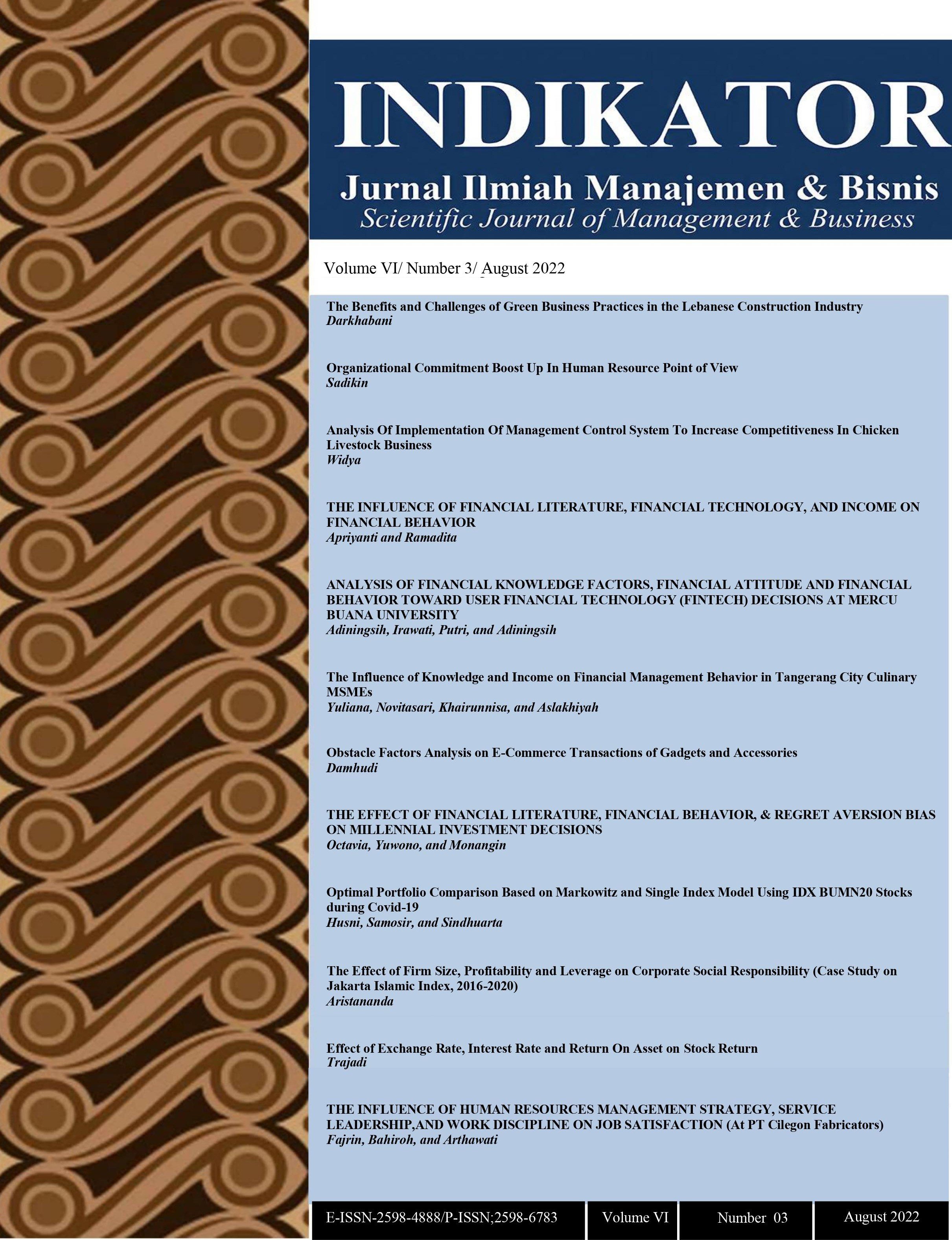
Analysis of Financial Knowledge Factors, Financial Attitude and Financial Behavior Toward User Financial Technology (Fintech) Decisions At Mercu Buana University
DOI:
https://doi.org/10.22441/indikator.v6i3.14105Keywords:
Financial Literacy, Financial TechnologyAbstract
One of the latest technological developments in Indonesia is financial technology or Financial Technology (Fintech). In the current era of modern technology, the use of money in physical form has begun to be eliminated with more modern technology, namely digital wallets. Fintech payment offers an easy method of financial technology and the use of money that becomes more practical and efficient. Fintech is also seen as a new market that integrates finance and technology and replaces traditional financial structures with new technology-based processes. Fintech can provide services with ease and minimize costs compared to traditional methods that already exist. The purpose of this research is to find out how the influence of financial literacy on the decisions of users of financial technology (Fintech) in the city of West Jakarta. The sampling method in this study is a quantitative method with an associative approach. The sampling technique used in this study was non-probability sampling using accidental sampling.
References
Anisah, N., & Crisnata, HF (2021). Analysis of the Financial Literacy Level of OVO Fintech Payment Users. JAD: Dewantara's Journal of Accounting and Financial Research, 4(1), 46-58.
Ansori, M. (2019). The Development and Impact of Financial Technology (Fintech) on the Islamic Finance Industry in Central Java. Islamic Vehicles: Journal of Islamic Studies, 5(1), 31-45.
Arner, D. (2016). FinTech: Evolution and regulation.http://law.unimelb.edu.au/
Davis, FD (1989). Perceived usefulness, perceived ease of use, and user acceptance of information technology. MIS quarterly, 319-340.
Databoks.katadata.shopeepay beat Ovo Gopay during the corona pandemic
Halim, YKE, & Astuti, D. (2015). Financial Stressors, Financial Behavior, Risk Tolerance, Financial Solvency, Financial Knowledge, and Financial Satisfaction. Finesta Journal, 3(1), 19–23.
Herdjiono, I., & Damanik, LA (2016). Effect of Financial Attitude, Financial Knowledge, Parental Income on Financial Management Behavior. Journal of Theoretical and Applied Management. Arikunto, Suharsimi. 2006. Research Procedures A Practical Approach. Jakarta: Rineka Cipta.
Humaira, Climate (2017). The Influence of Financial Knowledge, Financial Attitude, and Personality on Financial Management Behavior in Central MSME Actors for Batik Crafts in Bantul Regency. Essay. Yogyakarta State University.
Kholilah, N., & Iramani, R. (2013). The study of financial management behavior in the Surabaya community. Journal of Business and Banking, 3(1), 69-80.
Kusumawardhany, SS, Shanti, YK, Azzahra, K., Arianti, BF, & Romadhina, AP (2021). Application of Financial Literacy in Understanding Financial Technology. TORCH: Abdimas Journal, 2(2), 151-160.
Rahma, TIF (2018). Medan City Community Perceptions of the Use of Financial Technology. AT-TAWASSUTH: Islamic Economics Journal, 3(1), 184-203.
Rahman, A., Risman, A., (2021), Is Behavior Finance Affected by Income, Learning Finance and Lifestyle? , The EUrASEANs, No 4(29)
Risman, A., Prowanta, E. & Siswanti, I. (2021). Behavioral Corporate Finance. Yogyakarta: Penerbit KBM Indonesia
Rumondang, A., Sudirman, A., Effendy, F., Simarmata, J., & Agustin, T. (2019). Fintech: Financial System Innovation in the Digital Age. (T. Limbong, Editor.) Jakarta: Our Writing Foundation.
Safira, GL, Goenawan, F., & Monica, V. (2019). Consumer Behavior in Choosing DANA as a Fintech Payment Application. e-Communication Journal,7(2), 1-11.
Saputri, M. A (2019). The Effect of Financial Literacy Level on Financial Management on MSME Actors in Mojolaban District. Essay, Islamic Banking Study Program, Faculty of Islamic Economics and Business, Surakarta State Islamic Institute.
Sari, MD (2019). Analysis of the Effect of Financial Literacy on the Behavior of Financial Technology (Fintech) Users in Bandar Lampung. Thesis, Management Study Program, Faculty of Economics and Business IIB Darmajaya Bandar Lampung.
Susanti, RAD, Fardahlia, D., & Indrihastuti, P. (2021). The Ease and Benefit of Its Influence on Decisions to Use Ovo, Go-pay, and Dana E-money Payment Systems. J-MACC: Journal of Management and Accounting,4(1), 57-71.
Downloads
Published
How to Cite
Issue
Section
License
The copyright to this article is transferred to Universitas Mercu Buana (UMB) if and when the article is accepted for publication. The undersigned hereby transfers any and all rights in and to the paper including without limitation all copyrights to UMB. The undersigned hereby represents and warrants that the paper is original and that he/she is the author of the paper, except for material that is clearly identified as to its original source, with permission notices from the copyright owners where required. The undersigned represents that he/she has the power and authority to make and execute this assignment.
We declare that:
1. This paper has not been published in the same form elsewhere.
2. It will not be submitted anywhere else for publication prior to acceptance/rejection by this Journal.
3. A copyright permission is obtained for materials published elsewhere and which require this permission for reproduction.
Furthermore, I/We hereby transfer the unlimited rights of publication of the above mentioned paper in whole to UMB. The copyright transfer covers the exclusive right to reproduce and distribute the article, including reprints, translations, photographic reproductions, microform, electronic form (offline, online) or any other reproductions of similar nature.
The corresponding author signs for and accepts responsibility for releasing this material on behalf of any and all co-authors. This agreement is to be signed by at least one of the authors who have obtained the assent of the co-author(s) where applicable. After submission of this agreement signed by the corresponding author, changes of authorship or in the order of the authors listed will not be accepted.
Retained Rights/Terms and Conditions
1. Authors retain all proprietary rights in any process, procedure, or article of manufacture described in the Work.
2. Authors may reproduce or authorize others to reproduce the Work or derivative works for the authors personal use or for company use, provided that the source and the UMB copyright notice are indicated, the copies are not used in any way that implies UMB endorsement of a product or service of any employer, and the copies themselves are not offered for sale.
3. Although authors are permitted to re-use all or portions of the Work in other works, this does not include granting third-party requests for reprinting, republishing, or other types of re-use.
This work is also licensed under a Creative Commons Attribution-NonCommercial 4.0 International License.









