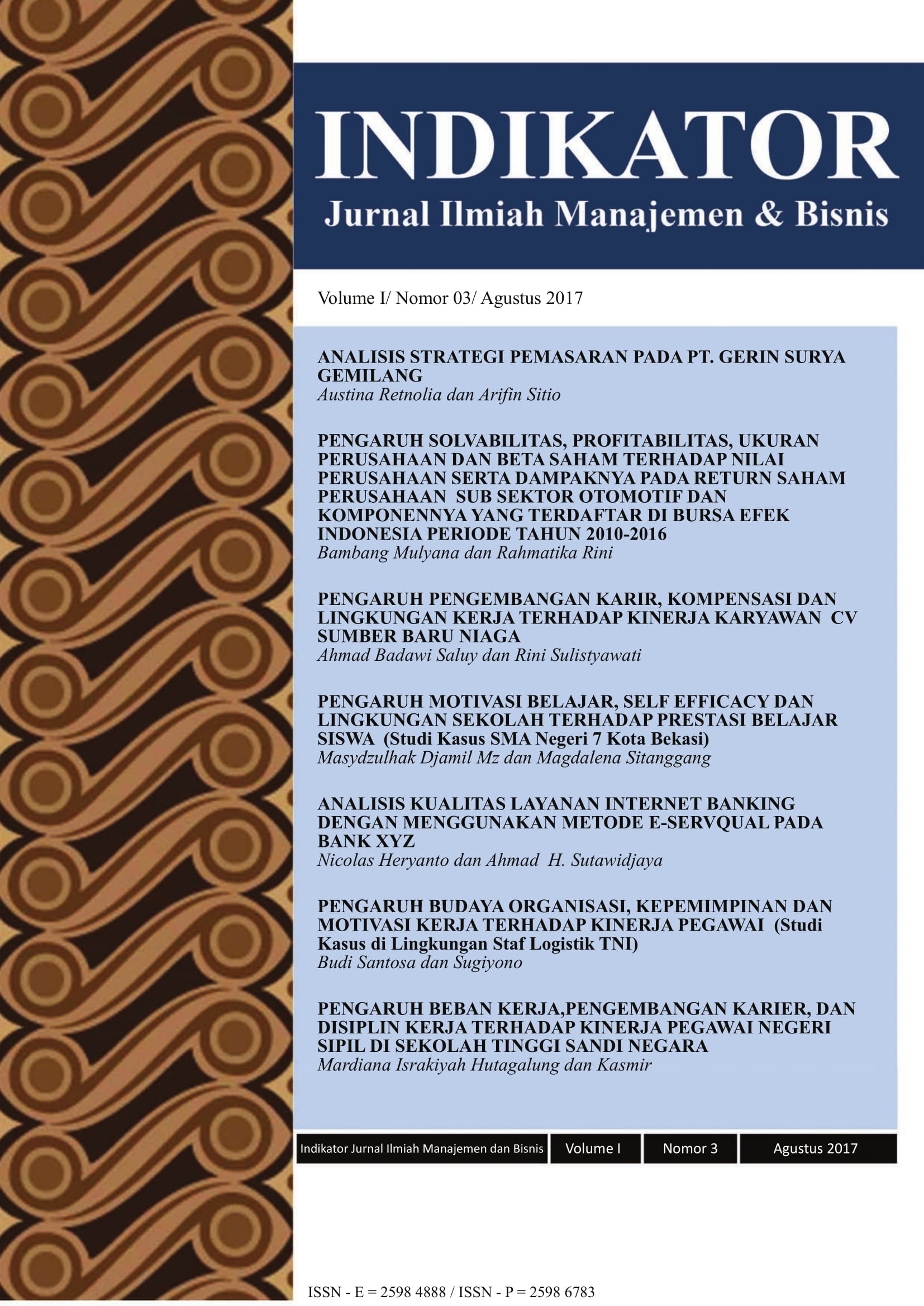
PENGARUH MOTIVASI BELAJAR; SELF EFFICACY DAN LINGKUNGAN SEKOLAH TERHADAP PRESTASI BELAJAR SISWA
DOI:
https://doi.org/10.22441/indikator.v1i3.2328Keywords:
Learning Motivation, Self Efficacy, School Environment, Learning AchievementAbstract
This study aims to analyze the influence of learning motivation; self efficacy; and school environment on learning achievement. Backed by the efforts of SMA Negeri 7 Kota Bekasi continue to strive to follow the development of the world of Education for the improvement of service quality; Human Resources and the quality of graduates. The object of research used is the students of SMA Negeri 7 Kota Bekasi from 3 classes representing all levels of education as many as 120 students. The sampling using Slovin formula so that the sample obtained 92 students SMA Negeri 7 Kota Bekasi. To analyze the research data used Partial Least Square (PLS) Version 3.0. The result of the research shows that (1) Learning Motivation has positive and significant effect on Student Learning Achievement of SMA Negeri 7 Kota Bekasi; (2) Self Effiacy has no significant effect on Student Learning Achievement of SMA Negeri 7 Kota Bekasi; (3) School Environment has positive and significant influence On Student Achievement of State Senior High School 7 Bekasi; and (4) Learning Motivation; Self Efficacy; and School Environment together significantly influence on Student Achievement of SMA Negeri 7 Kota Bekasi.
References
Abdillah; Willy dan Jogiyanto. 2015. Partial Least Square (PLS): Alternatif Structural Equation Modelling (SEM) Dalam Penelitian Bisnis. Yogyakarta: Penerbit Andi.
Ackah; David. 2014. “The Impact of Motivation on Employee Performance in the Manufacturing Industry in Ghana”. Global Journal of Management Studies and Researches. Vol. 1 No. 5; hal. 291-310.
Afzal; Hasan.; Imran Ali.; Muhammad Aslam Khan.; Kashif Hamid. 2010. “A Study of University Students’ Motivation and Its Relationship with Their Academic Performance”. International Journal of Business and Management. Vol. 5 No. 4; hal. 80-88
Ali; Mohamad. 2013. Penelitian Kependidikan (Prosedur & Strategi). Bandung: Angkasa.
Bandura; A. 2008. Self Efficacy In The Corsini Encyclopedia of Psychology. 4th Edition. New Jersey: John & Wiley Sons.
Dalyono; M. 2012. Psikologi Pendidikan. Jakarta : Rineka Cipta
Darmawan; D. dan Permasih. 2011. Kurikulum & Pembelajaran. Jakarta: Penerbit PT Raja Grafindo Persada.
Desmita. 2011. Psikologi Perkembangan Peserta Didik. Bandung: Remaja Rosda Karya.
Dimyati dan Mudjiono. 2009. Belajar dan Pembelajaran. Jakarta:Rineka Cipta.
Djamarah; Syaiful Bahri. 2008. Psikologi Belajar. Jakarta : Rineka Cipta.
Ghufron; M. Nur dan Rini Risnawita S. 2010. Teori-teori Psikologi. Yogyakarta: ArRuzz Media.
Hamalik; Oemar. 2011. Kurikulum dan Pembelajaran. Jakarta: Bumi Aksara.
Haryono; Sugeng. 2016. “Pengaruh Kedisiplinan Siswa dan Motivasi Belajar terhadap Prestasi Belajar Siswa pada Mata Pelajaran Ekonomi”. Faktor Jurnal Ilmiah Kependidikan. Vol. 3 No. 3.
Hernawati; Irma Priscilla. 2014. “Pengaruh Motivasi Belajar terhadap Prestasi Belajar di Sekolah Gratis SD Negeri Pakisjajar 02 Kabupaten Malang”. Jurnal Psikovidya. Vol. 18 No. 2.
Indriani; Ari. 2014. “Pengaruh Motivasi Belajar Siswa Kelas V terhadap Prestasi Belajar Matematika di SD Negeri Bejirejo Kecamatan Kunduran Kabupaten Blora”. Jurnal Ilmiah Pendidikan Matematika. Vol. 4 No. 2.
Kemendikbud. 2012. Uji Publik Kurikulum 2013: Penyederhanaan dan Tematik Integratif. Jakarta: Kemendikbud
Macneil; Angus J.; Doris L Prater.; and Steve Busch. 2009. “The Effect of School Culture and Climate on Student Achivemnet”. International Journal Leadership in Education. Vol. 12 No.1; hal. 73-84.
Motlagh; Shahrzad Elahi.; Kourosh Amrai.; Mohammad Javad Yazdani.; Haitham Altaib Abderahim.; and Hossein Souri. 2011. “The Relationship between Self-Efficacy and Academic Achivement in High School Students”. Procedia Social and Behavioral Sciences. Vol. 15; hal. 765-768.
Odeh. R.C; O. Angelina and Ivagher Ezekiel Dondo. 2015. “Influence of School Environment on Academic Achivement of Student Secondary Schools in Zone “A” Senatorial District of Benue State; Nigeria”. International of Recent Scientific Research. Vol. 6 Issue. 7; hal. 4914-4922.
Ormrod; Jeanne Ellis. 2008. Psikologi Pendidikan. Jilid I. Jakarta: Erlangga.
Papalia; Diane E. 2008. Human Development. 7 Edition. New York: McGraw Hill.
Sabdullah; Uyo. 2010. Pedagogik (Ilmu Mendidik). Bandung: Alfabet.
Saeed; Sitwat and David Zyngier. 2012. “How Motivaion Influences Student Engagement: A Qualitative Case Study”. Journal of Educaion and Learning. Vol. 1 No. 2; hal. 252-267.
Santrock; J.W. 2008. Psikologi Pendidikan. Jakarta: Kencana Prenada Media Group.
Sardiman. 2011. Interaksi dan Motivasi Belajar Mengajar. Jakarta: Raja Grafindo Persada.
Slameto. 2010. Belajar dan Faktorfaktor yang Mempengaruhinya. Jakarta : Rineka Cipta
Sudjana; Nana. 2009. Penilaian Hasil Proses Belajar Mengajar. Bandung: Remaja Rosdakarya.
Sunarti. 2013. “Pengarruh Intelegensi dan Motivasi Belajar terhadap Prestasi Belajar Siswa Kelas X SMA Negeri 6 Purworejo”. Jurnal Oikonomia. Vol. 2 No. 4.
Sugiyana. 2015. “Pengaruh Self-Regulated Learning; Self Efficacy dan Perhatian Orang Tua Terhadap Prestasi Belajar Matematika Siswa”. Jurnal Psikopediagogia. Vol. 4 No. 1; hal. 65.
Uno; Hamzah B. 2011. Teori Motivasi dan Pengukuran. Jakarta: Bumi Aksara.
Usaini; Mudassir Ibrahim and Norsuhaily Abu Bakar. 2015. “The Influence of School Environment on Academic Performance of Secondary School Students in Kuala Terengganu; Malaysia”. International Conference on Empowering Islamic Civilization in The 21st Century. Vol. 6 No. 1; hal. 252-261.
Zameer; Hashim.; Shehzad Ali.; Waqar Nisar.; and Muhammad Amir. 2014. “The Impact of The Motivation on The Employee’s Performance Beverage Industry of Pakistan”. International Journal of Academic Research in Accounting; Finance and Management Sciences. Vol. 4 No. 1; hal 293-298.
Downloads
Published
How to Cite
Issue
Section
License
The copyright to this article is transferred to Universitas Mercu Buana (UMB) if and when the article is accepted for publication. The undersigned hereby transfers any and all rights in and to the paper including without limitation all copyrights to UMB. The undersigned hereby represents and warrants that the paper is original and that he/she is the author of the paper, except for material that is clearly identified as to its original source, with permission notices from the copyright owners where required. The undersigned represents that he/she has the power and authority to make and execute this assignment.
We declare that:
1. This paper has not been published in the same form elsewhere.
2. It will not be submitted anywhere else for publication prior to acceptance/rejection by this Journal.
3. A copyright permission is obtained for materials published elsewhere and which require this permission for reproduction.
Furthermore, I/We hereby transfer the unlimited rights of publication of the above mentioned paper in whole to UMB. The copyright transfer covers the exclusive right to reproduce and distribute the article, including reprints, translations, photographic reproductions, microform, electronic form (offline, online) or any other reproductions of similar nature.
The corresponding author signs for and accepts responsibility for releasing this material on behalf of any and all co-authors. This agreement is to be signed by at least one of the authors who have obtained the assent of the co-author(s) where applicable. After submission of this agreement signed by the corresponding author, changes of authorship or in the order of the authors listed will not be accepted.
Retained Rights/Terms and Conditions
1. Authors retain all proprietary rights in any process, procedure, or article of manufacture described in the Work.
2. Authors may reproduce or authorize others to reproduce the Work or derivative works for the authors personal use or for company use, provided that the source and the UMB copyright notice are indicated, the copies are not used in any way that implies UMB endorsement of a product or service of any employer, and the copies themselves are not offered for sale.
3. Although authors are permitted to re-use all or portions of the Work in other works, this does not include granting third-party requests for reprinting, republishing, or other types of re-use.
This work is also licensed under a Creative Commons Attribution-NonCommercial 4.0 International License.









