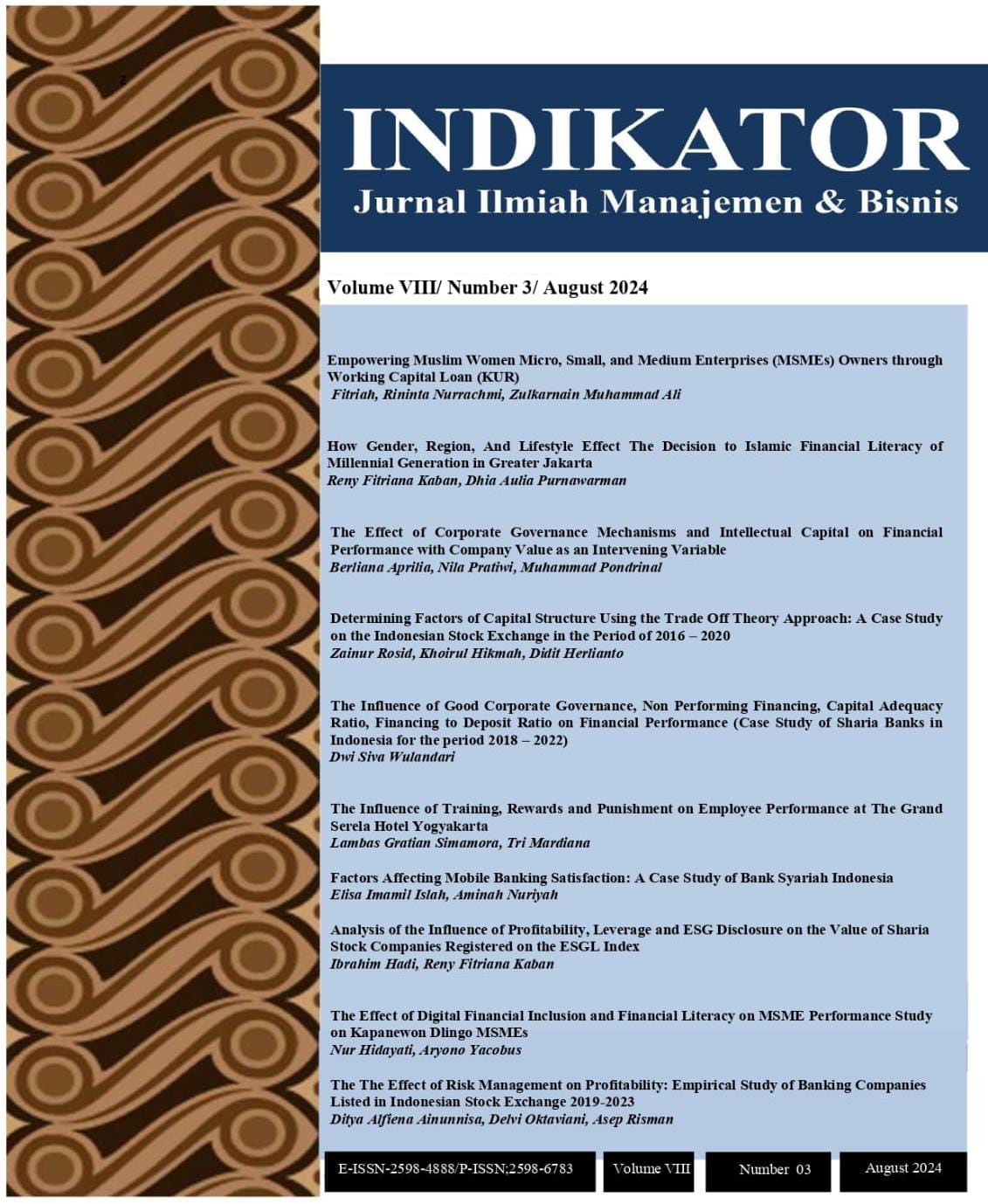
Factors Affecting Mobile Banking Satisfaction: A Case Study of Bank Syariah Indonesia
DOI:
https://doi.org/10.22441/indikator.v8i3.28024Keywords:
Efficiency fulfilment, system availability, feature. reliability. customer satisfactionAbstract
Main Objective The purpose of this study was to determine the effect of efficiency, fulfilment, system availability, privacy, responsiveness, feature and reliability to customer satisfaction study case in Indonesia Sharia Bank in JABODETABEK. Method This research uses a descriptive quantitative approach with a case study of PT.Bank Syariah Indonesia in JABOBETABEK costumer. The data collection technique was obtained from distributing questionnaires via google form and the data was processed using software. By using multiple linear regression analysis. Key Findings The results showed that the seven variables had a significant effect on mobile banking customer satisfaction. The strongest dimensions in explaining the quality of BSI mobile services are feature, reliability, and privacy, respectively. Factors affecting reliability and feature variables have the strongest influence on mobile banking customer satisfaction. Theoretical and Practical Implications The results of this study show that system vailability and responsiveness have no effect on mobile banking customer satisfaction, indicating that customer satisfaction is not directly influenced by the BSI mobile system which is not the main factor taken into consideration by customers in using the mobile BSI.References
Arikunto, S. (2006). Research Procedure: A Practical Approach. Jakarta: Rineka Cipta.
Arikunto, S. (2012). Research Procedures A Practical Approach. Jakarta: Rineka Cipta.
Belache, D., Cenjor, I., & Pérez-Rueda, A. (2019). Instagram Stories Versus Facebook Wall: an Advertising Effectiveness Analysis. Spanish Journal of Marketing, Vol. 32, No. 2, 69-94.
Dewi, C. I., & Sudiartha, I. G. (2018). The Effect of Service Quality and Product Quality on Customer Satisfaction of PT. Bali Regional Development Bank. E-Journal of Management, Udayana University, 4539-4569.
Dharmmesta, B. S. (2010). Marketing Management Consumer Behavior Analysis. Yogyakarta: BPFE.
Fandy, T. (2003). Principles of Total Quality Service. Yogyakarta: CV Andi Offset.
Ghozali. (2011). Multivariate Applications with IBM SPSS 19 Program, 5th Edition. Semarang: Diponegoro University Publishing Agency.
Ghozali, I. (2009). Application of Multivariate Analysis with the SPSS Program. Semarang: Diponegoro University Publishing House.
Hasan, A. (2010). Sharia Marketing The Surefire Way to Increase Market Growth of Islamic Banks. Bogor: Ghalia Indonesia.
Hidayat, R. (2009). The Effect of Service Quality, Product Quality and Customer Value on Customer Satisfaction and Loyalty of Bank Mandiri Customers. Journal of Management and Entrepreneurship, Vol. 11, No. 1, 59-72.
Khallaf, A. (1985). Principles of Islamic Law. Jakarta: Risalah.
Kotler, P., & Kevin, L. (2009). Marketing Management (Bob Sabran translator), Thirteenth Edition. Jakarta: Erlangga.
Kurniawati, H. A., Arif, A., & Winarno, W. A. (2017). Analysis of Interest in Use Mobile Banking with a Modified Technology Acceptance Model (TAM) Approach. e-Journal of Business Economics and Accounting University of Jember, Vol. 4, No. 1.
Mohammad, A. A., & Alhamadani, S. (2011). Service Quality Perspectives and Customer Satisfaction in Commercial Banks Working in Jordan. Middle Eastern Finance and Economics, 61- 71.
Risman, A., Mulyana, B., Silvatika, B., & Sulaeman, (2021), A. The Effect of Digital Finance on Financial Stability. Management Science Letters, 11(7), 1979-1984. https://doi.org/10.5267/j.msl.2021.3.012
Risman, A., Ali, A. J., Soelton, M., & Siswanti, I. (2023). The Behavioral finance of MSMEs in the advancement of financial inclusion and financial technology (Fintech). The Indonesian Accounting Review, 13(1), 91-101. doi:http://dx.doi.org/10.14414/tiar.v13i1.3213
Sigit, K. N., & Soliha, E. (2017). Product Quality and Service Quality on Customer Satisfaction and Loyalty. Journal of Finance and Banking, Vol. 21, No. 1, 157-168.
Sugiyono. (2011). Quantitative, Qualitative and Combination Research Methods (Mixed Methods). Bandung: Alfabeta.
Sugiyono. (2016). Quantitative, Qualitative, and R&D Research Methods. Bandung: Alfabeta.
Suliyanto. (2009). Business Research Methods. Yogyakarta: CV Andi Offset.
Sumarni, M.(2012). Management Marketing Bank Edition Revised Edition. Yogyakarta: Liberty.
Suntoyo, D. (2012). Fundamentals of Marketing Management. Yogyakarta: CAPS.
Supranto, J., & Limakrisna, N. (2011). Consumer Behavior and Marketing Strategies to Win Business Competition. Second Edition. Jakarta: Mitra Wacana Media.
Supriyono, M. (2011). Banking Smart Book. Yogyakarta: CV Andi Offset.
Tjiptono, F., & Gregorilus, C. (2011). Service, Quality & Satisfaction. Yogyakarta: CV Andi Offset.
Downloads
Additional Files
Published
How to Cite
Issue
Section
License
The copyright to this article is transferred to Universitas Mercu Buana (UMB) if and when the article is accepted for publication. The undersigned hereby transfers any and all rights in and to the paper including without limitation all copyrights to UMB. The undersigned hereby represents and warrants that the paper is original and that he/she is the author of the paper, except for material that is clearly identified as to its original source, with permission notices from the copyright owners where required. The undersigned represents that he/she has the power and authority to make and execute this assignment.
We declare that:
1. This paper has not been published in the same form elsewhere.
2. It will not be submitted anywhere else for publication prior to acceptance/rejection by this Journal.
3. A copyright permission is obtained for materials published elsewhere and which require this permission for reproduction.
Furthermore, I/We hereby transfer the unlimited rights of publication of the above mentioned paper in whole to UMB. The copyright transfer covers the exclusive right to reproduce and distribute the article, including reprints, translations, photographic reproductions, microform, electronic form (offline, online) or any other reproductions of similar nature.
The corresponding author signs for and accepts responsibility for releasing this material on behalf of any and all co-authors. This agreement is to be signed by at least one of the authors who have obtained the assent of the co-author(s) where applicable. After submission of this agreement signed by the corresponding author, changes of authorship or in the order of the authors listed will not be accepted.
Retained Rights/Terms and Conditions
1. Authors retain all proprietary rights in any process, procedure, or article of manufacture described in the Work.
2. Authors may reproduce or authorize others to reproduce the Work or derivative works for the authors personal use or for company use, provided that the source and the UMB copyright notice are indicated, the copies are not used in any way that implies UMB endorsement of a product or service of any employer, and the copies themselves are not offered for sale.
3. Although authors are permitted to re-use all or portions of the Work in other works, this does not include granting third-party requests for reprinting, republishing, or other types of re-use.
This work is also licensed under a Creative Commons Attribution-NonCommercial 4.0 International License.









