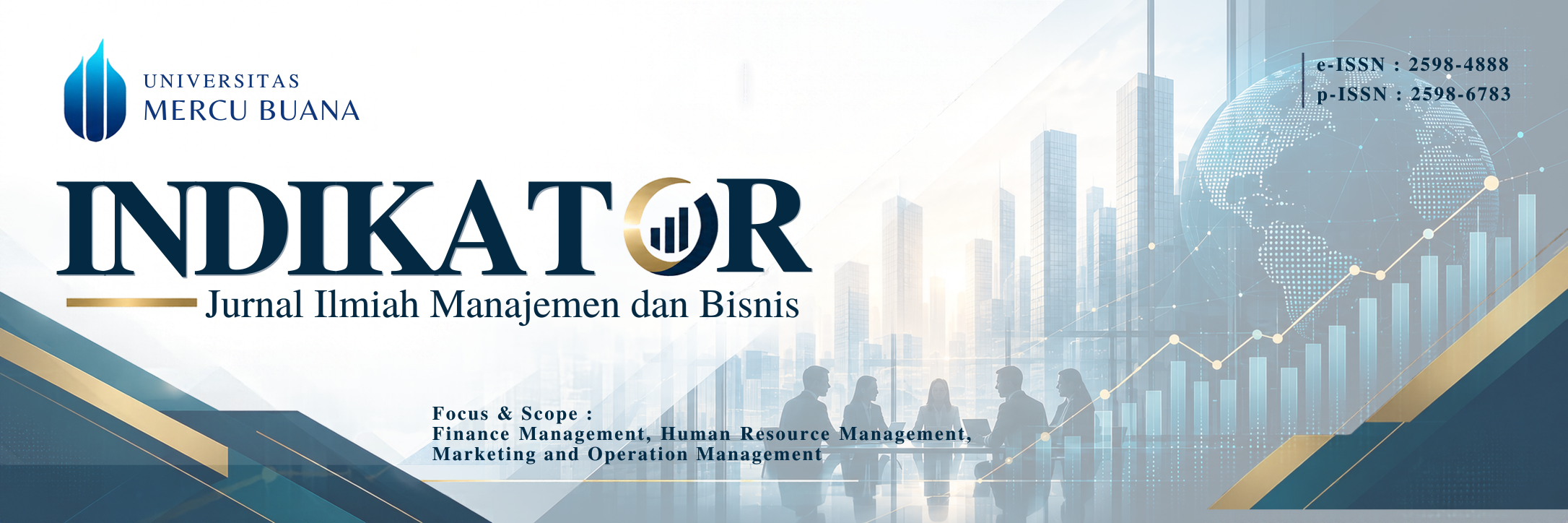
The Influence of Social Media Usage, Knowledge Sharing, and Learning Organization on Employee Performance (A Study on Fulltiime Employees at Hotel Merapi Merbabu)
DOI:
https://doi.org/10.22441/indikator.v9i2.31997Keywords:
Media Sosial, Knowledge Sharing, Learning Organization, Kinerja KaryawanAbstract
This research aims to explore and analyze the impact of social media usage, knowledge sharing, and learning organization on the performance of full-time employees at Hotel Merapi Merbabu. The study population includes full-time employees, and purposive sampling was utilized to select 92 respondents. Data collection was conducted through online questionnaires distributed via Google Forms, and the data were analyzed using SPSS software. The findings indicate that social media usage significantly and positively influences employee performance. Likewise, knowledge sharing and the learning organization both have significant positive effects on employee performance. These results highlight that establishing an effective learning organization, improving knowledge sharing, and leveraging social media effectively can be strategic methods to enhance employee performance in the hospitality sector.References
Azizi, R., & Aulia, P. 2020. Pengaruh Knowledge Sharing Terhadap Kinerja Karyawan Di Laboratorium Klinik Pramita Cabang Martadinata Bandung. eProceedings of Management, 7(3).
Emiliana, Sri (2018). Pembelajaran Organisasi dan Manajemen Pengetahuan.
Abdillah, L. (2022). Peranan Media Sosial Modern. Bening Media Publishing.
Cahyadi, L. (2021). Memahami Learning Organization. Forum Ilmiah, 18(3), 381-388
Kamaruzzaman, dkk. (2019). Knowledge Sharing: Teori dan Implementasi. Dalam Sitti Aliyah, hlm. 153. Jakarta: Pustaka Ilmu.
Kilgour, M., Sasser, S., & Larke, R. (2015). The Use of Social Media in Marketing: Strategies and Challenges.
Ninik, P., dan Yuni, S. (2017). Manajemen Pengetahuan Pendekatan Konsep dan Aplikasi Riset. Yogyakarta: Tim Media Mandala.
Nurdin, N., Semmaila, B., & Kamase, J. (2023). Pengaruh Kepemimpinan, Motivasi Kerja, dan Kepuasan Kerja Terhadap Kinerja Pegawai (Studi Kasus: Badan Pengelola Keuangan Daerah Kabupaten Sidenreng Rappang). Innovative: Journal Of Social Science Research, 3(5), 3899–3908.
Purba. (2021). Metodologi Penelitian Deskriptif
Rosarita, Niken. 2018. Memaksimalkan Penggunaan Media Sosial dalam Lembaga Pemerintah. Direktorat Jenderal Informasi dan Komunikasi Publik, Kementerian Komunikasi dan Informatika. Jakarta Pusat.
Suhardi. 2019. Pengaruh Motivasi Kerja, Kompetensi, Lingkungan Kerja Dan. Kompensasi Terhadap Kinerja Karyawan PT Asuransi Jiwa Di Kota Batam.
Stephen.P.Robbins, Timoty A. Judge. (2015). Perilaku Organisasi Edisi 16. Salemba Empat. Jakarta.
Downloads
Published
How to Cite
Issue
Section
License
The copyright to this article is transferred to Universitas Mercu Buana (UMB) if and when the article is accepted for publication. The undersigned hereby transfers any and all rights in and to the paper including without limitation all copyrights to UMB. The undersigned hereby represents and warrants that the paper is original and that he/she is the author of the paper, except for material that is clearly identified as to its original source, with permission notices from the copyright owners where required. The undersigned represents that he/she has the power and authority to make and execute this assignment.
We declare that:
1. This paper has not been published in the same form elsewhere.
2. It will not be submitted anywhere else for publication prior to acceptance/rejection by this Journal.
3. A copyright permission is obtained for materials published elsewhere and which require this permission for reproduction.
Furthermore, I/We hereby transfer the unlimited rights of publication of the above mentioned paper in whole to UMB. The copyright transfer covers the exclusive right to reproduce and distribute the article, including reprints, translations, photographic reproductions, microform, electronic form (offline, online) or any other reproductions of similar nature.
The corresponding author signs for and accepts responsibility for releasing this material on behalf of any and all co-authors. This agreement is to be signed by at least one of the authors who have obtained the assent of the co-author(s) where applicable. After submission of this agreement signed by the corresponding author, changes of authorship or in the order of the authors listed will not be accepted.
Retained Rights/Terms and Conditions
1. Authors retain all proprietary rights in any process, procedure, or article of manufacture described in the Work.
2. Authors may reproduce or authorize others to reproduce the Work or derivative works for the authors personal use or for company use, provided that the source and the UMB copyright notice are indicated, the copies are not used in any way that implies UMB endorsement of a product or service of any employer, and the copies themselves are not offered for sale.
3. Although authors are permitted to re-use all or portions of the Work in other works, this does not include granting third-party requests for reprinting, republishing, or other types of re-use.
This work is also licensed under a Creative Commons Attribution-NonCommercial 4.0 International License.









