
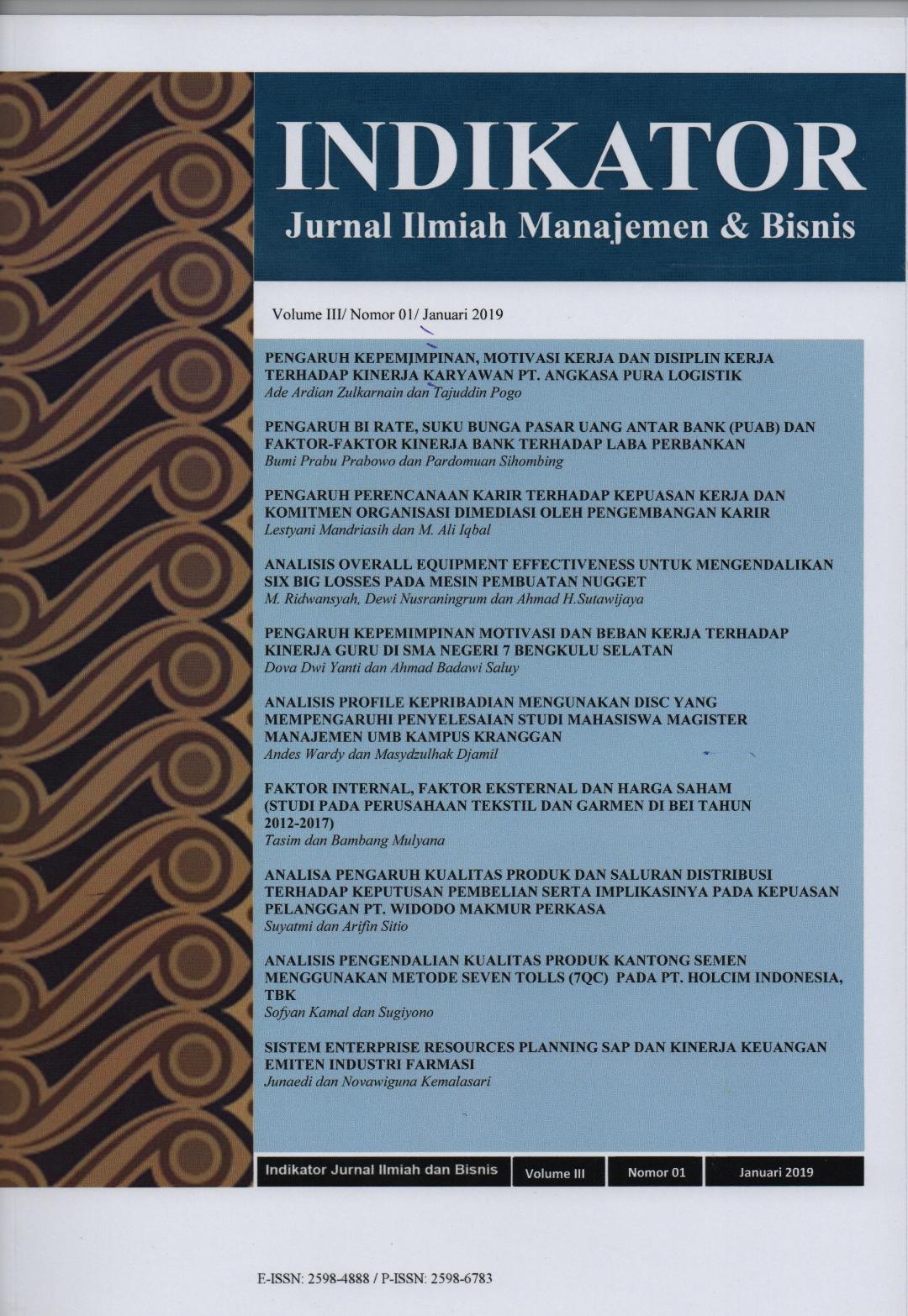
ANALISIS PENGENDALIAN KUALITAS PRODUK KANTONG SEMEN MENGGUNAKAN METODE SEVEN TOLLS (7QC) PADA PT. HOLCIM INDONESIA, TBK
DOI:
https://doi.org/10.22441/indikator.v3i1.5172Keywords:
Seven Tolls (7QC), Faktor Manuasia, Faktor Metode, Faktor Lingkungan Kerja, Faktor Mesin, Kualitas Produk Kantong SemenAbstract
Tujuan penelitian ini adalah untuk menganalisis pengendalian kualitas produk kantong semen menggunakan metode seven tolls (7QC) pada PT. Holcim Indonesia, Tbk. Metode yang digunakan adalah metode deskriptif analisis. Populasi dalam penelitian ini adalah produk kantong semen yang diproduksi oleh PT Holcim Indonesia, Tbk yang mengalami kerusakan/cacat yang tidak diketahui jumlahnya. Penentuan jumlah sampel dilakukan menggunakan teknik purposive sampling dan ditetapkan sampel adalah kantong semen produksi PT Holcim Indonesia, Tbk yang ditemukan mengalami kerusakan/cacat sehingga tidak sampai ketangan konsumen. Teknik analisis data dalam penelitian ini menggunakan metode seven tools. Metode seven tools untuk pengendalian kualitas terdiri dari check sheet, scatter diagram, fishbone diagram, pareto chart, flow chart, histogram, control chart. Hasil penelitian menunjukkan bahwa 1) Faktor Manuasia dalam tulang ikan berpengaruh terhadap jumlah kantong rusak pada produksi kantong semen di Mesin Bottomer, 2) Faktor Metode dalam tulang ikan berpengaruh terhadap jumlah kantong rusak pada produksi kantong semen di Mesin Bottomer, 3) Faktor Lingkungan Kerja dalam tulang ikan tidak berpengaruh terhadap jumlah kantong rusak pada produksi kantong semen di Mesin Bottomer, dan 4) Faktor Mesin dalam tulang ikan berpengaruh terhadap jumlah kantong rusak pada produksi kantong semen di Mesin Bottomer.
References
Bayu Tasman dan Henny Yulius. (2016). Analisis Pengendalian Kualitas Kantong Semen TIpe Pasted Bag Menggunakan Metode Seven Tolls (7QC) Pada PT. Semen Padang. Jurnal Teknologi, Vo. 6, No. 1, Juni 2016, Hal. 51 – 63.
Gunawan, C. (2014). Implementasi Pengendalian Kualitas dengan Metode Statistik pada Proses Produksi Pakaian Bayi di PT. Dewi Murni Solo. Jurnal Ilmiah Mahasiswa Universitas Surabaya, 3(2), 1 – 14.
Iswandi Idris, Ruri Aditya Sari., Wulandar., dan Uthumporn, U. (2016). Pengendalian Kualitas Tempe Dengan Metode Seven Tools. Jurnal Teknovasi, Volume 03, Nomor 1, 66 – 80.
Mulyati, Dewi Shofi. (2015). Perbaikan Pengendalian Kualitas Dengan Menggunakan Seven Quality Control Tools Dan Metoda Fmea (Failure Mode And Effects Analysis). Makalah, Universitas Islam Bandung.
Permana, Raden Galih Krisna Murti dan Simanjuntak, Timbul H. (2014). Analisa Pengendalian Kualitas pada Proses Final Inspeksi dengan Menggunakan Metode Seven Tools di PT Nissan Motor Indonesia. Program Studi Teknik Industri STT Wastukancana, Edisi Ke-4 Cetakan 1.
Rani, Annisa Mulia dan Widodo Setiawan. (2016). Menganalisis Defect Sanding Mark Unit Pick Up Tmc Dengan Metode Seven Tools PT. ADM. Jurnal Integrasi Sistem Industri, Volume 3 No. 1.
Ratnadi, Erlian Suprianto. (2016). Pengendalian Kualitas Produksi Menggunakan Alat Bantu Statistik (Seven Tools) Dalam Upaya Menekan Tingkat Kerusakan Produk. Program Studi Teknik & Manajemen Pembekalan Fakultas Teknik Universitas Nurtanio Bandung
Varsh, M., M.,V. (2015). Application of 7 Quality Control (7 QC) Tools for Continuous Improvement of Manufacturing Processes. International Journal of Engineering Research and General Science 2(1), June – July.
Downloads
Published
How to Cite
Issue
Section
License
The copyright to this article is transferred to Universitas Mercu Buana (UMB) if and when the article is accepted for publication. The undersigned hereby transfers any and all rights in and to the paper including without limitation all copyrights to UMB. The undersigned hereby represents and warrants that the paper is original and that he/she is the author of the paper, except for material that is clearly identified as to its original source, with permission notices from the copyright owners where required. The undersigned represents that he/she has the power and authority to make and execute this assignment.
We declare that:
1. This paper has not been published in the same form elsewhere.
2. It will not be submitted anywhere else for publication prior to acceptance/rejection by this Journal.
3. A copyright permission is obtained for materials published elsewhere and which require this permission for reproduction.
Furthermore, I/We hereby transfer the unlimited rights of publication of the above mentioned paper in whole to UMB. The copyright transfer covers the exclusive right to reproduce and distribute the article, including reprints, translations, photographic reproductions, microform, electronic form (offline, online) or any other reproductions of similar nature.
The corresponding author signs for and accepts responsibility for releasing this material on behalf of any and all co-authors. This agreement is to be signed by at least one of the authors who have obtained the assent of the co-author(s) where applicable. After submission of this agreement signed by the corresponding author, changes of authorship or in the order of the authors listed will not be accepted.
Retained Rights/Terms and Conditions
1. Authors retain all proprietary rights in any process, procedure, or article of manufacture described in the Work.
2. Authors may reproduce or authorize others to reproduce the Work or derivative works for the authors personal use or for company use, provided that the source and the UMB copyright notice are indicated, the copies are not used in any way that implies UMB endorsement of a product or service of any employer, and the copies themselves are not offered for sale.
3. Although authors are permitted to re-use all or portions of the Work in other works, this does not include granting third-party requests for reprinting, republishing, or other types of re-use.
This work is also licensed under a Creative Commons Attribution-NonCommercial 4.0 International License.









