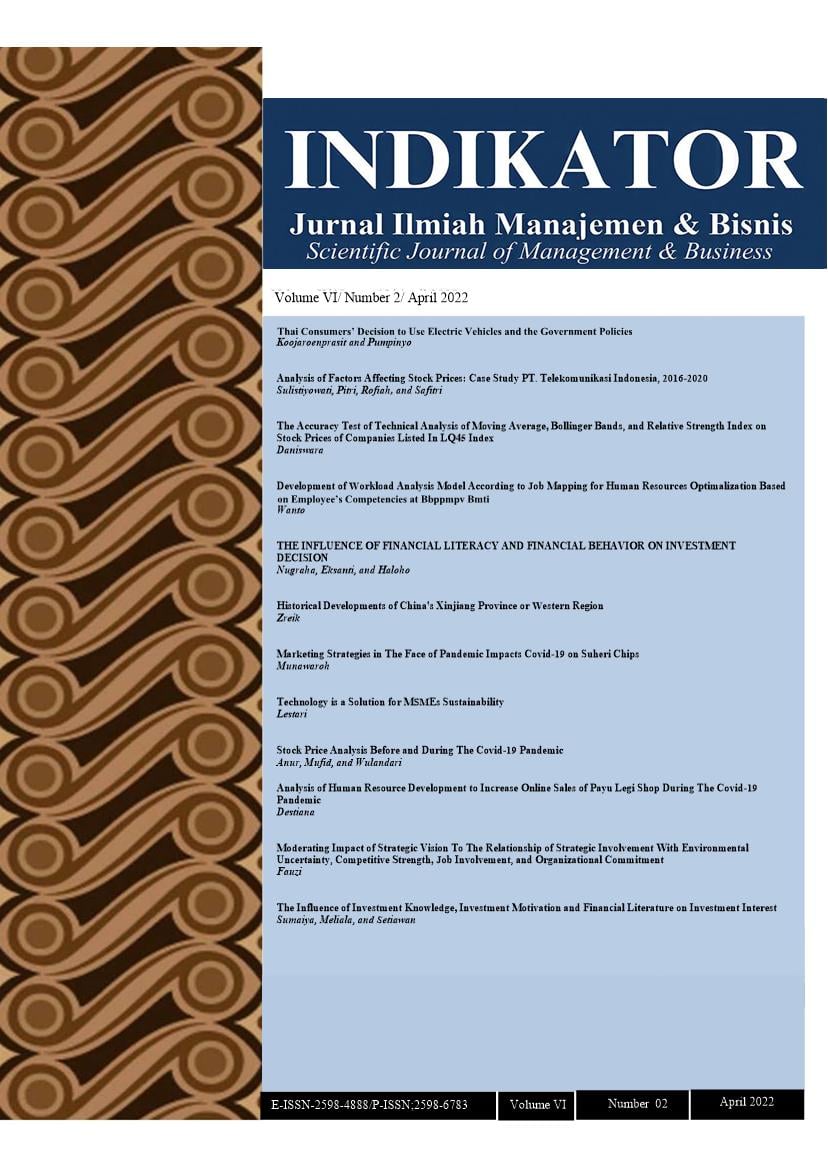
Historical Developments of China's Xinjiang Province or Western Region
DOI:
https://doi.org/10.22441/indikator.v6i2.15069Keywords:
Xinjiang, Western Region, Ancient China, UyghursAbstract
In this study, the author examines the history of Xinjiang, which has since become a province of China and a vital component of the mainland's culture. This research is entirely based on secondary sources using historical research methods. In addition to the analytical descriptive technique, the functional approach was allotted. According to the findings, ethnic and religious diversity abounds in Xinjiang. Even though Xinjiang has been the site of several conflicts and invasions, the Silk Road has made it a more vital commercial route for the region's ethnic groups and neighboring countries. Xinjiang's residents followed a variety of faiths, including Zoroastrianism, Buddhism, and Islam.References
Alfred Schinz. (1996). The magic square: cities in ancient China. Edition Axel Menges
Annping Chin. (2007). The Authentic Confucius. Scrubner
Gary Seaman; Daniel Marksm. (1991) Rulers from the steppe: state formation on the Eurasian periphery, Ethnographics Press, Center for Visual Anthropology, University of Southern California
Gibb Rosskeen, Hamilton Alexander; Bernard Lewis; Johannes Hendrik Kramers; Charles Pellat; Joseph Schacht. (1998) The Encyclopaedia of Islam. Brill
James Millward. (2006). Eurasian Crossroads: A History of Xinjiang. (Columbia University Press)
Joanne Smith. (2000) Four Generations of Uyghurs: The Shift towards Ethno-political Ideologies among Xinjiang's Youth. Inner Asia Vol. 2, No. 2, (Special Issue: Xinjiang)
Joe Cribb. (1984). The Sino-Kharosthi Coins of Khotan: Their Attribution and Relevance to Kushan Chronolog: PART 1. (The Numismatic Chronicle). Retrieved June 22, 2021, from www.jstor.org/stable/42667383
John E Hill. (2009). Through the Jade Gate to Rome: A Study of the Silk Routes during the Later Han Dynasty, 1st to 2nd centuries CE. Charleston, (South Carolina: BookSurge)
John Haywood. (1998). Historical Atlas of the Medieval World, AD 600–1492, (Barnes & Noble)
Jonathan Karem Skaff. (2009). Nicola Di Cosmo (ed.). Military Culture in Imperial China. (Harvard University Press)
Mark Edward Lewis. (2012). China's Cosmopolitan Empire: The Tang Dynasty, (Harvard University Press)
Michael Dillon. (2004). Xinjiang: China's Muslim far Northwest, (Routledge, Curzon)
Nicholas Vakar. (1935). “The Annexation of Chinese Turkestan.” (Slavonic and East European Review)
Patricia Buckley Ebrey; Anne Walthall; James B. Palais. (2006). East Asia: A Cultural, Social, and Political History, (Boston: Houghton Mifflin)
René Grousset. (1970). The Empire of the Steppes. (Rutgers University Press)
Susan Whitfield. (2004). The Silk Road: trade, travel, war and faith. (Serindia Publications)
Columbia University. (2019). The Early Chinese Empire: The Qin and the Han. Asia for Educators, www.afe.easia.columbia.edu/main_pop/kpct/kp_qinhan.htm
Valerie Hansen. (2012). The Silk Road: A New History. (Oxford University Press)
Y.A. Zadneprovskiy. (1 January 1994). “The Nomads of Northern Central Asia After The Invasion of Alexander”
Kwang-tzuu Chen & Fredrick Hiebert. (June 1995). The Late Prehistory of Xinjiang in Relation to Its Neighbors. Journal of World Prehistory, Vol. 9, No. 2
Frederick S. Starr. (15 March 2004) Xinjiang: China's Muslim Borderland. M.E. Sharpe
China.org. (August 25, 2005). Western Region' Full of Cultural Diversity and Interest
Michal Biran. (September 15, 2005). The Empire of the Qara Khitai in Eurasian History: Between China and the Islamic World
BBC News. (May 7, 2011). Regions and territories: Xinjiang.
Central Government Web Portal. (July 21, 2014) Announcement by the State Council on the first list of major historical and cultural sites protected at the national level. http://www.gov.cn/guoqing/2014-07/21/content_2721152.htm
Global Times. (January 1, 2019). Xinjiang has been multicultural since ancient times, new archaeological evidence finds,
Li Xia. (March 21, 2019). Prehistoric stone architecture discovered in Xinjiang. Xinhua. www.xinhuanet.com/english/2019-03/21/c_137913406.htm
Downloads
Published
How to Cite
Issue
Section
License
The copyright to this article is transferred to Universitas Mercu Buana (UMB) if and when the article is accepted for publication. The undersigned hereby transfers any and all rights in and to the paper including without limitation all copyrights to UMB. The undersigned hereby represents and warrants that the paper is original and that he/she is the author of the paper, except for material that is clearly identified as to its original source, with permission notices from the copyright owners where required. The undersigned represents that he/she has the power and authority to make and execute this assignment.
We declare that:
1. This paper has not been published in the same form elsewhere.
2. It will not be submitted anywhere else for publication prior to acceptance/rejection by this Journal.
3. A copyright permission is obtained for materials published elsewhere and which require this permission for reproduction.
Furthermore, I/We hereby transfer the unlimited rights of publication of the above mentioned paper in whole to UMB. The copyright transfer covers the exclusive right to reproduce and distribute the article, including reprints, translations, photographic reproductions, microform, electronic form (offline, online) or any other reproductions of similar nature.
The corresponding author signs for and accepts responsibility for releasing this material on behalf of any and all co-authors. This agreement is to be signed by at least one of the authors who have obtained the assent of the co-author(s) where applicable. After submission of this agreement signed by the corresponding author, changes of authorship or in the order of the authors listed will not be accepted.
Retained Rights/Terms and Conditions
1. Authors retain all proprietary rights in any process, procedure, or article of manufacture described in the Work.
2. Authors may reproduce or authorize others to reproduce the Work or derivative works for the authors personal use or for company use, provided that the source and the UMB copyright notice are indicated, the copies are not used in any way that implies UMB endorsement of a product or service of any employer, and the copies themselves are not offered for sale.
3. Although authors are permitted to re-use all or portions of the Work in other works, this does not include granting third-party requests for reprinting, republishing, or other types of re-use.
This work is also licensed under a Creative Commons Attribution-NonCommercial 4.0 International License.









