Numerical Study of Nano Enhanced PCM Incorporated Heat Sink with Wavy Shaped Plate Fins
DOI:
https://doi.org/10.22441/ijimeam.v8i1.35039Keywords:
PCM, NePCM, temperature, heat sink, liquid fraction, cavityAbstract
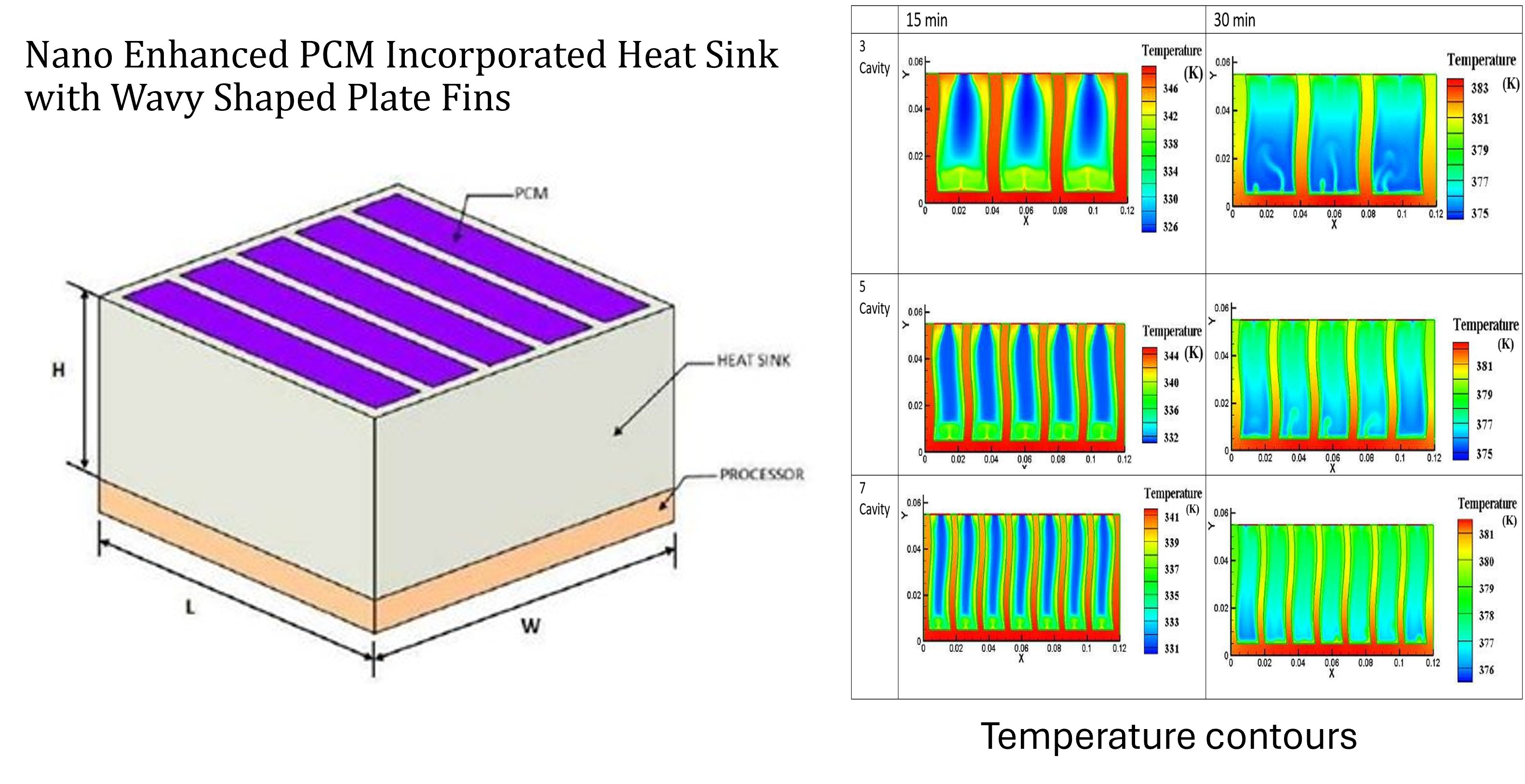
Modern high-power electronic devices require efficient passive cooling strategies to maintain safe operating temperatures. This study presents a two-dimensional numerical investigation of a nano-enhanced phase change material (NePCM)-based heat sink incorporating wavy-shaped plate fins. The NePCM consists of paraffin with 3 wt% CuO nanoparticles to enhance thermal conductivity. The novelty of this work lies in the integration of wavy-shaped fins to promote natural convection and accelerate PCM melting, thereby improving heat dissipation performance. The governing continuity, momentum, and energy equations are solved using the enthalpy–porosity method under a constant heat flux of 10,000 W/m² and a convective boundary condition of 10 W·m⁻²·K⁻¹. Parametric analyses are conducted by varying the number of cavities (3, 5, and 7) and fin height (40–50 mm). The results show that the NePCM heat sink reduces the peak temperature from 438 K (conventional) to 381 K, corresponding to a reduction of approximately 13% after 30 minutes. The wavy fin configuration enhances fluid circulation within the molten PCM, leading to faster melting and improved heat absorption. Increasing cavity number from 3 to 7 reduces the average temperature by up to ~7 K, while increasing fin height to 50 mm further lowers the temperature by approximately 10–20 K compared to shorter fins. The combined effect of latent heat storage and enhanced natural convection induced by wavy fins significantly improves thermal management performance, making the proposed design a promising solution for compact electronic cooling applications.Downloads
References
[1] R. Viswanath, V. Wakharkar, A. Watwe, and V. Lebonheur, “Thermal performance challenges from silicon to systems,” Intel Technol. J., vol. 4, no. 3, pp. 1–16, 2000.
[2] D. Kraus and A. Bar-Cohen, Thermal Analysis and Control of Electronic Equipment. New York, NY, USA: McGraw-Hill, 1983.
[3] H. M. Ali and A. Arshad, “Experimental investigation of n-eicosane based circular pin-fin heat sinks for passive cooling of electronic devices,” Int. J. Heat Mass Transf., vol. 112, pp. 649–661, 2017, doi: 10.1016/j.ijheatmasstransfer.2017.05.004.
[4] G. L. Liu and J. Liu, “Convective cooling of compact electronic devices via liquid metals with low melting points,” J. Heat Transf., vol. 143, no. 5, Art. no. 050801, 2021, doi: 10.1115/1.4050404.
[5] A. Radwan, S. Ookawara, S. Mori, and M. Ahmed, “Uniform cooling for concentrator photovoltaic cells and electronic chips by forced convective boiling in 3D-printed monolithic double-layer microchannel heat sink,” Energy Convers. Manag., vol. 166, pp. 356–371, 2018, doi: 10.1016/j.enconman.2018.04.037.
[6] A. Moradikazerouni et al., “Comparison of the effect of five different entrance channel shapes of a micro-channel heat sink in forced convection with application to cooling a supercomputer circuit board,” Appl. Therm. Eng., vol. 150, pp. 1078–1089, 2019, doi: 10.1016/j.applthermaleng.2019.01.051.
[7] S. W. Pua, K. S. Ong, K. C. Lai, and M. S. Naghavi, “Natural and forced convection heat transfer coefficients of various finned heat sinks for miniature electronic systems,” Proc. Inst. Mech. Eng. A, vol. 233, no. 2, pp. 249–261, 2019, doi: 10.1177/0957650918784420.
[8] R. S. Kumar and S. Jayavel, “Forced convective air-cooling effect on electronic components of different geometries and orientations at flow shedding region,” IEEE Trans. Compon. Packag. Manuf. Technol., vol. 8, no. 4, pp. 597–605, 2018, doi: 10.1109/TCPMT.2018.2797185.
[9] K. Liang, Z. Li, M. Chen, and H. Jiang, “Comparisons between heat pipe, thermoelectric system, and vapour compression refrigera-tion system for electronics cooling,” Appl. Therm. Eng., vol. 146, pp. 260–267, 2019, doi: 10.1016/j.applthermaleng.2018.09.120.
[10] T. D. Swanson and G. C. Birur, “NASA thermal control technologies for robotic spacecraft,” Appl. Therm. Eng., vol. 23, no. 9, pp. 1055–1065, 2003, doi: 10.1016/S1359-4311(03)00036-X.
[11] M. Alimohammadi et al., “Experimental investigation of the effects of using nano/phase change materials (NPCM) as coolant of electronic chipsets under free and forced convection,” Appl. Therm. Eng., vol. 111, pp. 271–279, 2017, doi: 10.1016/j.applthermaleng.2016.09.028.
[12] Y. Lv et al., “A novel nanosilica-enhanced phase change material with anti-leakage and anti-volume-change properties for battery thermal management,” Energy Convers. Manag., vol. 163, pp. 250–259, 2018, doi: 10.1016/j.enconman.2018.02.061.
[13] R. Baby and C. Balaji, “Thermal performance of a PCM heat sink under different heat loads: An experimental study,” Int. J. Therm. Sci., vol. 79, pp. 240–249, 2014, doi: 10.1016/j.ijthermalsci.2013.12.018.
[14] A. Kurhade et al., “Computational study of PCM cooling for electronic circuit of smartphone,” Mater. Today Proc., vol. 47, pp. 3171–3176, 2021, doi: 10.1016/j.matpr.2021.06.284.
[15] T. J. Lu, “Thermal management of high-power electronics with phase change cooling,” Int. J. Heat Mass Transf., vol. 43, no. 13, pp. 2245–2256, 2000, doi: 10.1016/S0017-9310(99)00318-X.
[16] S. Krishnan and S. V. Garimella, “Thermal management of transient power spikes in electronics: Phase change energy storage or copper heat sinks?” J. Electron. Packag., vol. 126, no. 3, pp. 308–316, 2004, doi: 10.1115/1.1772411.
[17] F. L. Tan and C. P. Tso, “Cooling of mobile electronic devices using phase change materials,” Appl. Therm. Eng., vol. 24, no. 2–3, pp. 159–169, 2004, doi: 10.1016/j.applthermaleng.2003.09.005.
[18] R. Baby and C. Balaji, “Thermal optimization of PCM based pin fin heat sinks: An experimental study,” Appl. Therm. Eng., vol. 54, no. 1, pp. 65–77, 2013, doi: 10.1016/j.applthermaleng.2012.10.056.
[19] R. Kalbasi, “Introducing a novel heat sink comprising PCM and air adapted to electronic device thermal management,” Int. J. Heat Mass Transf., vol. 169, p. 120914, 2021, doi: 10.1016/j.ijheatmasstransfer.2021.120914.
[20] R. Bhuiya et al., “Thermal management of phase change material integrated thermoelectric cooler with different heat sink geome-tries,” J. Energy Storage, vol. 51, p. 104304, 2022, doi: 10.1016/j.est.2022.104304.
[21] Z. Deng et al., “Experimental study on melting performance of phase change material-based finned heat sinks by a comprehen-sive evaluation,” J. Therm. Anal. Calorim., vol. 144, no. 3, pp. 869–882, 2021, doi: 10.1007/s10973-020-09508-y.
[22] M. Bayat, M. R. Faridzadeh, and D. Toghraie, “Investigation of finned heat sink performance with nano enhanced phase change material (NePCM),” Therm. Sci. Eng. Prog., vol. 5, pp. 50–59, 2018, doi: 10.1016/j.tsep.2017.10.021.
[23] S. K. Saha, K. Srinivasan, and P. Dutta, “Studies on optimum distribution of fins in heat sinks filled with phase change materials,” J. Heat Transf., vol. 130, no. 3, Art. no. 034505, 2008, doi: 10.1115/1.2804948.
[24] C. Oluah, E. T. Akinlabi, and H. O. Njoku, “Selection of phase change material for improved performance of Trombe wall systems using the entropy weight and TOPSIS methodology,” Energy Build., vol. 217, Art. no. 109967, 2020, doi: 10.1016/j.enbuild.2020.109967.
[25] A. Kumar, R. Kothari, S. K. Sahu, and S. I. Kundalwal, “Thermal performance of heat sink using nano-enhanced phase change ma-terial (NePCM) for cooling of electronic components,” Microelectron. Reliab., vol. 121, Art. no. 114144, 2021, doi: 10.1016/j.microrel.2021.114144.
[26] H. Bashirpour-Bonab, “Investigation and optimization of PCM melting with nanoparticle in a multi-tube thermal energy storage system,” Case Stud. Therm. Eng., vol. 28, p. 101643, 2021, doi: 10.1016/j.csite.2021.101643.
[27] N. Pradeep et al., “Silver nanoparticles for enhanced thermal energy storage of phase change materials,” Mater. Today Proc., vol. 45, pp. 607–611, 2021, doi: 10.1016/j.matpr.2020.02.671.
[28] K. Chopra et al., “Effect of simultaneous and consecutive melting/solidification of phase change material on domestic solar water heating system,” Renew. Energy, vol. 188, pp. 329–348, 2022, doi: 10.1016/j.renene.2022.01.059.
[29] P. M. J. Stalin et al., “Investigations on thermal properties of CeO₂/water nanofluids for heat transfer applications,” Mater. Today Proc., vol. 47, pp. 6815–6820, 2021, doi: 10.1016/j.matpr.2021.05.137.
[30] V. Shatikian, G. Ziskind, and R. Letan, “Numerical investigation of a PCM-based heat sink with internal fins,” Int. J. Heat Mass Transf., vol. 48, no. 17, pp. 3689–3706, 2005, doi: 10.1016/j.ijheatmasstransfer.2004.10.042.
[31] V. Shatikian et al., “Simulation of PCM melting and solidification in a partitioned storage unit,” in Proc. Heat Transfer Summer Conf., vol. 36940, pp. 347–353, Jan. 2003, doi: 10.1115/HT2003-47167.
[32] S. L. Tariq et al., “Nanoparticles enhanced phase change materials (NePCMs): A recent review,” Appl. Therm. Eng., vol. 176, p. 115305, 2020, doi: 10.1016/j.applthermaleng.2020.115305.
[33] H. Yang, Y. Li, L. Zhang, and Y. Zhu, “Thermal performance enhancement of phase change material heat sinks for thermal man-agement of electronic devices under constant and intermittent power loads,” Int. J. Heat Mass Transf., vol. 181, p. 121899, 2021, doi: 10.1016/j.ijheatmasstransfer.2021.121899.
[34] T. Ramesh, A. S. Praveen, P. B. Pillai, and S. Salunkhe, “Phase change material aided thermal scheming of high-power LED: Effect of PCM with varying pitch of hexagonal fins,” Mater. Res. Innov., vol. 26, no. 6, pp. 331–340, 2022, doi: 10.1080/14328917.2021.1984665.
[35] H. Nazir et al., “Recent developments in phase change materials for energy storage applications: A review,” Int. J. Heat Mass Transf., vol. 129, pp. 491–523, 2019, doi: 10.1016/j.ijheatmasstransfer.2018.09.126.
[36] M. Mozafari, A. Lee, and J. Mohammadpour, “Thermal management of single and multiple PCMs based heat sinks for electronics cooling,” Therm. Sci. Eng. Prog., vol. 23, p. 100919, 2021, doi: 10.1016/j.tsep.2021.100919.
[37] M. Mohammadi, A. Taheri, M. Passandideh-Fard, and M. Sardarabadi, “Electronic chipset thermal management using a nanoflu-id-based mini-channel heat sink: An experimental study,” Int. Commun. Heat Mass Transf., vol. 118, p. 104836, 2020, doi: 10.1016/j.icheatmasstransfer.2020.104836.
[38] S. Mahmoud et al., “Experimental investigation of inserts configurations and PCM type on the thermal performance of PCM based heat sinks,” Appl. Energy, vol. 112, pp. 1349–1356, 2013, doi: 10.1016/j.apenergy.2013.04.059.
[39] Y. Kozak, B. Abramzon, and G. Ziskind, “Experimental and numerical investigation of a hybrid PCM-air heat sink,” Appl. Therm. Eng., vol. 59, no. 1–2, pp. 142–152, 2013, doi: 10.1016/j.applthermaleng.2013.05.021.
[40] A. Arshad et al., “An experimental study of enhanced heat sinks for thermal management using n-eicosane as phase change mate-rial,” Appl. Therm. Eng., vol. 132, pp. 52–66, 2018, doi: 10.1016/j.applthermaleng.2017.12.066.
[41] X. Q. Wang, C. Yap, and A. S. Mujumdar, “A parametric study of phase change material (PCM)-based heat sinks,” Int. J. Therm. Sci., vol. 47, no. 8, pp. 1055–1068, 2008, doi: 10.1016/j.ijthermalsci.2007.07.016.
[42] B. Kamkari and D. Groulx, “Experimental investigation of melting behaviour of phase change material in finned rectangular en-closures under different inclination angles,” Exp. Therm. Fluid Sci., vol. 97, pp. 94–108, 2018, doi: 10.1016/j.expthermflusci.2018.04.007.
[43] R. Karami and B. Kamkari, “Investigation of the effect of inclination angle on the melting enhancement of phase change material in finned latent heat thermal storage units,” Appl. Therm. Eng., vol. 146, pp. 45–60, 2019, doi: 10.1016/j.applthermaleng.2018.09.105.
Downloads
Published
How to Cite
Issue
Section
License
Copyright (c) 2026 Soumik Kumar Hazra

This work is licensed under a Creative Commons Attribution-ShareAlike 4.0 International License.