Ambient-Temperature Sensitivity of Operating-Data Fouling-Resistance Indicators for an Air-Cooled Condenser in a Binary Geothermal Power Plant
DOI:
https://doi.org/10.22441/ijimeam.v8i3.40219Keywords:
air-cooled condenser, fouling resistance, ambient temperature, overall heat-transfer coefficient, binary geothermal power plant, condition monitoringAbstract
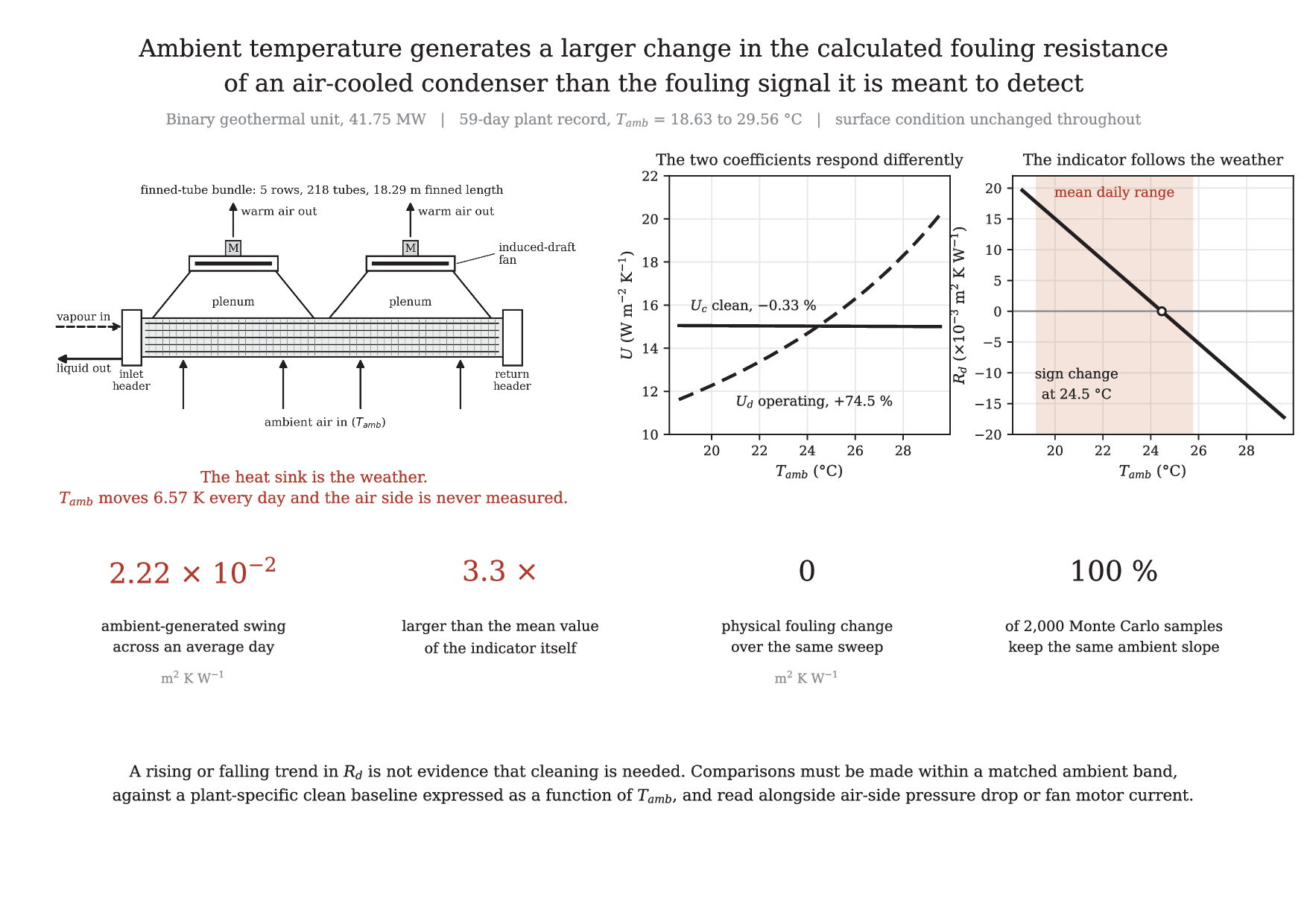
Air-cooled condensers (ACCs) reject heat directly to the atmosphere, so operating-data fouling indicators are read against a heat sink that moves continuously. This study quantifies how much of the calculated fouling resistance of an ACC serving a 41.75 MW binary geothermal unit is generated by ambient-temperature variation alone, with the physical surface condition held unchanged, and establishes how that component depends on whether cooling-air flow is measured or inferred. A zone-resolved thermal model was built from bundle geometry, plant working-fluid states and a measured fan air velocity of 6.02 m s⁻¹, with n-pentane and air properties taken from CoolProp. The indicator was evaluated over the observed ambient range of 18.63 to 29.56 °C under three routes that differ only in which air-side quantity is measured. Ambient variation alone moved the indicator by 2.22 × 10⁻² m² K W⁻¹ across the mean daily range, which exceeded its own mean value by a factor of 3.3 and reversed its sign at 24.5 °C although the surface condition did not change. The negative values carry no physical meaning, because a deposit cannot reduce thermal resistance. The sign of the reported trend followed the air-side assumption rather than the equipment, and four clean-condition treatments shifted the level of the indicator without altering its ambient slope, which stayed negative in 100 % of 2,000 Monte Carlo samples. The calculated resistance therefore measures the ambient sensitivity of the method and not the fouling state of the bundle. Matched-ambient comparison bands, a plant-specific clean baseline and independent air-side indicators are required before it can support a cleaning or maintenance decision.
Downloads
References
[1] M. Kahraman, A. B. Olcay, and E. Sorgüven, “Thermodynamic and thermoeconomic analysis of a 21 MW binary type air-cooled geothermal power plant and determination of the effect of ambient temperature variation on the plant performance,” Energy Convers. Manage., vol. 192, pp. 308–320, 2019, doi: 10.1016/j.enconman.2019.04.036.
[2] M. Astolfi, M. C. Romano, P. Bombarda, and E. Macchi, “Binary ORC (organic Rankine cycles) power plants for the exploitation of medium–low temperature geothermal sources—Part A: Thermodynamic optimization,” Energy, vol. 66, pp. 423–434, 2014, doi: 10.1016/j.energy.2013.11.056.
[3] A. S. Zavorin, S. V. Lavrinenko, S. Tsibulskiy, S. A. Yankovsky, P. Berezny, and N. S. Yankovskaya, “Numerical studies of an air-cooled condenser as part of the thermal diagram of a binary geothermal power plant,” Therm. Sci. Eng. Prog., vol. 66, Art. no. 103969, 2025, doi: 10.1016/j.tsep.2025.103969.
[4] O. V. Güler, “Optimal photovoltaic integration for offsetting temperature-dependent auxiliary electricity demand in an air-cooled geothermal power plant,” Energies, vol. 19, no. 20, Art. no. 4768, 2026, doi: 10.3390/en19204768.
[5] J. B. Škundrić, P. M. Živković, M. M. Tica, M. A. Tomić, and C. P. Barz, “Investigation of air-cooled condenser’s operating parameters in modern thermal power plant,” Therm. Sci., vol. 27, no. 3B, pp. 2477–2487, 2023, doi: 10.2298/TSCI220806203S.
[6] X. Zhu, T. Yu, J. Zhan, and Y. Zhou, “Investigation of the performance of cold-end system in direct air-cooled power units under the influence of ambient winds,” Therm. Sci., vol. 28, no. 3B, pp. 2433–2446, 2024, doi: 10.2298/TSCI230609046Z.
[7] H. V. Inamdar, E. A. Groll, J. A. Weibel, and S. V. Garimella, “Air-side fouling of finned heat exchangers: Part 1, review and proposed test protocol,” Int. J. Refrig., vol. 151, pp. 77–86, 2023, doi: 10.1016/j.ijrefrig.2023.02.017.
[8] H. V. Inamdar, E. A. Groll, J. A. Weibel, and S. V. Garimella, “Air-side fouling of finned heat exchangers: Part 2, experimental investi-gation and assessment of test protocol,” Int. J. Refrig., vol. 151, pp. 63–76, 2023, doi: 10.1016/j.ijrefrig.2023.03.016.
[9] L. Morozyuk, V. Sokolovska-Yefymenko, A. Moshkatiuk, V. Ierin, and A. Basov, “Experimental study and analysis of an air-cooled condenser with the fouling on the heat exchange surface for small-scale commercial refrigeration systems,” Int. J. Air-Conditioning Refrig., vol. 31, Art. no. 18, 2023, doi: 10.1007/s44189-023-00034-8.
[10] R. W. Serth and T. G. Lestina, Process Heat Transfer: Principles, Applications and Rules of Thumb, 2nd ed. Oxford, U.K.: Academic Press, 2014, doi: 10.1016/C2011-0-07242-3.
[11] X. Mei, H. Kiyomoto, S. Kato, and Y. Kansha, “Data-driven soft sensor for crude oil fouling monitoring in heat exchanger networks,” IEEE Sens. J., vol. 23, no. 21, pp. 26336–26346, 2023, doi: 10.1109/JSEN.2023.3317936.
[12] P. Patil, B. Srinivasan, and R. Srinivasan, “Monitoring fouling in heat exchangers under temperature control based on excess thermal and hydraulic loads,” Chem. Eng. Res. Des., vol. 181, pp. 41–54, 2022, doi: 10.1016/j.cherd.2022.02.032.
[13] J. P. V. de Cesaro, M. A. S. S. Ravagnani, and C. B. B. Costa, “Variable properties in fouling estimation in heat exchanger networks with fouling,” Heat Transfer Eng., early access, Jul. 12, 2026, doi: 10.1080/01457632.2026.2697387.
[14] F. S. Marincowitz, M. T. F. Owen, and J. Muiyser, “Multi-objective optimisation for wind resistant air-cooled condenser operation,” Appl. Therm. Eng., vol. 218, Art. no. 119382, 2023, doi: 10.1016/j.applthermaleng.2022.119382.
[15] S. B. Dekebo, G.-T. Oh, and M.-W. Lee, “Cleaning schedule optimization of heat exchanger network using moving window deci-sion-making algorithm,” Appl. Sci., vol. 13, no. 1, Art. no. 604, 2023, doi: 10.3390/app13010604.
[16] I. H. Bell, J. Wronski, S. Quoilin, and V. Lemort, “Pure and pseudo-pure fluid thermophysical property evaluation and the open-source thermophysical property library CoolProp,” Ind. Eng. Chem. Res., vol. 53, no. 6, pp. 2498–2508, 2014, doi: 10.1021/ie4033999.
[17] M. M. Shah, “A general correlation for heat transfer during film condensation inside pipes,” Int. J. Heat Mass Transfer, vol. 22, no. 4, pp. 547–556, 1979, doi: 10.1016/0017-9310(79)90058-9.
[18] W. M. Kays and A. L. London, Compact Heat Exchangers, 3rd ed. New York, NY, USA: McGraw-Hill, 1984.
[19] R. K. Shah and D. P. Sekulić, Fundamentals of Heat Exchanger Design. Hoboken, NJ, USA: John Wiley & Sons, 2003, doi: 10.1002/9780470172605.
[20] K. Shaikh et al., “Improvement of heat transfer and fouling retardation performance of heat exchanger using green functionalized graphene nanoplatelets additives,” J. Taiwan Inst. Chem. Eng., vol. 153, Art. no. 105227, 2023, doi: 10.1016/j.jtice.2023.105227.
[21] K. Shaikh et al., “Retardation of CaCO3 fouling on heat exchanger surface using water-based cloves-functionalized multiwall car-bon nanotubes (C-MWCNT) nanofluids,” J. Therm. Anal. Calorim., vol. 148, no. 22, pp. 12937–12946, 2023, doi: 10.1007/s10973-023-12551-0.
[22] K. Shaikh et al., “Performance evaluation of green synthesized graphene nanoplatelets/multiwall carbon nanotubes hybrid nanofluids for the retardation of mineral fouling and its environmental benefits,” Carbon, vol. 238, Art. no. 120243, 2025, doi: 10.1016/j.carbon.2025.120243.
[23] S. Abdullah, K. Shaikh, S. N. Kazi, and M. N. M. Zubir, “Inhibition of CaCO3 scaling on heat exchanger surface with green function-alized graphene nanoplatelets (GGNP) coating,” Therm. Sci. Eng. Prog., vol. 65, Art. no. 103962, 2025, doi: 10.1016/j.tsep.2025.103962.
[24] K. Shaikh et al., “Comparative study on inhibition of mineral scaling on heat exchanger surface with green functionalized gra-phene nanoplatelets, multiwall carbon nanotubes, and their hybrid,” Chem. Eng. Res. Des., vol. 222, pp. 313–324, 2025, doi: 10.1016/j.cherd.2025.09.012.
[25] A. Ahmed, K. Shaikh, S. N. Kazi, M. N. M. Zubir, R. Nawaz, and S. U. Hasnain, “A critical review on mitigation of crystallization fouling in heat exchangers through surface modification,” Surf. Interfaces, vol. 94, Art. no. 109493, 2026, doi: 10.1016/j.surfin.2026.109493.
[26] X. Xie, Y. Chen, L. Dai, and L. Xu, “Modeling and experimental study of air-cooled finned-tube condenser using coupled distribu-tion parameter method and air-side temperature distribution,” Appl. Therm. Eng., vol. 249, Art. no. 123411, 2024, doi: 10.1016/j.applthermaleng.2024.123411.
Downloads
Published
How to Cite
Issue
Section
License
Copyright (c) 2026 International Journal of Innovation in Mechanical Engineering and Advanced Materials

This work is licensed under a Creative Commons Attribution-ShareAlike 4.0 International License.
This work is licensed under CC BY-SA

A Creative Commons Attribution-ShareAlike (CC BY-SA) license allows you to use, share, and build upon a creator's work for any purpose—including commercial use—as long as you follow specific rules.