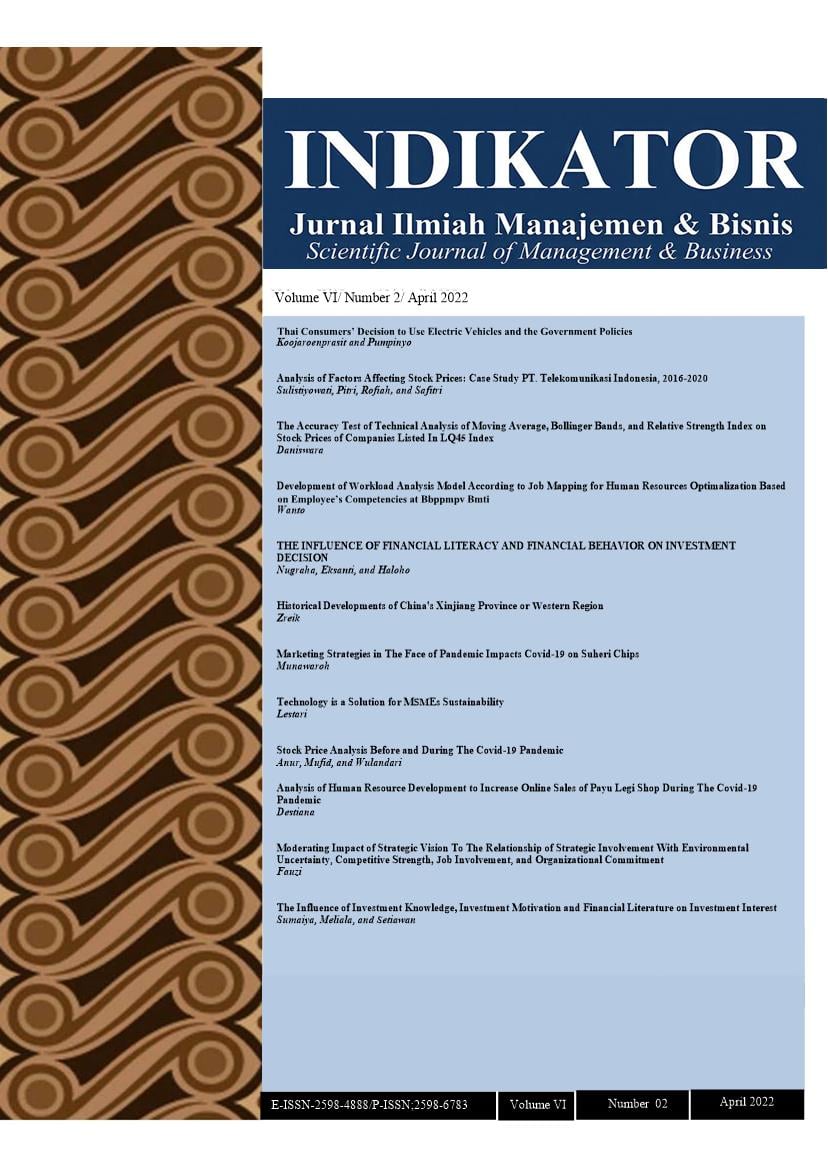
Technology is a solution for MSMEs Sustainability
DOI:
https://doi.org/10.22441/indikator.v6i2.14771Keywords:
MSME businesses, cloud kitchen, technologyAbstract
The Corona virus, which began to emerge at the end of 2019 in China, has so far spread widely throughout the world including Indonesia, where this greatly affects various aspects of human life. Many MSME businesses must close because of the current economic situation. Therefore, MSME owners during the COVID-19 pandemic must start rethinking their business strategy. Because only with innovation, micro, small and medium business owners will be able to survive and continue to be sustainable. One of the innovations is to use technology, namely cloud kitchens that are attached to the use of online applications. During the COVID-19 epidemic, this study looks at the possibility of MSME business owners to adopt Cloud-based technology platforms as their new business model. The data for this study were obtained from 100 MSME owners engaged in the food and beverage sector using quantitative techniques. Data processing using SPSS 22.0 program and path analysis. The research findings reveal that there is a relationship between perceived ease of use and perceived benefits that affect the intention to use/adopt cloud kitchens as their new business model. This study contributes to the intention to adopt small businesses towards technology, namely cloud kitchens for MSME owners. Practical implications for other stakeholders are also presented in this studyReferences
Ali, S., Khalid, N., Javed, H., & Islam, D. (2021). Consumer Adoption of Online Food Delivery Ordering (OFDO) Services in Pakistan: The Impact of the COVID-19 Pandemic Situation. Journal of Open Innovation: Technology, Market, and Complexity, 7(10), 1–23.
Allen, R. (2020). Digital Marketing Models: The Technology Acceptance Model. Diambil Kembali Dari Smart Insight. https://www.smartinsights.com/manage-digital-transformation/digital-transformation-strategy/digital-marketing-models-technology-acceptance-model/#:~:text=The Technology Acceptance Model %28TAM%29 is designed to,at the University of M
Asri, G., & Herwanto, D. (2021). Influence of work motivation to improve employee performance: a research study on work discipline and work motivation towards employee performance at xyz kuningan MSMEs, West Java. Journal Ilmiah Manajemen Dan Bisnis, 7(1), 64–80.
BaliPost. (2021). Kontribusi UMKM terhadap PDB sebesar 61,07%. Diambil Kembali Dari Balipost. https://www.balipost.com/news/2021/05/05/190313/Kontribusi-UMKM-Terhadap-PDB-sebesar...html
Beniwa, T., & Mathur, V. (2021). Multi-Brand Cloud Kitchens: The Efficient Route. International Advanced Research Journal in Science, Engineering and Technology, 8(8), 551–560.
Budiarto, D. S., Vivianti, E., & Diansari, R. E. (2021). Maintaining the Performance and Sustainability of MSMEs with E-Commerce: Research during the Covid-19 Pandemic. Journal of Economics, Business, & Accountancy Ventura, 23(3). https://doi.org/10.14414/jebav.v23i3.2463
C.N.B.S. (2021). Serap 80% Tenaga Kerja RI, Urgensi Perluasan Kredit UMKM. Diambil Kembali Dari CNBC Indonesia, 20210921132723–19–277934 –80– .
Chavan, S. (2020). The qualitative analysis of cloud kitchen Emerging as a viable food & beverage (F&B) alternative Post covid-19. The International Journal of Analytical and Experimental Modal Analysis, 12(09), 463–471.
Choudhary, N. (2019). Strategic Analysis of Cloud Kitchen – A Case Study. Management Today; An International Journal of Management Studies, 9(3), 184–190.
Chouhan, N., Vig, H., & Deshmukh, R. (2021). Cloud Kitchen Market by Type, Product Type and Nature Analysis and Industry Forecast, 2021–2027. Allied Market Research.
Davis, F., Bagozzi, R., & Warsaw, P. (1989). User acceptance of computer technology: a comparison of two theoretical models. Management Science, 35(8), 982–1003.
Handoko, L. (2020). Membangkitkan UMKM di Masa Pandemi dengan Inovasi dan Teknologi. Diambil Kembali Dari Lembaga Ilmu Pengetahuan Indonesia. http://lipi.go.id/siaranpress/Membangkitkan-UMKM-di-Masa-Pandemi-dengan-Inovasi-dan-Teknologi/22212
Hendryadi. (2010). POPULASI DAN SAMPEL. https://teorionline.wordpress.com/2010/01/24/populasi-dan-sampel/
Hermawan, A., Management, F., & Buana, U. M. (2022). Stock Valuation Analysis in Making Investment Decisions Covid-19 Pandemic. Jurnal Indikator, 6(1), 21–36.
Hindarwati, E., Rahayu, A., & Wibowo, L. (2021). Orientasi Kewirausahaan dalam Kinerja UMKM di Jember. Jurnal Manajemen Dan Kewirausahaan (JMDK, 9(1), 42–54.
Juliana, P., A., W., W., M., S., & Goeltom, D. (2020). Pengenalan dan Pelatihan Mengenai Cloud Kitchen–Small Business Culinary: Dessert Kepada Siswa-Siswi SMA/SMK. Journal of Social Responsibility Projects by Higher Education Forum, 1(2), 53–60.
Lin, F., Fofanah, S., & Liang, D. (2011). Assessing citizen adoption of e-Government initiatives in Gambia: A validation of the technology acceptance model in information systems success. Government Information Quarterly, 28(2), 271–279.
Maksum, I., Rahayu, A., & Kusumawardhani, D. (2020). A Social Enterprise Approach to Empowering Micro, Small and Medium Enterprises (SMEs) in Indonesia. Journal of Open Innovation Technology Market and Complexity, 6(3), 1–17.
Milo, M. R. (2021). Pengaruh Kualitas Makanan Dan Kualitas Pelayanan Terhadap Kepuasan Pelanggan Serta Implikasinya Terhadap Minat Pembelian Ulang Taman Kuliner Kumkum. Jurnal Indikator, 5(2), 39–49.
Moyeenudin, H., Anandan, R., Parvez, S., & G, B. (2020). A Research on Cloud Kitchen Prerequisites and Branding Strategies. International Journal of Innovative Technology and Exploring Engineering (IJITEE, 9(3), 983–987.
Newman, D. (2016). The Future of Technology Adoption and the Impact of Transformation. Diambil Kembali Dari Converge Technology Business. https://convergetechmedia.com/future-technology-adoption-impact-transformation/
Oyetade, K., Harmse, A., & Zuva, T. (2020). Technology Adoption Factors in Education: A Review. International Conference on Artificial Intelligence, Big Data, Computing and Data Communication Systems (IcABCD, 1–10. https://doi.org/10.1109/icABCD49160.2020.9183830
Plewa, C., Troshani, I., Francis, A., & Rampersad, G. (2012). Technology adoption and performance impact in innovation domains. Industrial Management & Data Systems, 112(5), 748–765.
Saturwa, H., Suharno, & Ahmad, A. (2021). The impact of Covid-19 pandemic on MSMEs. Jurnal Ekonomi Dan Bisnis, 24(1), 65–82.
Setioko, S., Fitriani, Y., & Munawaroh, K. (2021). Strategi Peningkatan Usaha Kecil Mikro dan Menengah (UMKM) di Era PandemiCovid-19 Pada Kota Metro. Journal of Community Development, 2(2), 60–65.
Sherkar, A., Fernandes, M., & Zagade, S. (2021). Rise of Cloud Kitchens amidst the Covid 19 Pandemic. Kalyan Bharati, 36(VII), 237–243.
Shimomura, N. (2020). Impact of COVID-19 Pandemic on MSMEs in Indonesia. UNDP Indonesia Resident Representative.
Sukarno, P. (2020). Tren Cloud Kitchen, Ekonom : Solusi Bagus Bagi UMKM Kembangkan Bisnis. Diambil Kembali Dari Bisnis.Com. https://ekonomi.bisnis.com/read/20200616/12/1253551/tren-cloud-kitchen-ekonom-solusi-bagus-bagi-umkm-kembangkan-bisnis-
Sulistyowati, A. (2020). Telah Mendunia, Benarkah Konsep Cloud Kitchen akan Gerus UMKM? Diambil Kembali Dari Jeda.Id. https://jeda.id/real/telah-mendunia-benarkah-konsep-cloud-kitchen-akan-gerus-umkm-5724
Susanna, D. (2020). When will the COVID-19 Pandemic in Indonesia End? Jurnal Kesehatan Masyarakat Nasional, 15(04), 160–162.
Suyanto, & Kurniawan, T. (2019). Faktor yang Mempengaruhi Tingkat Kepercayaan Penggunaan FinTech pada UMKM Dengan Menggunakan Technology Acceptance Model (TAM. Jurnal Akuntansi & Manajemen Akmenika, 16(1), 175–186.
Süzer, Ö., Uçuk, C., Dogdubay, M., & Dinç, Y. (2021). Cloud Kitchens as a Reflection of Industry 4.0 on the Food and Beverage Industry (A Conceptual Analysis. Journal of Tourism and Gastronomy Studies, 9(2), 975–989.
Taherdoost, H. (2018). A review of technology acceptance and adoption models and theories. 11th International Conference Interdisciplinarity in Engineering. 22, 960–967.
Tairas, D. (2020). COVID-19 Pandemic and MSMEs: Impact and Mitigation. Jurnal Ekonomi Indonesia, 9(1), 67–80.
Tambunan, T. (2020). MSMES in Times of Crisis, evidence from Indonesia. Journal of Developing Indonesia, 5(2), 91–106.
Troise, C., O’Driscoll, A., Tani, M., & Prisco, A. (2020). Online food delivery services and behavioural intention – a test of an integrated TAM and TPB framework. British Food Journal, 123(2).
Wankhede, N., Fernandes, M., & Deore, G. (2021). A Study on Sustainability of Cloud Kitchen in Mumbai Region. Kalyan Bharati, 36(VII), 349–355.
Wu, Y.-C., Chena, C.-S., & Chan, Y.-J. (2020). The outbreak of COVID-19: An overview. Journal of the Chinese Medical Association, 83(3), 217–220.
Published
How to Cite
Issue
Section
License
The copyright to this article is transferred to Universitas Mercu Buana (UMB) if and when the article is accepted for publication. The undersigned hereby transfers any and all rights in and to the paper including without limitation all copyrights to UMB. The undersigned hereby represents and warrants that the paper is original and that he/she is the author of the paper, except for material that is clearly identified as to its original source, with permission notices from the copyright owners where required. The undersigned represents that he/she has the power and authority to make and execute this assignment.
We declare that:
1. This paper has not been published in the same form elsewhere.
2. It will not be submitted anywhere else for publication prior to acceptance/rejection by this Journal.
3. A copyright permission is obtained for materials published elsewhere and which require this permission for reproduction.
Furthermore, I/We hereby transfer the unlimited rights of publication of the above mentioned paper in whole to UMB. The copyright transfer covers the exclusive right to reproduce and distribute the article, including reprints, translations, photographic reproductions, microform, electronic form (offline, online) or any other reproductions of similar nature.
The corresponding author signs for and accepts responsibility for releasing this material on behalf of any and all co-authors. This agreement is to be signed by at least one of the authors who have obtained the assent of the co-author(s) where applicable. After submission of this agreement signed by the corresponding author, changes of authorship or in the order of the authors listed will not be accepted.
Retained Rights/Terms and Conditions
1. Authors retain all proprietary rights in any process, procedure, or article of manufacture described in the Work.
2. Authors may reproduce or authorize others to reproduce the Work or derivative works for the authors personal use or for company use, provided that the source and the UMB copyright notice are indicated, the copies are not used in any way that implies UMB endorsement of a product or service of any employer, and the copies themselves are not offered for sale.
3. Although authors are permitted to re-use all or portions of the Work in other works, this does not include granting third-party requests for reprinting, republishing, or other types of re-use.
This work is also licensed under a Creative Commons Attribution-NonCommercial 4.0 International License.









