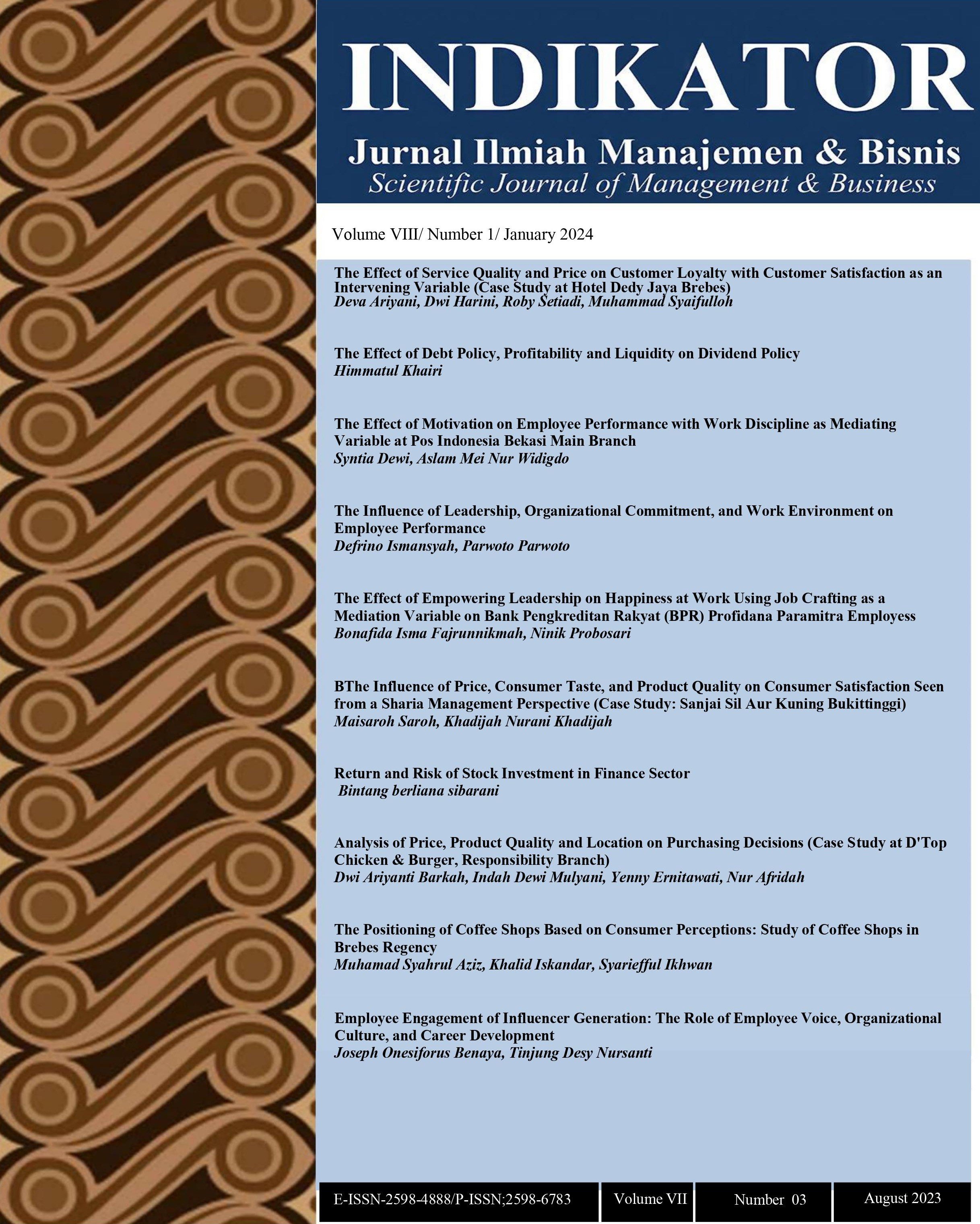
The Effect of Debt Policy, Profitability and Liquidity on Dividend Policy
DOI:
https://doi.org/10.22441/indikator.v8i1.21735Keywords:
Debt Policy, Profitability, Liquidity, Dividend PolicyAbstract
The purpose of this study is to investigate the impact of debt policy (measured by Debt to Equity Ratio), profitability (measured by Return on Asset), and liquidity (measured by Current Ratio) on dividend policy (measured by Dividend Payout Ratio). The study focuses on companies listed on the Indonesia Stock Exchange (IDX) under the Jakarta Islamic Index 70. Secondary data from financial statements spanning three consecutive years (2019 to 2021) were utilized for the analysis. The research employed purposive sampling, resulting in a sample of 44 companies, and multiple linear regression analysis was employed to test the research hypotheses. The findings indicate that, collectively, debt policy, profitability, and liquidity significantly influence the dividend policy of companies within the Jakarta Islamic Index from 2019 to 2021. However, when considering individual variables, only profitability demonstrates a significant impact on dividend policy among the listed companies from 2019 to 2021
References
Adil, C. M., Zafar, N., & Yaseen, N. (2011). Empirical analysis of determinants of dividend payout: Profitability and liquidity. In Interdisciplinary Journal of Contemporary Research in Business (pp. 289–300).
Ahmad, G. N., & Wardani, V. K. (2014). The effect of fundamental factor to dividend policy: Evidence in Indonesia Stock Exchange. International Journal of Business and Commerce, 4, 14–25.
Ahmed, I. E. (2015). Liquidity, profitability and the dividends payout policy. World Review of Business Research, 5, 73–85.
Al‐Malkawi, H. A. N., Rafferty, M., & Pillai, R. (2010). Dividend Policy: A Review of Theories and Empirical Evidence. International Bulletin of Business Administration, 9.
Al‐Najjar, B., & Belghitar, Y. (2011). Corporate cash holdings and dividend payments: Evidence from simultaneous analysis. Managerial and Decision Economics.
Apriliani, A., & Natalylova, K. (2017). Faktor-faktor yang mempengaruhi kebijakan dividen pada perusahaan manufaktur di Bursa Efek Indonesia. Jurnal Bisnis Dan Akuntansi.
Arilaha, M. A. (2009). Pengaruh free cash flow, profitabilitas, likuiditas, dan leverage terhadap kebijakan dividen. Jurnal Keuangan Dan Perbankan, 13, 78 – 87.
Baker, H. K., & Powell, G. E. (2012). Dividend policy in Indonesia: survey evidence from executives. Journal of Asia Business Studies, 6(1), 79–92.
Estuti, E. P., Fauziyanti, W., & Hendrayanti, S. (2019). Pengaruh Likuiditas, Profitabilitas Dan Kebijakan Dividen Terhadap Kebijakan Hutang Perusahaan. In Prosiding Seminar Universitas Muhammadiyah Semarang.
Frankfurter, G. M., & Jr, B. G. W. (2002). Dividend policy theories and their empirical tests. International Review of Financial Analysis, II, 111–138.
Ivory, S., & Suryono, B. (2020). Analisis Pengaruh Profitabilitas, Likuiditas, Kebijakan Hutang, Ukuran Perusahaan Terhadap Kebijakan Dividen Pada Perusahaan Manufaktur Periode 2014-2018. Jurnal Ilmu Dan Riset Akuntansi.
Kania, S. L. (2005). What factors motivate the corporate dividend decision? In Theses, Dissertations & Honors Papers.195.
Lestari, K. F., Tanuatmodjo, H., & Mayasari. (2017). Pengaruh Likuiditas Dan Profitabilitas Terhadap Kebijakan Dividen. Journal of Business Management and Enterpreneurship Education, 6, 242–247.
Mauris, F. I., & Nora, A. R. (2019). The effect of collaterallizable assets, growth in net assets, liquidity, leverage and profitability on dividend policy. In Budapest International Research and Critics Institute (BIRCI-Journal): Humanities and Social Sciences.
Monika, N., & Sudjarni, L. K. (2017). Pengaruh likuiditas, profitabilitas dan leverage terhadap kebijakan dividen pada perusahaan manufaktur di Bursa Efek Indonesia. E-Jurnal Manajemen Unud, Vol. 7, 905–932.
Myers, M., & Bacon, F. (2004). The determinants of corporate dividend policy. Academy of Accounting and Financial.
N. Bhattacharyya. (2007). Dividend policy: a review. Managerial Finance, 33(1), 4–13.
Naceur, S. Ben, Goaied, M., & Belanes, A. (2006). On the determinants and dynamics of dividend policy. International Review of Finance, 6, 1–23.
Pattiruhu, J. R., & Paais, M. (2020). Effect of liquidity, profitability, leverage, and firm size on dividend policy. TJournal of Asian Finance, Economics and Business, Vol 7, 035–042.
Risman, A., Parwoto & Sulaeman, A., (2020).. The Mediating Role of Firm’s Performance on The Relationship between Free Cash Flow and Capital Structure, Psychology and Education Journal, Vol. 58 No. 1: 1209-1216.
Ulfa, M., Wijaya, A. L., & Ubaidillah, M. (2021). Pengaruh Profitabilitas, Likuiditas, Kebijakan Hutang, Free Cash Flow Terhadap Kebijakan Dividen Dengan Ukuran Perusahaan Sebagai Moderasi. SIMBA: Seminar Inovasi Manajemen Bisnis Dan Akuntansi.
Wijayanto, E., & Putri, A. N. (2018). Analisis Pengaruh Rasio Likuiditas, Rasio Leverage, Rasio Profitabilitas Dan Kepemilikan Manajerial Terhadap Kebijakan Dividen. Jurnal Aktual Akuntansi Keuangan Bisnis Terapan, VOL. 1.
Zainuddin, Z., & Mananohas, O. A. (2020). The Effect of Debt Policies, Profitability, Managerial Ownership Structure, and Liquidity on Dividend Policy. The Indonesian Journal Of Accounting Research, Vol. 23(No. 3, Sept 2020), Page 411-428.
Published
How to Cite
Issue
Section
License
The copyright to this article is transferred to Universitas Mercu Buana (UMB) if and when the article is accepted for publication. The undersigned hereby transfers any and all rights in and to the paper including without limitation all copyrights to UMB. The undersigned hereby represents and warrants that the paper is original and that he/she is the author of the paper, except for material that is clearly identified as to its original source, with permission notices from the copyright owners where required. The undersigned represents that he/she has the power and authority to make and execute this assignment.
We declare that:
1. This paper has not been published in the same form elsewhere.
2. It will not be submitted anywhere else for publication prior to acceptance/rejection by this Journal.
3. A copyright permission is obtained for materials published elsewhere and which require this permission for reproduction.
Furthermore, I/We hereby transfer the unlimited rights of publication of the above mentioned paper in whole to UMB. The copyright transfer covers the exclusive right to reproduce and distribute the article, including reprints, translations, photographic reproductions, microform, electronic form (offline, online) or any other reproductions of similar nature.
The corresponding author signs for and accepts responsibility for releasing this material on behalf of any and all co-authors. This agreement is to be signed by at least one of the authors who have obtained the assent of the co-author(s) where applicable. After submission of this agreement signed by the corresponding author, changes of authorship or in the order of the authors listed will not be accepted.
Retained Rights/Terms and Conditions
1. Authors retain all proprietary rights in any process, procedure, or article of manufacture described in the Work.
2. Authors may reproduce or authorize others to reproduce the Work or derivative works for the authors personal use or for company use, provided that the source and the UMB copyright notice are indicated, the copies are not used in any way that implies UMB endorsement of a product or service of any employer, and the copies themselves are not offered for sale.
3. Although authors are permitted to re-use all or portions of the Work in other works, this does not include granting third-party requests for reprinting, republishing, or other types of re-use.
This work is also licensed under a Creative Commons Attribution-NonCommercial 4.0 International License.









