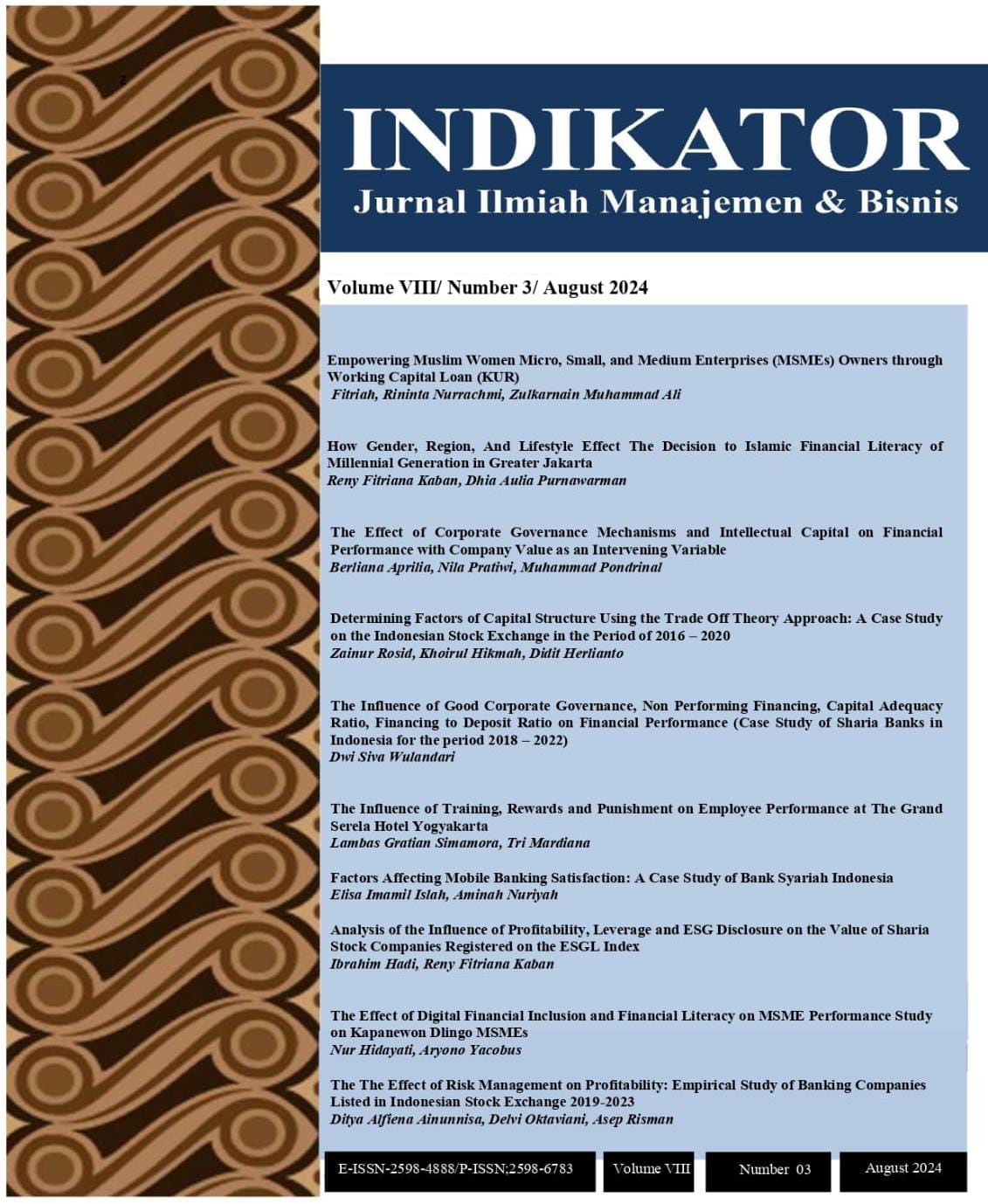
The Influence of Good Corporate Governance, Non Performing Financing, Capital Adequacy Ratio, Financing to Deposit Ratio on Financial Performance (Case Study of Sharia Banks in Indonesia for the period 2018 – 2022)
DOI:
https://doi.org/10.22441/indikator.v8i3.26829Keywords:
Good Corporate Governance, Non Performing Financing, Capital Adequacy Ratio, Financing to Deposit Ratio, Return on Assets.Abstract
This research aims to determine and analyze the influence of Good Corporate Governance, Non Performing Financing, Capital Adequacy Ratio, and Financing to Deposit Ratio on Return on Assets of Sharia Banks in Indonesia in 2018 - 2022. The population in this research is 13 Sharia Commercial Banks in Indonesia. Indonesia for the period 2018 – 2022. The sample used was 10 Sharia Commercial Banks. The data collection method uses the documentation method. The data analysis method in this research uses the Eviews program application. The results of this research are that Good Corporate Governance has no effect on Return On Assets, Non Performing Financing has a negative effect on Return On Assets, Capital Adequacy Ratio has no positive effect on Return On Assets and Financing to Deposit Ratio has no positive effect on Return On Assets.
References
Andrianto dan Firmansyah, M. A. (2019). Manajemen Bank Syariah. Surabaya: Qiara Media Partner.
Aninda, I. A., Gendro, W., & Risah, R. (2020). Pengaruh Risiko Likuiditas, Net Interest Margin, Dan Good Corporate Governance Terhadap Kinerja Keuangan Bank Umum. Modus, 32(1), 53-65.
Caraka, Rezzy Eko. (2018). Spatial Data Panel. Ponorogo: Wade Publish.
Effendi, I., & Hariani, P. (2020). Dampak Covid-19 terhadap Bank Syariah: Impact of Covid-19 on Islamic Banks. EKONOMIKAWAN: Jurnal Ilmu Ekonomi Dan Studi Pembangunan, 20(79), 221–230.
Ikatan Bankir Indonesia. (2018). Bisnis Kredit Perbankan. Jakarta: PT. Gramedia Pustaka Utama.
Iqbal, M. & Saiful, A. (2021). Pengaruh Capital Adequacy Ratio, Non Performing Financing, Financing To Deposit Ratio, Operational Efficiency Ratio, Dan Profit Sharing Ratio Terhadap Kinerja Keuangan Bank Umum Syariah. Jurnal Revenue Jurnal Akuntansi, 2(2), 259-270.
Iskandar, S. (2017). Akuntansi Perbankan, Bogor: In Media.
Ismail. (2018). Manajemen Perbankan dari Teori Menuju Aplikasi, Jakarta: Prenamedia Group
Jaelani, A. & Winaya, P. (2022). Pengaruh Tingkat Kesehatan Bank Dengan Metode Risk Based Bank Rating (RBBR) Terhadap Kinerja Keuangan (Studi Pada Bank Umum Kategori BUKU 3 Periode Tahun 2018-2020). Adi Bisnis Digital Interdisiplin, 3(1), 29-41.
Jumono, S., Sugiyanto., & Matari, C. (2018), Why Have Bank Profitability Been High in Indonesia? An Analysis Using Dynamic Panel Data Approach. Journal of Economic & Management Perspectives 12 (2), 353-367.
Kasmir. (2019). Analisis Laporan Keuangan Edisi Pertama Cetakan Keduabelas. Jakarta: Raja Grafindo Persada.
Kumalasari, D. & Heri, P. (2018). Good Corporate Governance Affects on Corporate Value Through Return on Equity and Return on Asset of Manufacture Company. The First International Research Conference on Economics and Business, KnE Social Sciences, 114-126.
Muhammad. (2020). Bank Syariah: Analisis Kekuatan, peluang, dan Ancaman. Yogyakarta: Ekonisia
Rusdiyanto, Susetyorini, dan Elan, Umi. 2019. Good Corporate Governance Cetakan Pertama. Bandung: PT Refika Aditama.
Safitri, V. I. & Ai, H. (2020). Pengaruh Capital Adequacy Ratio (Car), Non Performing Financing (Npf), Financing To Deposit Ratio (Fdr) Dan Efisiensi Operasional (Bopo) Terhadap Profitabilitas (Return On Assets) Pada Bank Umum Syariah Yang Terdaftar Di Bank Indonesia. JCA Ekonomi, 1(1), 252- 264.
Simatupang, A. L. & Tri, J. W. P. (2021). Analisis Rasio Keuangan (CAMEL) Terhadap Kinerja Keuangan BPD Dengan GCG Sebagai Pemoderasi Periode 2017 – 2019 (Studi Empiris Pada Bank Pembangunan Daerah Di Indonesia Tahun 2017 – 2019). Diponegoro Journal of Accounting, 10(4), 1-14.
Suganda, T. R. (2018). Event Sudy: Teori dan Pembahasan Reaksi Pasar Modal Indonesia. Malang: Seribu Bintang.
Sugiyono. (2018). Metode Penelitian Kuantitatif. Bandung: Alfabeta
Supriadi, A., Agus, I. H., & Lia, U. (2021). Pengaruh Corporate Governance, Financing To Deposit Ratio Dan Non-Performing Financing Terhadap Kinerja Keuangan Perbankan Syariah Dengan Capital Adequacy Ratio Sebagai Variabel Intervening. Jurnal Riset Akuntansi Tirtayasa, 6(2), 93-105.
Suwarno, R. C. & Ahmad, M. M. (2018). Analisis Pengaruh NPF, FDR, BOPO, CAR, dan GCG terhadap Kinerja Keuangan Bank Umum Syariah di Indonesia Periode 2013-2017. Bisnis, 6(1), 94-117.
Wahasusmiah, R. & Watie, K. R. (2018). Metode RGEC : Penilaian Tingkat Kesehatan Bank Pada Perusahaan Perbankan Syariah. I-FINANCE, 04(02), 170-184.
Wahyuni, R. & Muhammad, J. (2021). Pengaruh Capital Adequacy Ratio, Non Performing Financing, Financing To Deposit Ratio Terhadap Kinerja Keuangan. Journal of Accounting, Financa and Auditing, 3(2), 35-44.
Widarjono, Agus. (2018). Ekonometrika Pengantar Dan Aplikasinya Disertai Panduan Eviews. Edisi keli. Yogyakarta: UPP STIM YKPN Yogyakarta.
Yastutik, I. & Fetria, E. Y. (2021). Pengaruh tingkat likuiditas, Islamic corporate governance (ICG) dan efisiensi operasional terhadap kinerja keuangan dengan risiko pembiayaan sebagai variabel moderating. Journal of Accounting and Digital Finance, 1(3), 181-194.
Yuliana, I. R. & Sinta, L. (2021). Pengaruh CAR, FDR, Dan BOPO Terhadap ROA Pada Bank Syariah Di Indonesia. Jurnal Ilmiah Akuntansi Kesatuan, 9(2), 309-334.
Yulita, D., Maryono., & Agus, B. S. (2020). Pengaruh Capital Adequacy Ratio (CAR), Non Performing Loan (NPL), Net Interest Margin (NIM), Biaya Operasional Dan Pendapatan Operasional (BOPO) Serta Loan To Deposit Ratio (LDR) Terhadap Return On Assets (ROA). Dinamika Akuntansi, Keuangan dan Perbankan, 9(2), 189-200.
Downloads
Published
How to Cite
Issue
Section
License
The copyright to this article is transferred to Universitas Mercu Buana (UMB) if and when the article is accepted for publication. The undersigned hereby transfers any and all rights in and to the paper including without limitation all copyrights to UMB. The undersigned hereby represents and warrants that the paper is original and that he/she is the author of the paper, except for material that is clearly identified as to its original source, with permission notices from the copyright owners where required. The undersigned represents that he/she has the power and authority to make and execute this assignment.
We declare that:
1. This paper has not been published in the same form elsewhere.
2. It will not be submitted anywhere else for publication prior to acceptance/rejection by this Journal.
3. A copyright permission is obtained for materials published elsewhere and which require this permission for reproduction.
Furthermore, I/We hereby transfer the unlimited rights of publication of the above mentioned paper in whole to UMB. The copyright transfer covers the exclusive right to reproduce and distribute the article, including reprints, translations, photographic reproductions, microform, electronic form (offline, online) or any other reproductions of similar nature.
The corresponding author signs for and accepts responsibility for releasing this material on behalf of any and all co-authors. This agreement is to be signed by at least one of the authors who have obtained the assent of the co-author(s) where applicable. After submission of this agreement signed by the corresponding author, changes of authorship or in the order of the authors listed will not be accepted.
Retained Rights/Terms and Conditions
1. Authors retain all proprietary rights in any process, procedure, or article of manufacture described in the Work.
2. Authors may reproduce or authorize others to reproduce the Work or derivative works for the authors personal use or for company use, provided that the source and the UMB copyright notice are indicated, the copies are not used in any way that implies UMB endorsement of a product or service of any employer, and the copies themselves are not offered for sale.
3. Although authors are permitted to re-use all or portions of the Work in other works, this does not include granting third-party requests for reprinting, republishing, or other types of re-use.
This work is also licensed under a Creative Commons Attribution-NonCommercial 4.0 International License.









