
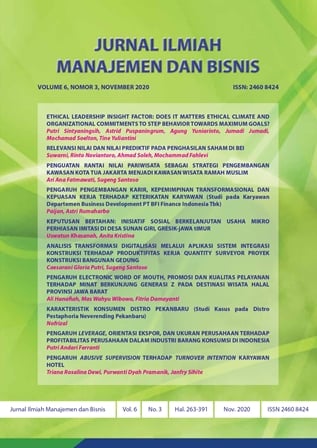
ANALISIS TRANSFORMASI DIGITALISASI MELALUI APLIKASI SISTEM INTEGRASI KONSTRUKSI TERHADAP PRODUKTIVITAS KERJA QUANTITY SURVEYOR PROYEK KONSTRUKSI BANGUNAN GEDUNG
DOI:
https://doi.org/10.22441/jimb.v6i3.9866Keywords:
digitization, productivity, re-engineering business processes, quantity surveyor, constructionAbstract
In this study, the authors transformed the digitalization by using a construction integration system application in one of the building construction projects built by PT. X with the aim of compiling an analysis of system application digitalization transformation. Construction integration through re-engineering business processes to increase productivity so as to speed up the work time of surveyors and also to assess the impact of implementing the construction integration system on the quantity of surveyors. The results show that with the transformation of digitizing the use of the construction integration system application, procurement process becomes a more effective and efficient process in increasing productivity because it can reduce processes that are not needed in a procurement process. The impact of implementing this transformation is in the grouping of budgets / costs according to the scope of work and location, starting from making work orders and progressing the work, shortening the work progress transaction flow, and in controlling the work area that has been done. PT. X carried out the transformation by creating a construction integration system digitization program used in building construction projects. This transformation is implemented in all PT. X with the aim of increasing employee productivity in order to avoid project implementation time.Downloads
References
AbouRizk S. M., Leonhard, E. B. Managing Performance in Construction. New Jersey: John Wiley & Sons, Inc.; 2010.
Ahuja, H. N. Dozzi, S.P. Aourizk, S. M. Project Management. New York: John Wiley & Sons. 1994.
Amin, M., Susanto, A. Kajian Quantity Surveyor pada Tahap Pre Contract dan Post Contract Studi Kasus : Proyek Ad-Premier Office. Jakarta. 2015.
B. García de Soto, I. Agustí-Juan, J. Hunhevicz, S. Joss, K. Graser, G. Habert, B.T. Adey, Productivity of Digital Fabrication in Construction: Cost and Time Analysis of a Robotically Built Wall. Journal of Automation in Construction. 2018.
Bock, T. The Future of Construction Automation: Technological Disruption and the Upcoming Ubiquity of Robotics. Journal of Automation in Construction. 2015.
Brandon. Quantity Surveying Techniques: New Directions. WileyBlackWell. 1990.
Cheng, M.Y, Tsai H.C., Lai, Y.Y. Construction management process reengineering performance measurements. Journal of Automation in Construction. 2009.
Ellitan, L. Re-engineering Proses Bisnis: Tinjauan Konseptual dan Metodologi. Universitas Widya Mandala, Surabaya. 1999.
Hammer, M. Re-engineering Work: Don’t Automate, Obliterate. Harvard Business Revolution. 1990.
Hernandi, Y., Tamtana, J. S., Faktor-faktor yang Mempengaruhi Produktivitas Pekerja pada Pelaksanaan Konstruksi Gedung Bertingkat. Universitas Trisakti. 2020.
Jung, K., Chu, B., Hong, D. Robot-based Construction Automation: an Application to Steel Beam Assembly (Part II), Journal of Automation in Construction. 2013.
Kaming P.F., Olomolaiye, P.O., Holt G. and Harris, F. C. Factors Influencing Construction Time and Cost Overruns on High-rise Projects in Indonesia, Journal of Construction Management and Economic. 1997.
Oesterreich, T.D., Teuteberg, F. Understanding the Implications of Digitisation and Automation in the Context of Industry 4.0: A Triangulation Approach and Elements of a Research agenda for the Construction Industry. Osnabruck University, Germany. 2016.
Peppard, J. Management Challenges in Information Systems. Cranfield University. 1995.
Porter, Me. E. The Competitive Advantage: Creating and Sustaining Superior Performance. NY: Free Press. 1985.
Seeley, I. H. Quantity Surveying Practice. Macmillan Education, UK. 1997.
Shehata, M. E., El-Gohary, K. M. Towards Improving Construction Labor Productivity and Projects’ Performance. Alexandria University. 2012.
Skibniewski, M. J., Russell, J. S. Construction Robot Fleet Management System Prototype. Journal of Computation in Civil Engineering. 1991.
Vähä, P., Heikkilä, T., Kilpeläinen, P., Järviluoma, M., Gambao, E. Extending Automation of Building Construction — Survey on Potential Sensor Technologies and Robotic Applications. Journal of Automation in Construction. 2013.
Yates, J. K. Productivity Improvement for Construction and Engineering : Implementing Programs that Save Money and Time. American Society of Civil Engineers. 1955.
Yu, E. Modelling Strategic Relationship for Process Reengineering. Social Modeling for Requirements Engineering. 2011.
Downloads
Published
How to Cite
Issue
Section
License
The copyright of this article was transferred to Universitas Mercu Buana if and when the article was accepted for publication. The undersigned below transfers all and all rights in and to paper including without limitation all copyright to UMB. The undersigned states and guarantees that the paper is genuine and that he is the author of the paper, except material that is clearly identified as the original source, with the notification of the permission of the copyright owner if necessary and has the power and authority to make and carry out this assignment. We state that this paper has not been published in the same form elsewhere.
Furthermore, I / We hereby transfer unlimited publicity rights to the above mentioned papers as a whole to Universitas Mercu Buana. Copyright transfers include the right to reproduce and distribute articles, including reprints, translations, photo reproductions, microforms, electronic forms (offline, online) or other reproductions that have similar properties. The appropriate author signs and accepts the responsibility for releasing this material on behalf of each and all co-authors. This agreement must be signed by at least one of the authors who has obtained approval from the co-author (s) where applicable.
After the submission of this agreement is signed by the appropriate author, changes in authorship or in the order of the registered author will not be accepted. Retained Rights / Provisions and Conditions Although the author is permitted to reuse all or part of the Work in another work, this does not include giving a third party request for reprinting, republishing, or any other type of reuse.









