Implementing OSA-CBM Architecture for Operational Readiness Assessment of Aging Motor Grader Engines
DOI:
https://doi.org/10.22441/ijimeam.v8i1.38575Keywords:
condition-based maintenance (CBM), oil analysis, open system architecture (OSA), wear metalsAbstract
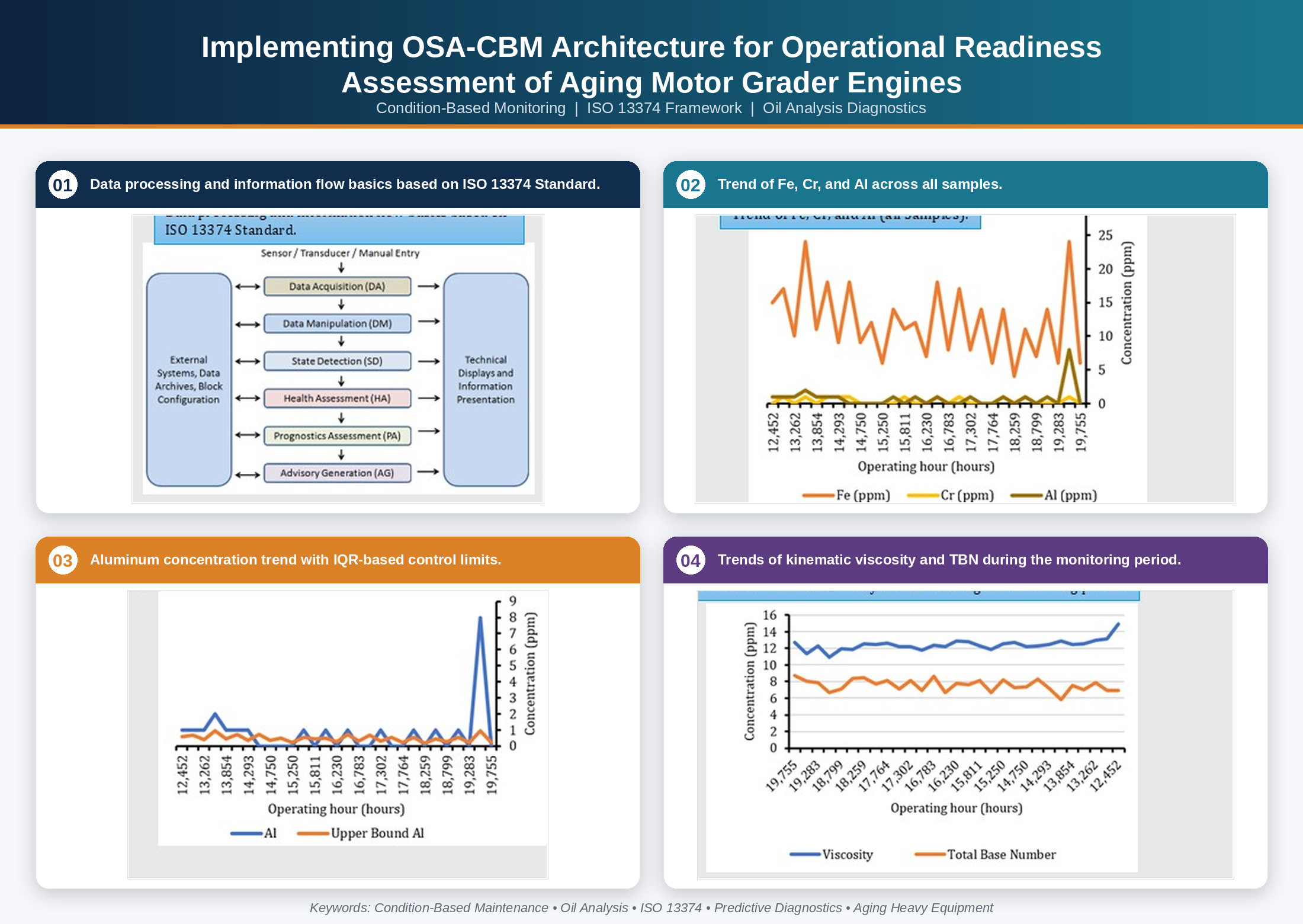
Traditional interval-based maintenance policies for diesel engines often rely on fixed overhaul schedules recommended by Original Equipment Manufacturers (OEM), which may not accurately reflect the actual health status of aging heavy equipment in harsh mining environments. Such static approaches risk either premature, costly overhauls or catastrophic, unexpected failures. This study proposes a robust methodology by integrating Interquartile Range (IQR)-based statistical control limits within the Open System Architecture for Condition-Based Maintenance (OSA-CBM) framework to evaluate the operational readiness of an aging motor grader engine. Historical oil analysis data from May 2024 to November 2025, covering an extended operational period from 13,515 to 19,755 hours, were examined to identify wear behavior and lubricant degradation. The implementation of the seven functional layers of OSA-CBM, from data acquisition to advisory generation, ensures a structured and traceable diagnostic process. The results indicate that primary wear metal parameters, specifically iron (Fe) and chromium (Cr), remained stable with Risk Index (RI) values below unity (RI < 1), signifying a steady-state wear condition despite the engine operating far beyond typical overhaul intervals. Although a significant isolated spike in aluminum (Al) was detected with a Risk Index of 3.20, the absence of correlated increases in Fe or Cr suggests episodic contamination or a transient event rather than progressive mechanical wear. Furthermore, lubricant condition indicators, including kinematic viscosity and Total Base Number (TBN), consistently complied with SAE 15W-40 specifications. These findings demonstrate that embedding unit-specific statistical boundaries within the OSA-CBM architecture provides reliable, data-driven decision support, enabling justified operational life extension and optimized maintenance strategies for aging heavy-duty engines.
Downloads
References
[1] R. Ramirez Camba, C. Garcia Garcia, M. Garcia Tobar, and J. Fajardo Merchan, "An integrated methodological approach for inter-preting used oil analysis in diesel engines," Lubricants, vol. 13, no. 4, Art. no. 169, Apr. 2025, doi: 10.3390/lubricants13040169.
[2] W. Chokelarb, P. Sriprom, L. Permana, and P. Assawasaengrat, "Assessment of overall remaining useful life of lubricants by inte-grating oil quality and performance," Heliyon, vol. 10, no. 18, Art. no. e37486, Sep. 2024, doi: 10.1016/j.heliyon.2024.e37486.
[3] T. Omiya, K. Hanyuda, and E. Nagatomi, "Predicting engine oil degradation across diverse vehicles and identifying key factors," Mech. Syst. Signal Process., vol. 229, Art. no. 112524, Apr. 2025, doi: 10.1016/j.ymssp.2025.112524.
[4] M. G. A. Nassef et al., "Physics-informed transfer learning for predicting engine oil degradation and RUL across heterogeneous heavy-duty equipment fleets," Lubricants, vol. 13, no. 12, Art. no. 545, Dec. 2025, doi: 10.3390/lubricants13120545.
[5] D. C. Benjumea, H. Laniado, and O. Combita, "Analytical model to monitor the oil conditions on the main components of mining dumpers," Results Eng., vol. 17, Art. no. 100934, Mar. 2023, doi: 10.1016/j.rineng.2023.100934.
[6] A. Ali and A. Abdelhadi, "Condition-based monitoring and maintenance: State-of-the-art review," Appl. Sci., vol. 12, no. 2, Art. no. 688, Jan. 2022, doi: 10.3390/app12020688.
[7] S. Domínguez-García, L. Béjar-Gómez, A. López-Velázquez, R. Maya-Yescas, and F. Nápoles-Rivera, "Maximizing lubricant life for internal combustion engines," Processes, vol. 10, no. 10, Art. no. 2070, Oct. 2022, doi: 10.3390/pr10102070.
[8] N. P. Ventikos, P. Sotiralis, and E. Annetis, "A combined risk-based and condition monitoring approach: Developing a dynamic model for the case of marine engine lubrication," Transp. Saf. Environ., vol. 4, no. 3, Art. no. tdac020, Sep. 2022, doi: 10.1093/tse/tdac020.
[9] M. Deliś, S. Kłysz, and R. Przysowa, "Correlative method for diagnosing gas-turbine tribological systems," Sensors, vol. 23, no. 12, Art. no. 5738, Jun. 2023, doi: 10.3390/s23125738.
[10] O. Surucu, S. A. Gadsden, and J. Yawney, "Condition monitoring using machine learning: A review of theory, applications, and re-cent advances," Expert Syst. Appl., vol. 221, Art. no. 119738, Jul. 2023, doi: 10.1016/j.eswa.2023.119738.
[11] B. Xu et al., "Improving laser-induced breakdown spectroscopy for highly efficient trace measurement of hazardous components in waste oils," Anal. Chem., vol. 95, no. 51, pp. 18685-18690, Dec. 2023, doi: 10.1021/acs.analchem.3c03579.
[12] M. Li, L. Zhang, D. Yuan, X. Sun, and Q. Tong, "A hyperspectral analysis-based approach for estimation of wear metal content in lubricating oil," Lubricants, vol. 13, no. 9, Art. no. 393, Sep. 2025, doi: 10.3390/lubricants13090393.
[13] Y. Pan, Y. Jing, T. Wu, and X. Kong, "An integrated data and knowledge model addressing aleatory and epistemic uncertainty for oil condition monitoring," Reliab. Eng. Syst. Saf., vol. 210, Art. no. 107546, Jun. 2021, doi: 10.1016/j.ress.2021.107546.
[14] Y. Pan, B. Liang, L. Yang, H. Liu, T. Wu, and S. Wang, "Spatial-temporal modeling of oil condition monitoring: A review," Reliab. Eng. Syst. Saf., vol. 248, Art. no. 110182, Aug. 2024, doi: 10.1016/j.ress.2024.110182.
[15] D. Li, H. Gao, K. Yang, F. Zhou, and X. Shi, "Abnormal identification of oil monitoring based on LSTM and SVDD," Wear, vols. 526-527, Art. no. 204793, Aug. 2023, doi: 10.1016/j.wear.2023.204793.
[16] J. Garcia, L. Rios-Colque, A. Peña, and L. Rojas, "Condition monitoring and predictive maintenance in industrial equipment: An NLP-assisted review of signal processing, hybrid models, and implementation challenges," Appl. Sci., vol. 15, no. 10, Art. no. 5465, May 2025, doi: 10.3390/app15105465.
[17] H. Tao, W. Feng, G. Yang, R. Du, and Y. Zhong, "A wear condition warning method for wind turbine gearbox based on oil online monitoring using learnable multiscale convolutional neural network," IEEE Sensors J., vol. 24, no. 21, pp. 35709-35721, Nov. 2024, doi: 10.1109/JSEN.2024.3462815.
[18] J. Zhao et al., "Real-time and online lubricating oil condition monitoring enabled by triboelectric nanogenerator," ACS Nano, vol. 15, no. 7, pp. 11869-11879, Jul. 2021, doi: 10.1021/acsnano.1c02980.
[19] D. Jiao, A. Urban, X. Zhu, and J. Zhe, "Oil property sensing array based on a general regression neural network," Tribol. Int., vol. 164, Art. no. 107221, Dec. 2021, doi: 10.1016/j.triboint.2021.107221.
[20] M. Rahimi, M.-R. Pourramezan, and A. Rohani, "Modeling and classifying the in-operando effects of wear and metal contaminations of lubricating oil on diesel engine: A machine learning approach," Expert Syst. Appl., vol. 203, Art. no. 117494, Oct. 2022, doi: 10.1016/j.eswa.2022.117494.
Downloads
Published
How to Cite
Issue
Section
License
Copyright (c) 2026 Nova Pangastuti, Muhammad Ilham Muslimin , Sepriandi Parningotan

This work is licensed under a Creative Commons Attribution-ShareAlike 4.0 International License.