Anthropometric-Based Ergonomic Design of a Portable Mini Ladder Hoist for Loading and Unloading Operations at Medium-Scale Ports
DOI:
https://doi.org/10.22441/ijimeam.v8i1.36659Keywords:
Anthropometry, ergonomic design, ladder hoist, loading and unloading, morphological analysis, port operationsAbstract
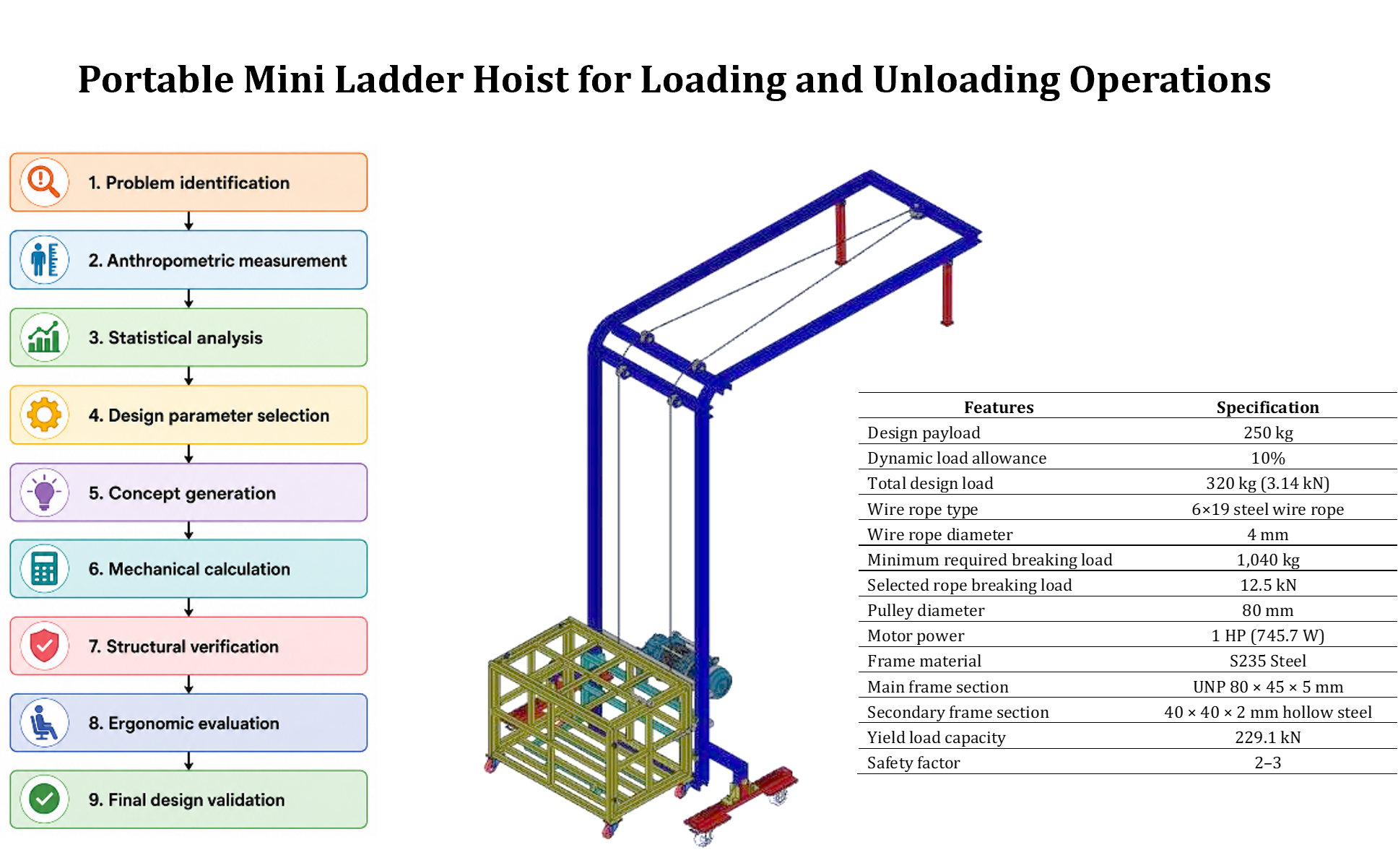
Loading and unloading activities at small- and medium-scale ports are often performed manually, exposing workers to excessive physical loads, awkward postures, and an increased risk of work-related musculoskeletal disorders (WMSDs). This study aimed to develop an anthropometric-based ergonomic portable mini ladder hoist to improve the safety and efficiency of loading and unloading operations. The study employed a Research and Development (R&D) approach involving anthropometric measurements of 20 stevedores using 16 standing-posture dimensions. The collected data were analyzed using Minitab 19 to determine the mean, standard deviation, and 5th and 95th percentile values, which were used as the basis for ergonomic design. Morphological analysis and a weighted decision matrix were applied to generate and select the optimum design concept. The selected concept was modeled in SolidWorks and evaluated through engineering calculations, including structural strength, wire-rope selection, pulley sizing, and motor power requirements. The final design consisted of a portable wheel-mounted frame fabricated from S235 steel and powered by a 1 HP electric hoist. The ladder hoist was designed to safely support a total lifting load of 320 kg with a lifting height of 3 m. Ergonomic evaluation using the Rapid Entire Body Assessment (REBA) method indicated a reduction in risk level from high-risk manual handling to a medium-risk category after implementation of the proposed design. The novelty of this study lies in the integration of local port-worker anthropometric data, morphological design methods, and mechanical design considerations into the development of a portable ladder hoist. The proposed design provides a practical and cost-effective lifting solution for loading and unloading operations at medium-scale ports and similar material-handling environments.
Downloads
References
[1] A. M. Adhaye and D. A. Jolhe, “Ergonomic assessment for designing manual material handling tasks at a food warehouse in India: A case study,” Hum. Factors Ergon. Manuf. Serv. Ind., vol. 33, no. 6, pp. 499–520, 2023, doi: 10.1002/hfm.21004.
[2] S. Leggieri, V. Fanti, D. G. Caldwell, and C. Di Natali, “Online ergonomic evaluation in realistic manual material handling task: Proof of concept,” Bioengineering, vol. 11, no. 1, Art. no. 14, 2024, doi: 10.3390/bioengineering11010014.
[3] P. Giannini, G. Bassani, C. A. Avizzano, and A. Filippeschi, “Wearable sensor network for biomechanical overload assessment in manual material handling,” Sensors, vol. 20, no. 14, Art. no. 3877, 2020, doi: 10.3390/s20143877.
[4] H. Chandra, “Manual material handling analysis using biomechanics at repair department workers,” J. Terap. Tek. Ind., vol. 4, no. 1, pp. 108–115, 2023, doi: 10.37373/jenius.v4i1.498.
[5] G. F. X. W. Wangge and Yanto, “Hasil pengukuran pendahuluan data antropometri posisi duduk pekerja industri di Jabodetabek,” J. Prakt. Keinsinyuran, vol. 1, no. 3, pp. 225–228, 2024, doi: 10.25170/jpk.v1i03.6126.
[6] Y. V. Servianus and Yanto, “A preliminary result of standing posture anthropometry of Indonesia male workers in Jakarta,” Cylinder: J. Ilm. Tek. Mesin, vol. 9, no. 1, pp. 43–46, 2023, doi: 10.25170/cylinder.v9i1.5030.
[7] O. Adiyanto, F. A. Prasetyo, and M. F. K. Ramadhani, “Manual material handling in the ‘karung’ lifting process using biomechanic and physiologi approach,” J. Penelit. Saintek, vol. 24, no. 1, pp. 32–38, 2019, doi: 10.21831/jps.v24i1.23611.
[8] M. R. Contreras-Valenzuela, D. Seuret-Jiménez, A. M. Hdz-Jasso, V. A. León Hernández, A. N. Abundes-Recilla, and E. Trutié-Carrero, “Design of a fuzzy logic evaluation to determine the ergonomic risk level of manual material handling tasks,” Int. J. Environ. Res. Public Health, vol. 19, no. 11, Art. no. 6511, 2022, doi: 10.3390/ijerph19116511.
[9] R. Zaman, A. Arefeen, J. Quarnstrom, S. Barman, J. Yang, and Y. Xiang, “Optimization-based biomechanical lifting models for manual material handling: A comprehensive review,” Proc. Inst. Mech. Eng. H, vol. 236, no. 9, pp. 1273–1287, 2022, doi: 10.1177/09544119221114208.
[10] H. Mohammadi, M. Motamedzade, M. A. Faghih, H. Bayat, M. H. Mohraz, and S. Musavi, “Manual material handling assessment among workers of Iranian casting workshops,” Int. J. Occup. Saf. Ergon., vol. 19, no. 4, pp. 675–681, 2013, doi: 10.1080/10803548.2013.11077021.
[11] A. A. Saputra, Wahyudin, and A. E. Nugraha, “Evaluasi aktivitas manual material handling dengan menggunakan metode biomekanika kerja pada pengangkatan thinner di bagian warehouse,” J. Sist. Tek. Ind., vol. 23, no. 2, pp. 233–244, 2021, doi: 10.32734/jsti.v23i2.6273.
[12] Z. Soufi, P. David, and Z. Yahouni, “Field studies analysis for new material handling system design approach,” Research Square, preprint, Apr. 5, 2021, doi: 10.21203/rs.3.rs-338962/v1.
[13] M. Waseem, U. Ghani, T. Habib, S. Noor, and T. Ahmed, “Productivity enhancement with material handling system design and human factors analysis: A case study,” Mehran Univ. Res. J. Eng. Technol., vol. 40, no. 3, pp. 556–569, 2021, doi: 10.22581/muet1982.2103.10.
[14] S. Pheasant and C. M. Haslegrave, Bodyspace: Anthropometry, Ergonomics and the Design of Work, 3rd ed. Boca Raton, FL, USA: CRC Press, 2018, doi: 10.1201/9781315375212.
[15] J. Panero and M. Zelnik, Human Dimension and Interior Space: A Source Book of Design Reference Standards. New York, NY, USA: Clarkson Potter/Ten Speed, 2014.
[16] A. Heriawan and M. Fitri, “Design of a 10 tons overhead crane with 21 meters span using finite element method,” Int. J. Innov. Mech. Eng. Adv. Mater., vol. 4, no. 3, pp. 74–80, 2022, doi: 10.22441/ijimeam.v4i3.18882.
[17] M. L. Nafis, H. Pranoto, and R. P. Youlia, “Enhancing high-speed performance: Modification of boom barrier gate with push braking system for ETC application,” Int. J. Innov. Mech. Eng. Adv. Mater., vol. 5, no. 3, pp. 88–98, 2023, doi: 10.22441/ijimeam.v5i3.23360.
[18] R. Kamaludin, R. Sundari, A. Sudarsono, and R. Anggraini, “Material selection of proposed air receiver tank applied for electrical generator,” Int. J. Innov. Mech. Eng. Adv. Mater., vol. 4, no. 3, pp. 81–87, 2022, doi: 10.22441/ijimeam.v4i3.19248.
[19] P. Telek and P. Koštál, “Material handling equipment selection algorithm for production workplaces,” Adv. Logist. Syst. Theory Pract., vol. 16, no. 2, pp. 37–46, 2022, doi: 10.32971/als.2022.011.
[20] S. Chatterjee and S. Chakraborty, “Application of the R method in solving material handling equipment selection problems,” Decis. Making Appl. Manag. Eng., vol. 6, no. 2, pp. 74–94, 2023, doi: 10.31181/dmame622023391.
Downloads
Published
How to Cite
Issue
Section
License
Copyright (c) 2026 Yohanes Viva Servianus, Gusti FX Wara Wangge, Matheus M Dwinanto, Fransiskus N Arfan

This work is licensed under a Creative Commons Attribution-ShareAlike 4.0 International License.