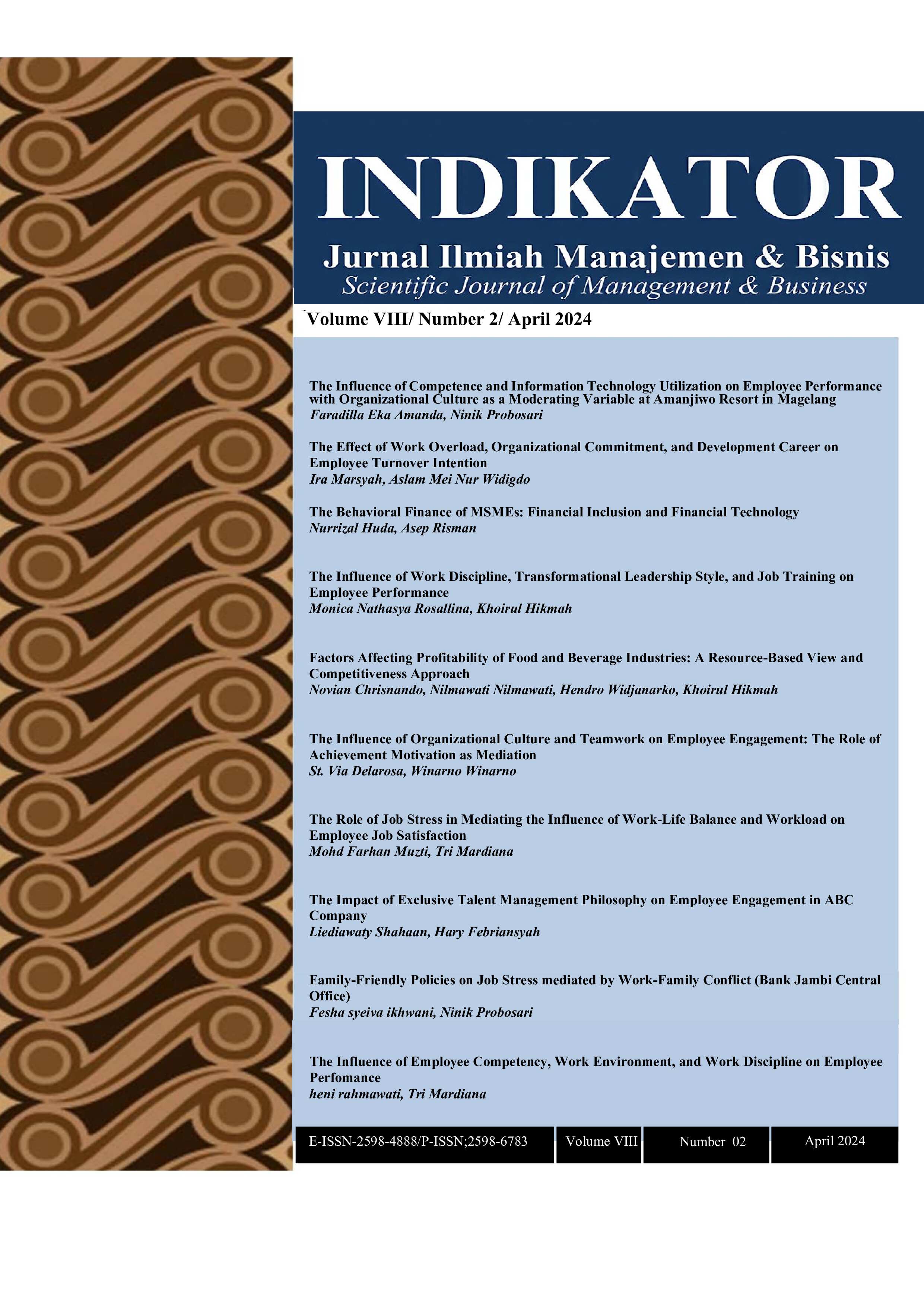
Factors Affecting Profitability of Food and Beverage Industries: A Resource-Based View and Competitiveness Approach
DOI:
https://doi.org/10.22441/indikator.v8i2.25861Keywords:
Profitability, Food and Beverage, Firm Size, Liquidity, Efficiency, Leverage, Market Power.Abstract
This study examines the determinants of profitability within Indonesia's food and beverage industry, specifically analyzing the role of firm size, liquidity, efficiency, leverage, and market power. Utilizing data from 24 companies listed on the Indonesia Stock Exchange from 2018-2022, the research employs multiple linear regression analysis to investigate these factors' impact on profitability, as indicated by Return On Assets (ROA). Results reveal that firm size, liquidity, efficiency, leverage, and market power collectively influence profitability, with market power emerging as the most significant determinant. While firm size and efficiency are positively associated with profitability, leverage negatively impacts it, and liquidity does not significantly affect it. The study's findings highlight the importance of strategic market positioning, operational efficiency, and prudent financial management in enhancing profitability.References
Ahmed, A. M., Sharif, N. A., Ali, M. N., & Hágen, I. (2023). Effect of Firm Size on the Association between Capital Structure and Profitability. Sustainability (Switzerland), 15(14). https://doi.org/10.3390/su151411196
Akram, T., Farooq, M. U., Akram, H., Ahad, A., & Numan, M. (2021). The Impact of Firm Size on Profitability-A Study on the Top 10 Cement Companies of Pakistan. Jurnal Aplikasi Manajemen Ekonomi Dan Bisnis, 6(1).
Alarussi, A. S., & Alhaderi, S. M. (2018). Factors affecting profitability in Malaysia. Journal of Economic Studies, 45(3), 442–458. https://doi.org/10.1108/JES-05-2017-0124
Ali, M. M., Hussin, N. N. A. N., & Ghani, E. K. (2019). Liquidity, growth and profitability of non-financial public listed Malaysia: A Malaysian evidence. International Journal of Financial Research, 10(3), 194–202. https://doi.org/10.5430/ijfr.v10n3p194
Anton, S. G., & Afloarei Nucu, A. E. (2021). The Impact of Working Capital Management on Firm Profitability: Empirical Evidence from the Polish Listed Firms. Journal of Risk and Financial Management, 14(1). https://doi.org/10.3390/jrfm14010009
Arhinful, R., & Radmehr, M. (2023). The effect of financial leverage on financial performance: evidence from non-financial institutions listed on the Tokyo stock market. Journal of Capital Markets Studies, 7(1), 53–71. https://doi.org/10.1108/jcms-10-2022-0038
Aydın Unal, E., Unal, Y., & Isık, O. (2017). The Effect Of Firm Size On Profitability: Evidence From Turkish Manufacturing Sector. Pressacademia, 6(4), 301–308. https://doi.org/10.17261/pressacademia.2017.762
Ayoush, M. D., Toumeh, A. A., & Shabaneh, K. I. (2021). Liquidity, leverage, and solvency: what affects profitability of industrial enterprises the most? Investment Management and Financial Innovations, 18(3), 249–259. https://doi.org/10.21511/imfi. 18(3).2021.22
Barney, J. (1991). Firm Resources and Sustained Competitive Advantage. Journal of Management, 17(1), 99–120. https://doi.org/10.1177/014920639101700108
BPS Indonesia. (2023). Statistik Indonesia. Statistik Indonesia 2020, 1101001.
Brigham, E. F., & Houston, J. F. (2019). Fundamentals of Financial Management Cegage Learning. In The Journal of Finance (Vol. 34, Issue 5).
Chang, C. C., Batmunkh, M. U., Wong, W. K., & Jargalsaikhan, M. (2019). Relationship between capital structure and profitability: Evidence from Four Asian Tigers. Journal of Management Information and Decision Sciences, 22(2), 54–65. https://doi.org/10.2139/ssrn.3411977
Dahmash, F., Al Salamat, W., Masadeh, W. M., & Alshurafat, H. (2021). The effect of a firm’s internal factors on its profitability: Evidence from Jordan. In Investment Management and Financial Innovations (Vol. 18, Issue 2, pp. 130–143). LLC CPC Business Perspectives. https://doi.org/10.21511/IMFI.18(2).2021.11
Donaldson, G. (1961). Corporate debt capacity: a study of corporate debt policy and the determination of corporate debt capacity (Harvard Graduate School of Business) Edition Addison Wesley Longman.
Durrah, O., Aziz, A., Rahman, A., Jamil, S. A., & Ghafeer, A. (2016). International Journal of Economics and Financial Issues Exploring the Relationship between Liquidity Ratios and Indicators of Financial Performance: An Analytical Study on Food Industrial Companies Listed in Amman Bursa. International Journal of Economics and Financial Issues |, 6(2), 435–441. http:www.econjournals.com
Fonseca, S., Guedes, M. J., & da Conceição Gonçalves, V. (2022). Profitability and size of newly established firms. International Entrepreneurship and Management Journal, 18(2), 957–974. https://doi.org/10.1007/s11365-020-00730-6
Jolly Cyril, E., & Singla, H. K. (2020). Comparative analysis of profitability of real estate, industrial construction and infrastructure firms: evidence from India. Journal of Financial Management of Property and Construction, 25(2), 273–291. https://doi.org/10.1108/JFMPC-08-2019-0069
Kartikasari, D., & Merianti, M. (2016). International Journal of Economics and Financial Issues The Effect of Leverage and Firm Size to Profitability of Public Manufacturing Companies in Indonesia. International Journal of Economics and Financial Issues |, 6(2), 409–413. http:www.econjournals.com
Lim, H., & Rokhim, R. (2020). Factors affecting profitability of pharmaceutical company: an Indonesian evidence. Journal of Economic Studies, 48(5), 981–995. https://doi.org/10.1108/JES-01-2020-0021
Lina Warrad, & Rania Al Omari. (2015). The Impact of Turnover Ratios on Jordanian Services Sectors’ Performance. Journal of Modern Accounting and Auditing, 11(2). https://doi.org/10.17265/1548-6583/2015.02.001
Mirzaei, A., Moore, T., & Liu, G. (2013). Does market structure matter on banks’ profitability and stability? Emerging vs. advanced economies. Journal of Banking and Finance, 37(8), 2920–2937. https://doi.org/10.1016/j.jbankfin.2013.04.031
Myers, S. C., & Majluf, N. S. (1984). Corporate financing and investment decisions when firms have information that investors do not have. Journal of Financial Economics, 13(2), 187–221. https://doi.org/10.1016/0304-405X(84)90023-0
Nguyen, T. N. L., & Nguyen, V. C. (2020). The determinants of profitability in listed enterprises: A study from Vietnamese stock exchange. Journal of Asian Finance, Economics and Business, 7(1), 47–58. https://doi.org/10.13106/jafeb.2020.vol7.no1.47
Porter, M. E. (1979). How Competitive Forces Shape Strategy.
Razdan Rohit, Das Mohit, & Sohoni Ajay. (2013). The Evolving Indonesian Consumer,. McKinsey & Company, Consumer Insight.
Risman, A., Subhani, M., & Ushakov, D. (2021). Nexus between Financial Fundamentals and Automotive (Car) Industry. ARDL approach. E3S Web of Conferences, 244. https://doi.org/10.1051/e3sconf/202124408015
Samo, A. H., & Murad, H. (2019). Impact of liquidity and financial leverage on firm’s profitability – an empirical analysis of the textile industry of Pakistan. Research Journal of Textile and Apparel, 23(4), 291–305. https://doi.org/10.1108/RJTA-09-2018-0055
Tan Jacqueline, & Santoso Roland. (2021). Indonesia Food and Beverage Retail Sector. New Zealand Trade and Enterprise.
Tan, Y. (2017). The impacts of competition and shadow banking on profitability: Evidence from the Chinese banking industry. North American Journal of Economics and Finance, 42, 89–106.
https://doi.org/10.1016/j.najef.2017.07.007
Wernerfelt, B. (1984). A Resource-based View of the Firm. In Strategic Management Journal (Vol. 5).
Zambrano Farías, F. J., Martínez, M. D. C. V., & Martín-Cervantes, P. A. (2022). Profitability determinants of the natural stone industry: Evidence from Spain and Italy. PloS One, 17(12), e0276885. https://doi.org/10.1371/journal.pone.0276885
Published
How to Cite
Issue
Section
License
The copyright to this article is transferred to Universitas Mercu Buana (UMB) if and when the article is accepted for publication. The undersigned hereby transfers any and all rights in and to the paper including without limitation all copyrights to UMB. The undersigned hereby represents and warrants that the paper is original and that he/she is the author of the paper, except for material that is clearly identified as to its original source, with permission notices from the copyright owners where required. The undersigned represents that he/she has the power and authority to make and execute this assignment.
We declare that:
1. This paper has not been published in the same form elsewhere.
2. It will not be submitted anywhere else for publication prior to acceptance/rejection by this Journal.
3. A copyright permission is obtained for materials published elsewhere and which require this permission for reproduction.
Furthermore, I/We hereby transfer the unlimited rights of publication of the above mentioned paper in whole to UMB. The copyright transfer covers the exclusive right to reproduce and distribute the article, including reprints, translations, photographic reproductions, microform, electronic form (offline, online) or any other reproductions of similar nature.
The corresponding author signs for and accepts responsibility for releasing this material on behalf of any and all co-authors. This agreement is to be signed by at least one of the authors who have obtained the assent of the co-author(s) where applicable. After submission of this agreement signed by the corresponding author, changes of authorship or in the order of the authors listed will not be accepted.
Retained Rights/Terms and Conditions
1. Authors retain all proprietary rights in any process, procedure, or article of manufacture described in the Work.
2. Authors may reproduce or authorize others to reproduce the Work or derivative works for the authors personal use or for company use, provided that the source and the UMB copyright notice are indicated, the copies are not used in any way that implies UMB endorsement of a product or service of any employer, and the copies themselves are not offered for sale.
3. Although authors are permitted to re-use all or portions of the Work in other works, this does not include granting third-party requests for reprinting, republishing, or other types of re-use.
This work is also licensed under a Creative Commons Attribution-NonCommercial 4.0 International License.









