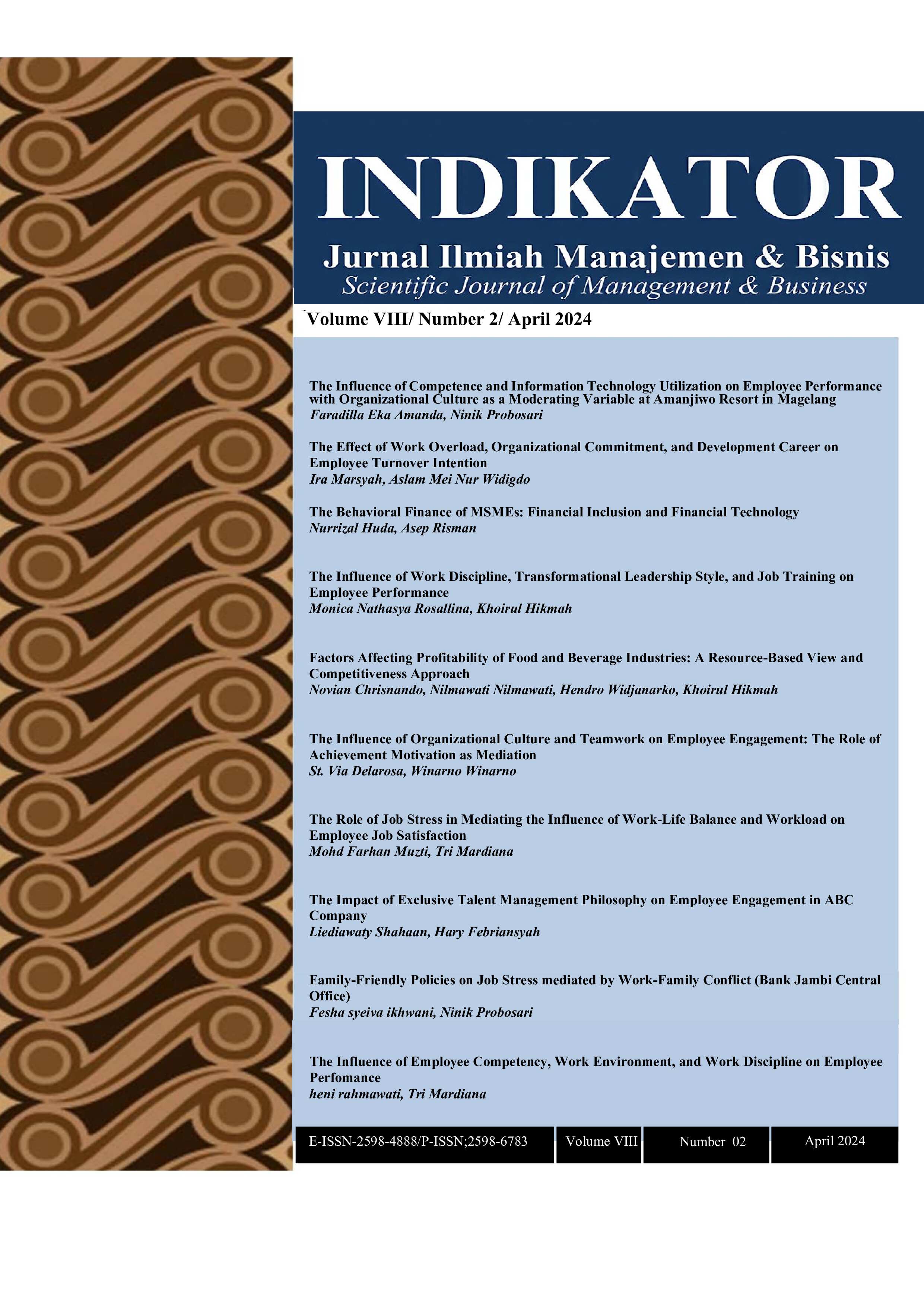
The Behavioral Finance of MSMEs: Financial Inclusion and Financial Technology
DOI:
https://doi.org/10.22441/indikator.v8i2.26780Keywords:
Financial Inclusion, Financial, Technology, Behavioral Finance, Behavioral Finance of MSMEs, MSMEs ActorsAbstract
This project is to gather empirical data on the topic to gain a better understanding of how financial technology, or Fintech, affects the financial behavior of micro, small, and medium-sized firms (MSMEs). 110 MSMEs spread over West Jakarta made up the sample in 2023. As part of the data gathering method, a random sample questionnaire with a 5-point Likert scale was created using the online tool Google Forms. The Structural Equation Modeling (SEM) model was applied to the data using Partial Least Squares (PLS) software. The results of the study show that financial inclusion and financial technology (Fintech) have a positive influence on MSMEs' financial behavior. Financial technology, or Fintech, may function as a mediator and positively influence MSMEs' financial behavior by promoting broader financial inclusion. This information will be useful to financial institutions, relevant governments, entrepreneurs, and business support organizations that aim to improve the financial behavior and practices of MSMEs. The significance of programs intended to promote good financial conduct, expand financial inclusion, and educate the public about the advantages of fintech in order to enable MSMEs to adopt more responsible financial practices.References
Ajzen I. (1985). From intentions to actions A theory of planned behavior. 11–39.
Anisyah, E. N., Pinem, D., & Hidayati, S. (2021). Pengaruh literasi keuangan, inklusi keuangan dan financial technology terhadap perilaku keuangan pelaku UMKM di Kecamatan Sekupang. Management and Business Review, 5(2), 310–324. https://doi.org/10.21067/mbr.v5i2.6083
BPS. (2022) Jumlah dan Persentase UMK Provinsi DKI Jakarta Menurut Kabupaten/Kota. Badan Pusat Statistik Provinsi DKI Jakarta. https://jakarta.bps.go.id/statictable/2022/09/12/612/jumlah-dan-persentase-umk-provinsi-dki-jakarta-menurut-kabupaten-kota-2016.html
Daqar, M. A. M. A. , A. S. and K. S. A. (2020). Fintech in the eyes of Millennials and Generation Z (the financial behavior and Fintech perception). Banks and Bank Systems, 15(3), 20–28. https://doi.org/10.21511/bbs.15(3).2020.03
Davis,F.D. 1989. ”Perceived Usefulness, Perceived Ease of Use, and User Acceptance of Information Technology”. MIS Quarterly.Vol. 13 No. 5: pp319-339.
Ghozali I. (2015). Partial Least Square Konsep, Teknik, dan Aplikasi Menggunakan Program SmartPLS 3.0. Badan Penerbit.
Gomber, P., Kauffman, R. J., Parker, C., & Weber, B. W. (2018). On the Fintech Revolution: Interpreting the Forces of Innovation, Disruption, and Transformation in Financial Services. Journal of Management Information Systems, 35(1), 220–265. https://doi.org/10.1080/07421222.2018.1440766
Herispon, H. (2019). The Effect of Financial Inclusion and Banking Behavior on Household Debt Behavior. JEBI (Jurnal Ekonomi Dan Bisnis Islam), 4(1), 51. https://doi.org/10.15548/jebi.v4i1.205
Hovland, C. I., Janis, I. L., & Kelley, H. H. (1953). Communication and persuasion. In Communication and persuasion. Yale University Press.
Humaira, I. (2017). Pengaruh Pengetahuan Keuangan, Sikap Keuangan Dan Kepribadian Terhadap Perilaku Manajemen Keuangan Pada Pelaku Umkm Sentra Kerajinan Batik. Skripsi Universitas Negeri Yogyakarta.
Junianto, Y., Kohardinata, C., & Silaswara, D. (2020). Financial Literacy Effect and Fintech in Investment Decision Making. Primanomics : Jurnal Ekonomi & Bisnis, 18(3), 150. https://doi.org/10.31253/pe.v18i3.472
Kementerian Koperasi dan UKM. (n.d.). DATA UMKM. Https://Kemenkopukm.Go.Id/Data-Umkm
Khusnah, H., Jannah, S. I., & Anugraini, M. (2023). Efek Mediasi Penggunaan Financial Technology Pada Pengaruh Literasi Keuangan Terhadap Inklusi Keuangan. Jurnal Akuntansi AKUNESA, 12(1), 35-43.
Kusumaningrum, S. M., Wiyono, G., & Maulida, A. (2023). Pengaruh literasi keuangan, inklusi keuangan, dan financial attitude terhadap pengelolaan keuangan UMKM di Kapanewon Godean, Kabupaten Sleman. Jurnal Samudra Ekonomi dan Bisnis, 14(2), 227-238. doi: 10.33059/ jseb.v14i2.6867.
Kusumar, F., Mendari, A. S., & Kunci, K. (2021). FINTECH PAYMENT : PENGARUHNYA PADA PERILAKU MANAJEMEN KEUANGAN MAHASISWA DI PALEMBANG. https://keuangan.kontan.co.id/
Otoritas Jasa Keuangan (2022, 24 November). Infografis Hasil Survei Nasional Literasi dan Inklusi Keuangan Tahun 2022. https://ojk.go.id/id/berita-dan-kegiatan/info-terkini/Pages/Infografis-Survei-Nasional-Literasi-dan-Inklusi-Keuangan-Tahun-2022.aspx
Ozili, P. K. (2018). Impact of digital finance on financial inclusion and stability. Borsa Istanbul Review, 18(4), 329–340. https://doi.org/10.1016/j.bir.2017.12.003
Pinem, D., & Mardiatmi, B. D. (2021). Analisis Literasi Keuangan, Inklusi Keuangan dan Pendapatan terhadap Perilaku Pelaku UMKM Di Depok Jawa Barat. Syntax Literate ; Jurnal Ilmiah Indonesia, 6(1), 104. https://doi.org/10.36418/syntax-literate.v6i1.1650
Puspitasari, R., & Astrini, D. (2021). Dampak Literasi Dan Inkuisi Keuangan Terhadap Kinerja Pelaku UMKM Di Kota Bogor. Jurnal Ilmiah Manajemen Kesatuan, 9(2), 181–190. https://doi.org/10.37641/jimkes.v9i2.771
Putri, D. A. (2020). FAKTOR-FAKTOR YANG MEMPENGARUHI PERILAKU MANAJEMEN KEUANGAN PELAKU UMKM. https://ojs.stiesa.ac.id/index.php/prisma
Rahadian, A., & Thamrin, H. (2023). Analysis of Factors Affecting MSME in Using Fintech Lending as Alternative Financing: Technology Acceptance Model Approach. Brazilian Business Review, 20(3), 301–322. https://doi.org/10.15728/bbr.2023.20.3.4.en
Rahayu, F. S., Risman, A., Firdaus, I., & Haningsih, L. (2023). The Behavioral Finance of MSME in Indonesia: Financial Literacy, Financial Technology (Fintech), and Financial Attitudes. International Journal of Digital Entrepreneurship and Business, 4(2), 95–107. https://doi.org/10.52238/ideb.v4i2.127
Rahmawati, V., W. W. W., & N. N. (2020). Analisis Inklusi Keuangan Pada Keputusan Struktur Modal UMKM (Studi Kasus Gerai UMKM Bogor).
Risman, A., Ali, A. J., Soelton, M., & Siswanti, I. (2023). The behavioral finance of MSMEs in the advancement of financial inclusion and financial technology (Fintech). The Indonesian Accounting Review, 13(1), 91. https://doi.org/10.14414/tiar.v13i1.3213
Risman, A., Prowanta, E. & Siswanti, I. (2021). Behavioral Corporate Finance. Yogyakarta: Penerbit KBM Indonesia.
Risman, A., Subhani, M., & Ushakov, D. (2021). Nexus between Financial Fundamentals and Automotive (Car) Industry. ARDL approach. E3S Web of Conferences, 244. https://doi.org/10.1051/e3sconf/202124408015.
Risman, A., Mulyana, B., Silvatika, B., & Sulaeman, (2021), A. The Effect of Digital Finance on Financial Stability. Management Science Letters, 11(7), 1979-1984. https://doi.org/10.5267/j.msl.2021.3.012.
Sampson, E. E. (1976). Social Psychology and Contemporary Society. John Wiley and Sons, Inc.
Singh, S., M. M. Sahni, and R. K. Kovid. 2020. What Drives FinTech Adoption? A Multi-Method Evaluation Using an Adapted Technology Acceptance Model. Management Decision, 58 (8), 1675–97. https://doi.org/10.1108/MD09-2019-1318.
Sugiyono. (2018). Metode Penelitian Kuantitatif. Alfabeta.
Suryanto, Rusdin, & Dai, R. M. (2020). Fintech as a catalyst for growth of micro, small, and medium enterprise in Indonesia. Academy of Strategic Management Journal, 19(5), 1–12.
Published
How to Cite
Issue
Section
License
The copyright to this article is transferred to Universitas Mercu Buana (UMB) if and when the article is accepted for publication. The undersigned hereby transfers any and all rights in and to the paper including without limitation all copyrights to UMB. The undersigned hereby represents and warrants that the paper is original and that he/she is the author of the paper, except for material that is clearly identified as to its original source, with permission notices from the copyright owners where required. The undersigned represents that he/she has the power and authority to make and execute this assignment.
We declare that:
1. This paper has not been published in the same form elsewhere.
2. It will not be submitted anywhere else for publication prior to acceptance/rejection by this Journal.
3. A copyright permission is obtained for materials published elsewhere and which require this permission for reproduction.
Furthermore, I/We hereby transfer the unlimited rights of publication of the above mentioned paper in whole to UMB. The copyright transfer covers the exclusive right to reproduce and distribute the article, including reprints, translations, photographic reproductions, microform, electronic form (offline, online) or any other reproductions of similar nature.
The corresponding author signs for and accepts responsibility for releasing this material on behalf of any and all co-authors. This agreement is to be signed by at least one of the authors who have obtained the assent of the co-author(s) where applicable. After submission of this agreement signed by the corresponding author, changes of authorship or in the order of the authors listed will not be accepted.
Retained Rights/Terms and Conditions
1. Authors retain all proprietary rights in any process, procedure, or article of manufacture described in the Work.
2. Authors may reproduce or authorize others to reproduce the Work or derivative works for the authors personal use or for company use, provided that the source and the UMB copyright notice are indicated, the copies are not used in any way that implies UMB endorsement of a product or service of any employer, and the copies themselves are not offered for sale.
3. Although authors are permitted to re-use all or portions of the Work in other works, this does not include granting third-party requests for reprinting, republishing, or other types of re-use.
This work is also licensed under a Creative Commons Attribution-NonCommercial 4.0 International License.









