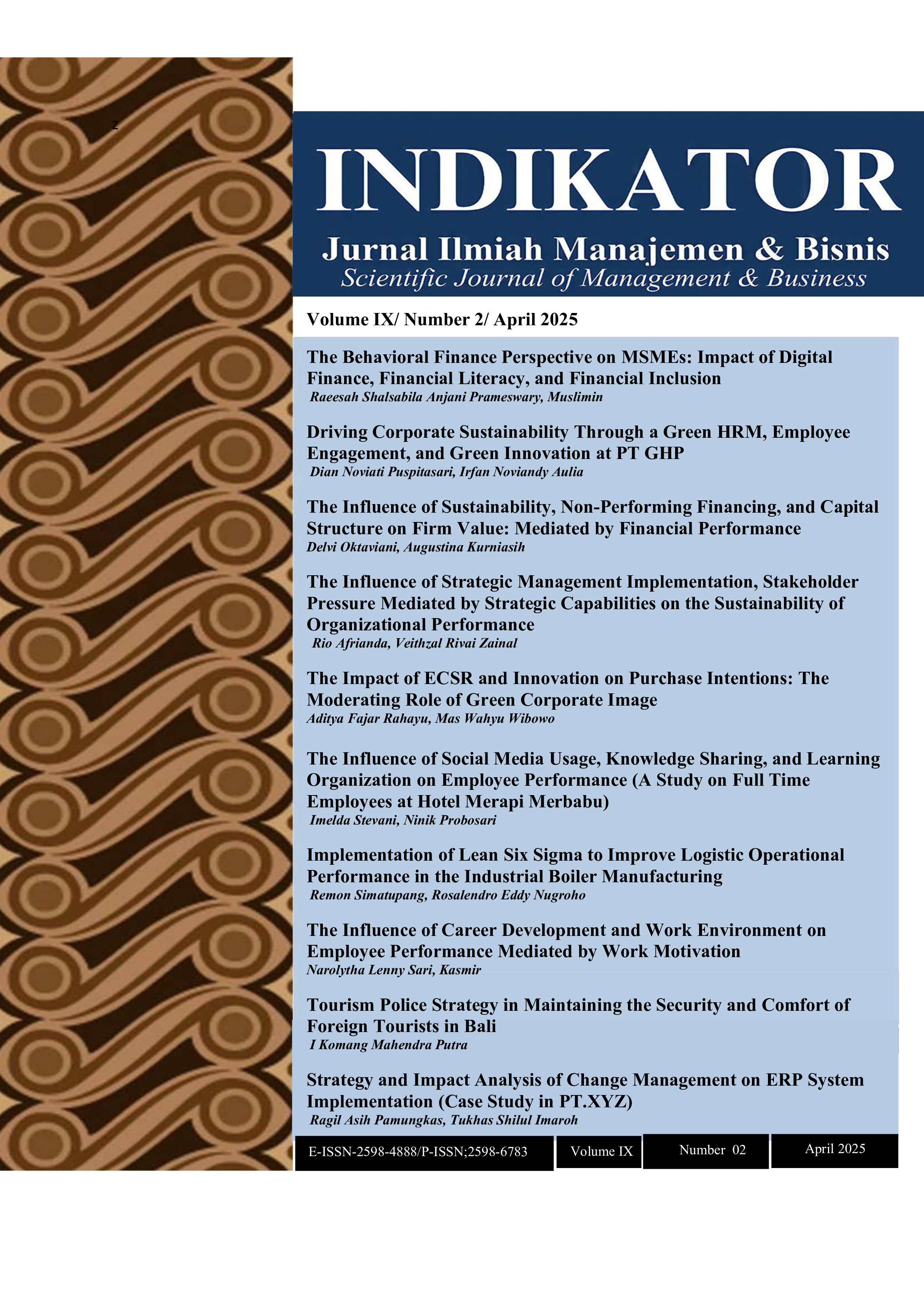
The Influence of Strategic Management Implementation, Stakeholder Pressure Mediated by Strategic Capabilities on the Sustainability of Organizational Performance
DOI:
https://doi.org/10.22441/indikator.v9i2.32900Kata Kunci:
Strategic Management. Stakeholder Pressure. Strategic Capabilities. Organizational Performance.Abstrak
The incorporation of corporate programs that focus on sustainability strategies contributes to the balance between economic growth and the use of natural resources. This issue is not only limited to companies in developed markets but is also relevant for power generation companies that need to find ways to implement sustainable practices while improving organizational performance.
In this context, the purpose of this study is to analyze whether strategic management can be considered as a strategic capability that contributes positively to the performance of power generation companies in Indonesia.
To achieve this goal, we conducted a quantitative study through a survey, with data collected from 162 companies. Based on univariate and multivariate analysis, the results of the study indicate that strategic management can be considered as a strategic capability for power generation companies in Indonesia, because strategic management has a significant relationship with organizational performance.Referensi
Afrianda, Rio, (2024). Economic Analysis And Factors Influencing Customer Satisfaction and Electricity Purchase Decisions in a Case Study at PT. PLN in Indonesia. International Journal Of Economic Literature 2 (6), 1664-1676
Afrianda, Rio, (2024). The Impact of Disruptive Technology on the Performance Of Electricity Companies in Indonesia, Strategic Management Perspective. International Journal Of Economic Literature 2 (6), 1693-1711
Barney, J. (1991). Firm Resources and Sustained Competitive Advantage. Journal of Management, 17(1), 99-120.
Barney, J. Firm resources and competitive advantage. Journal of Management, v. 17, n. 1, p. 99–120, 1991.
Bass, B. M., & Avolio, B. J. (1994). Improving Organizational Effectiveness Through Transformational Leadership. SAGE Publications.
Bell, J. E., Mollenkopf, D. A., & Stolze, H. J. (2013). Natural Resource Scarcity and the Closed-Loop Supply Chain: A Resource-Advantage View. Journal of Business Logistics, 34(2), 157-172.
Bell, J. E.; Mollenkopf, D. A.; Stolze, H. J. Natural resource scarcity and the closed-loop supply chain: a resource-advantage view. International Journal of Physical Distribution & Logistics Management, v. 43, n. 5, p. 351–379, 2013
David, F. R. (2011). Strategic Management: Concepts and Cases. Pearson Education.
De Marchi, V.; Di Maria, E.; Micelli, S. Environmental strategies, upgrading and competitive advantage in global value chains. Business Strategy and the Environment, v. 22, n. 1, p. 62–72, 2013.
Dierickx, I., & Cool, K. (1989). Asset Stock Accumulation and Sustainability of Competitive Advantage. Management Science, 35(12), 1504-1511.
Dierickx, I.; Cool, K. Asset stock accumulation and sustanaibility of competitive advantage. Management Science, v. 35, n. 12, p. 1504–1511, 1989.
EFQM. (2013). The EFQM Excellence Model. European Foundation for Quality Management.
Grant, R. M. (1991). The Resource-Based Theory of Competitive Advantage: Implications for Strategy Formulation. California Management Review, 33(3), 114-135.
Grant, R. M. (1996). Prospering in Dynamically-Competitive Environments: Organizational Capability as Knowledge Integration. Organization Science, 7(4), 375-387.
Grant, R. M. (2010). Contemporary Strategy Analysis: Text and Cases Edition. John Wiley & Sons.
Grant, R. M. The resource-based theory of competitive advantage: implications for strategy formulation. California Management Review, v. 33, n. 3, p. 114–135, 1991.
Gürel, E., & Tat, M. (2017). SWOT Analysis: A Theoretical Review. Journal of International Social Research, 10(51), 994-1006.
Johnson, G., Scholes, K., & Whittington, R. (2020). Exploring Corporate Strategy: Text and Cases. Pearson.
Kaplan, R. S., & Norton, D. P. (1996). The Balanced Scorecard: Translating Strategy into Action. Harvard Business Press.
Menguc, B., & Ozanne, L. K. (2005). Challenges of the "Green Imperative": A Natural Resource-Based Approach to the Environmental Orientation-Business Performance Relationship. Journal of Business Research, 58(4), 430-438.
Menguc, B.; Ozanne, L. K. Challenges of the “green imperative”: a natural resourcebased approach to the environmental orientation-business performance relationship. Journal of Business Research, v. 58, n. 4, p. 430–438, 2005.
Neely, A., Gregory, M., & Platts, K. (2002). Performance Measurement System Design: A Literature Review and Research Agenda. International Journal of Operations & Production Management, 25(12), 1228-1263.
Parmenter, D. (2015). Key Performance Indicators: Developing, Implementing, and Using Winning KPIs. John Wiley & Sons.
Paulraj, A. (2011). Understanding the Relationships between Internal Resources and Capabilities, Sustainable Supply Management and Organizational Sustainability. Journal of Supply Chain Management, 47(1), 19-37.
Paulraj, A. Understanding the relationships between internal resources and capabilities, sustainable supply management and organizational sustainability. Journal of Supply Chain Management, v. 47, n. 1, p. 19–37, 2011.
Porter, M. E. (1980). Competitive Strategy: Techniques for Analyzing Industries and Competitors. Free Press.
Porter, M. E. (1985). Competitive Advantage: Creating and Sustaining Superior Performance. Free Press.
Porter, M. E., & Kramer, M. R. (2011). Creating Shared Value. Harvard Business Review, 89(1/2), 62-77.
Porter, M. E., & Van Der Linde, C. (1995). Toward a new conception of the environment-competitiveness relationship. Inform, 9(4), 97–118.
Richard, P. J., Devinney, T. M., Yip, G. S., & Johnson, G. (2009). Measuring Organizational Performance: Towards Methodological Best Practice. Journal of Management, 35(3), 718-804.
Rueda-Manzanares, A., Aragón-Correa, J. A., & Sharma, S. (2008). The influence of stakeholders on the environmental strategy of service firms: The moderating effects of complexity, uncertainty and munificence. British Journal of Management, 19(2), 185–203.
Russo, M. V., & Fouts, P. A. (1997). A resource-based perspective on corporate environmental performance and profitability. Academy of Management Journal, 40, 534–559.
Sarkis, J., Gonzalez-Torre, P., & Adenso-Diaz, B. (2010). Stakeholder pressure and the adoption of environmental practices: The mediating effect of training. Journal of Operations Management, 28(2), 163–176.
Schein, E. H. (2010). Organizational Culture and Leadership. John Wiley & Sons.
Sehnem, S., & Rossetto, A. M. (2014). Estratégia ambiental e desempenho econômico e ambiental: Um modelo de análise para o setor de frigoríficos. Gestão e Produção, 21(4), 745–759.
Sharma, S., & Vredenburg, H. (1998). Proactive Corporate Environmental Strategy and the Development of Competitively Valuable Organizational Capabilities. Strategic Management Journal, 19(8), 729-753.
Sharma, S., & Vredenburg, H. (1998). Proactive corporate environmental strategy and the development of competitively valuable organizational capabilities. Strategic Management Journal, 19(8), 729.
Sharma, S.; Vredenburg, H. Proactive corporate environmental strategy and the development of competitively valuable organizational capabilities. Strategic Management Journal, v. 19, n. 8, p. 729, 1998.
Smith, T. (2003, November 2). Does Brazil have Italy on the ropes? The New York Times. Retrieved from http://www.nytimes.com/2003/11/02/business/the-business-world-does-brazil-have-italy-on-the-ropes.html?pagewanted=print.
Teece, D. J. (2007). Explicating Dynamic Capabilities: The Nature and Microfoundations of (Sustainable) Enterprise Performance. Strategic Management Journal, 28(13), 1319-1350.
Teece, D. J., Pisano, G., & Shuen, A. (1997). Dynamic Capabilities and Strategic Management. Strategic Management Journal, 18(7), 509-533.
Thomas, L. (2015, June 6). Furniture drives southern city’s economy. Retrieved from http://www.furnituretoday.com/article/488993-furniture-drives-southern-citys-economy.
Tondolo, V. A. G., & Bitencourt, C. C. (2014). Understanding dynamic capabilities from its antecedents, processes and outcomes. BBR - Brazilian Business Review, 5(11), 122–144.
Venkatraman, N., & Ramanujam, V. (1986). Measurement of Business Performance in Strategy Research: A Comparison of Approaches. Academy of Management Review, 11(4), 801-814.
Wernerfelt, B. (1984). A resource-based view of the firm. Journal of Strategic Management, 5, 171–180.
Wheelen, T. L., & Hunger, J. D. (2012). Strategic Management and Business Policy: Toward Global Sustainability. Pearson.
Zailani, S. H. M., Iranmanesh, M., Nikbin, D., & Jumadi, H. B. (2012). The impact of external institutional drivers and internal strategy on environmental performance. International Journal of Operations & Production Management, 32(6), 721–745.
Zhu, Q., & Sarkis, J. (2004). Relationships between operational practices and performance among early adopters of green supply chain management practices in Chinese manufacturing enterprises. Journal of Operations Management, 22(3), 265–289.
Zollo, M., & Winter, S. G. (2002). Deliberate Learning and the Evolution of Dynamic Capabilities. Organization Science, 13(3), 339-351.
Unduhan
File Tambahan
Diterbitkan
Cara Mengutip
Terbitan
Bagian
Lisensi
The copyright to this article is transferred to Universitas Mercu Buana (UMB) if and when the article is accepted for publication. The undersigned hereby transfers any and all rights in and to the paper including without limitation all copyrights to UMB. The undersigned hereby represents and warrants that the paper is original and that he/she is the author of the paper, except for material that is clearly identified as to its original source, with permission notices from the copyright owners where required. The undersigned represents that he/she has the power and authority to make and execute this assignment.
We declare that:
1. This paper has not been published in the same form elsewhere.
2. It will not be submitted anywhere else for publication prior to acceptance/rejection by this Journal.
3. A copyright permission is obtained for materials published elsewhere and which require this permission for reproduction.
Furthermore, I/We hereby transfer the unlimited rights of publication of the above mentioned paper in whole to UMB. The copyright transfer covers the exclusive right to reproduce and distribute the article, including reprints, translations, photographic reproductions, microform, electronic form (offline, online) or any other reproductions of similar nature.
The corresponding author signs for and accepts responsibility for releasing this material on behalf of any and all co-authors. This agreement is to be signed by at least one of the authors who have obtained the assent of the co-author(s) where applicable. After submission of this agreement signed by the corresponding author, changes of authorship or in the order of the authors listed will not be accepted.
Retained Rights/Terms and Conditions
1. Authors retain all proprietary rights in any process, procedure, or article of manufacture described in the Work.
2. Authors may reproduce or authorize others to reproduce the Work or derivative works for the authors personal use or for company use, provided that the source and the UMB copyright notice are indicated, the copies are not used in any way that implies UMB endorsement of a product or service of any employer, and the copies themselves are not offered for sale.
3. Although authors are permitted to re-use all or portions of the Work in other works, this does not include granting third-party requests for reprinting, republishing, or other types of re-use.
This work is also licensed under a Creative Commons Attribution-NonCommercial 4.0 International License.









