Demineralization of Silica-Rich Agar Processing Residues via Hydrofluoric Acid Leaching for Organic Fraction Enrichment
DOI:
https://doi.org/10.22441/ijimeam.v8i2.38546Keywords:
agar solid waste, hydrofluoric acid leaching, demineralization, silica removal, higher heating valueAbstract
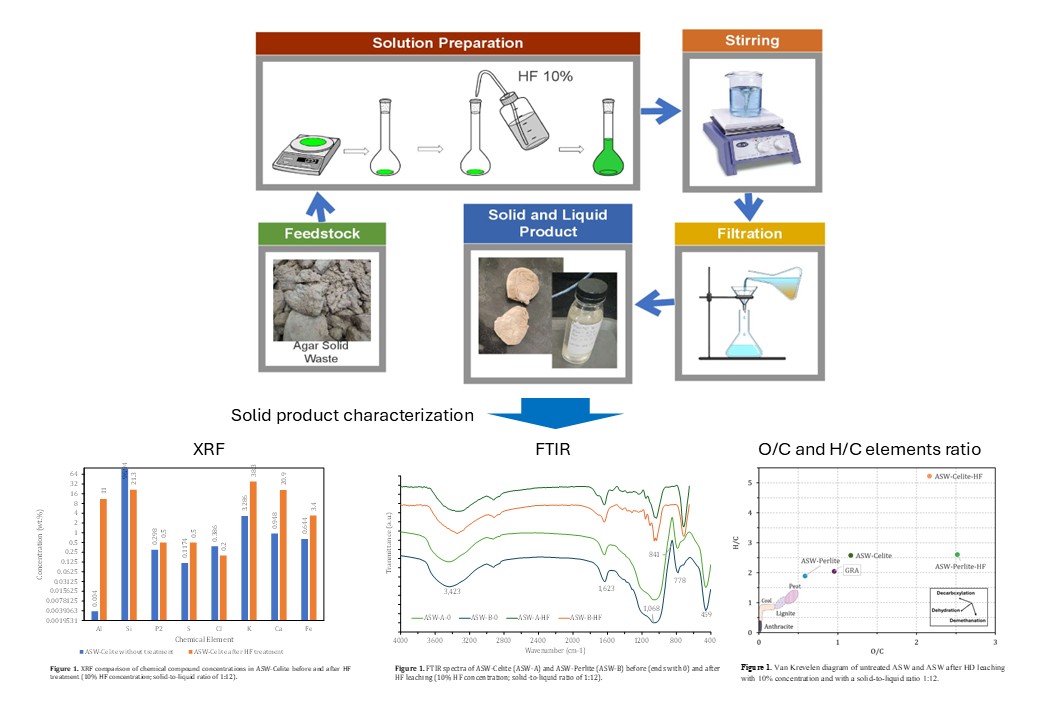
Agar solid waste (ASW) is a silica-rich industrial residue generated during agar extraction that contains organic residue mixed with mineral filtration aids such as Celite (diatomaceous earth) and perlite. Its high ash content and low organic fraction limit its direct utilization as a biomass-derived fuel. This study investigated hydrofluoric acid (HF) leaching as a demineralization pretreatment to reduce silica-rich minerals and improve the physicochemical quality of ASW. Two ASW samples obtained from different agar-processing plants, namely ASW-Celite (contain Celite) and ASW-Perlite (contain perlite), were treated using 10 wt% HF at a solid-to-liquid ratio of approximately 1:12. The treated samples were characterized using XRF, ICP-MS, FTIR, ultimate analysis, and proximate analysis. HF leaching caused substantial mass reduction, with solid yields of 24.99% for ASW-Celite-HF and 48.9% for ASW-Perlite-HF. Ash content decreased from 85.84 to 44.99 wt% in ASW-Celite and from 77.10 to 24.83 wt% in ASW-Perlite. XRF analysis confirmed significant silica removal, particularly in ASW-Celite, where SiO₂ decreased from 96.94 to 21.30%. ICP-MS further showed the reduction of several ash-forming and environmentally relevant elements, including Cr, Ni, Cu, Zn, Cd, P, S, Cl, Mn, and Fe. HF treatment also enriched the organic fraction, increasing carbon content from 4.69 to 12.52 wt% in ASW-Celite and from 9.83 to 16.10 wt% in ASW-Perlite. The HHV of ASW-Celite improved from 1.91 to 6.52 MJ/kg, whereas ASW-Perlite decreased from 4.80 to 3.19 MJ/kg due to its high oxygen content after treatment. These findings demonstrate that HF leaching effectively reduces silica-rich minerals in ASW, although further deoxygenation is required to improve its fuel quality for bioenergy applications.
Downloads
References
[1] M. Muryanto et al., “Characterization of solid waste biomass of agar processing plants and scale-up production of bioethanol,” Biomass Convers. Biorefin., vol. 14, no. 18, pp. 22357–22366, 2024, doi: 10.1007/s13399-023-04464-7.
[2] F. S. Tadeo et al., “Biochemical profiling of Gracilaria edulis agar waste for aquaculture applications,” Egypt. J. Aquat. Biol. Fish., vol. 29, no. 4, pp. 3139–3156, Jul. 2025, doi: 10.21608/EJABF.2025.449750.
[3] J. Basmal, I. Munifah, M. Rimmer, and N. Paul, “Identification and characterization of solid waste from Gracilaria sp. extraction,” IOP Conf. Ser. Earth Environ. Sci., vol. 404, no. 1, Art. no. 012057, Jan. 2020, doi: 10.1088/1755-1315/404/1/012057.
[4] I. Munifah, J. Basmal, R. Kusumawati, and H. E. Irianto, “Cellulase derived from Chryseobacterium indologenes LA4K isolated from Indonesian agar-agar industry solid waste,” IOP Conf. Ser. Earth Environ. Sci., vol. 462, no. 1, Art. no. 012007, Mar. 2020, doi: 10.1088/1755-1315/462/1/012007.
[5] A. O. L. Siang, A. M. Leman, D. Feriyanto, S. S. Abdulmalik, and S. Zakaria, “Sustainable biodiesel production from waste cooking oil and crude palm oil using a custom mini pilot plant,” Int. J. Innov. Mech. Eng. Adv. Mater., vol. 6, no. 1, pp. 7–21, Aug. 2024, doi: 10.22441/ijimeam.v6i1.23734.
[6] E. Agustian, A. Praptijanto, D. Sebayang, A. Z. M. Rus, and S. Hasan, “Biodiesel production from waste cooking oil by using ultrasonic tubular reactor,” Int. J. Innov. Mech. Eng. Adv. Mater., vol. 2, no. 1, pp. 31–38, 2016, doi: 10.22441/ijimeam.v2i1.18955.
[7] M. A. M. Sidik, A. M. Leman, D. Feriyanto, S. S. Abdulmalik, and S. Zakaria, “Green technology for sustainable agriculture: Bio-fertilizer production from municipal waste to preserve the environment,” Int. J. Innov. Mech. Eng. Adv. Mater., vol. 5, no. 3, pp. 118–124, Jan. 2024, doi: 10.22441/ijimeam.v5i3.23743.
[8] G. Wangge, Y. V. Servianus, and T. Rande, “Utilization of plastic waste and rice husk ash in polyethylene-based composites for ceiling applications,” Int. J. Innov. Mech. Eng. Adv. Mater., vol. 7, no. 3, pp. 162–172, Jan. 2026, doi: 10.22441/ijimeam.v7i3.36658.
[9] D. A. Roberts, N. A. Paul, S. A. Dworjanyn, Y. Hu, M. I. Bird, and R. de Nys, “Gracilaria waste biomass (sampah rumput laut) as a bioresource for selenium biosorption,” J. Appl. Phycol., vol. 27, pp. 611–620, 2015, doi: 10.1007/s10811-014-0346-y.
[10] I. Munifah and H. E. Irianto, “Characteristics of solid waste agar industries,” Squalen Bull. Mar. Fish. Postharvest Biotechnol., vol. 13, no. 3, pp. 125–132, Dec. 2018, doi: 10.15578/squalen.v13i3.292.
[11] K. Srivastava, N. Shringi, V. Devra, and A. Rani, “Pure silica extraction from perlite: Its characterization and affecting factors,” Int. J. Innov. Res. Sci. Eng. Technol., vol. 2, no. 7, pp. 2936–2942, 2013.
[12] A. Pourjavadi, R. Soleyman, H. Ghasemzadeh, and H. Salimi, “CMC/Celite superabsorbent composites: Effect of reaction variables on saline-absorbency under load,” Iran. Polym. J., vol. 19, no. 8, pp. 571–579, 2010.
[13] M. T. Phong, T. D. Hai, and P. D. Tuan, “Effects of fluxing agents on filter aids prepared from Lam-Dong diatomate,” ASEAN J. Chem. Eng., vol. 12, no. 2, pp. 27–34, 2012, doi: 10.22146/ajche.49740.
[14] V. S. Ekanthalu, S. Narra, T. Ender, E. Antwi, and M. Nelles, “Influence of post- and pre-acid treatment during hydrothermal carbonization of sewage sludge on P-transformation and the characteristics of hydrochar,” Processes, vol. 10, no. 1, Art. no. 151, Jan. 2022, doi: 10.3390/pr10010151.
[15] P. F. Pratt, “Digestion with hydrofluoric and perchloric acids for total potassium and sodium,” in Methods of Soil Analysis, Part 2: Chemical and Microbiological Properties, C. A. Black, Ed. Madison, WI, USA: American Society of Agronomy, 1965, pp. 1019–1021, doi: 10.2134/agronmonogr9.2.c19.
[16] R. G. Ayvazyan and K. Jacoby, “Kinetics and spectroscopic characterization of silica nanoparticles formed while etching quartz in hydrofluoric acid,” Mater. Chem. Phys., vol. 305, Art. no. 127881, Sep. 2023, doi: 10.1016/j.matchemphys.2023.127881.
[17] A. S. Buravtsov, D. E. Vernigora, O. V. Olender, A. V. Gladkov, M. V. Tryapyshko, and B. V. Grigorev, “Organic mud acid implementation in Western Siberian reservoir condition as an alternative to regular mud acid,” Neftyanoe Khozyaystvo—Oil Ind., vol. 2023, no. 9, pp. 123–127, 2023, doi: 10.24887/0028-2448-2023-9-123-127.
[18] T. R. Mandula and R. Srinivasan, “Electrochemical impedance spectroscopic studies on niobium anodic dissolution in HF,” J. Solid State Electrochem., vol. 21, no. 11, pp. 3155–3167, 2017, doi: 10.1007/s10008-017-3634-z.
[19] P. Crook, N. S. Meck, and R. B. Rebak, “The influence of composition upon surface degradation and stress corrosion cracking of the Ni-Cr-Mo alloys in wet hydrofluoric acid,” NACE Int. Corros. Conf. Ser., Paper C2007-07481, pp. 1–13, 2007, doi: 10.5006/C2007-07481/53715.
[20] I. Vlastelic and J. Piro, “Volatilisation of trace elements during evaporation to dryness of HF-dissolved silicates (BHVO-2, AGV-1, BIR-1, UB-N): Open- versus closed-system conditions,” Geostand. Geoanal. Res., vol. 46, no. 3, pp. 519–534, Sep. 2022, doi: 10.1111/ggr.12428.
[21] D. V. Yusupov et al., “Fluorite formation in poplar leaves (Populus balsamifera L.) in an HF-polluted area,” Water Air Soil Pollut., vol. 232, no. 9, Art. no. 369, 2021, doi: 10.1007/s11270-021-05279-w.
[22] A. L. Bezerra de Oliveira et al., “Hydrofluoric acid-free digestion of geological samples for the quantification of rare earth elements by inductively coupled plasma-optical emission spectrometry,” Geostand. Geoanal. Res., vol. 43, no. 4, pp. 689–699, Dec. 2019, doi: 10.1111/ggr.12286.
[23] Q. Guan et al., “Acidic constant of hydrofluoric acid in high-pressure and high-temperature geofluids,” ACS Earth Space Chem., vol. 10, no. 2, pp. 319–327, Feb. 2026, doi: 10.1021/acsearthspacechem.5c00224.
[24] Y. Yang, C. Lan, Y. Wang, Z. Zhao, and B. Li, “Recycling of ultrafine NdFeB waste by the selective precipitation of rare earth and the electrodeposition of iron in hydrofluoric acid,” Sep. Purif. Technol., vol. 230, Art. no. 115870, Jan. 2020, doi: 10.1016/j.seppur.2019.115870.
[25] K. G. W. Inn, “Geochemistry of resistates: The last word?,” J. Radioanal. Nucl. Chem., vol. 318, no. 1, pp. 767–776, 2018, doi: 10.1007/s10967-018-6123-7.
[26] R. W. Schutz, S. Hernandez, and H. W. Walker, “Effective inorganic salt corrosion inhibitors for titanium components exposed to dilute hydrofluoric acid well stimulation fluids,” NACE Int. Corros. Conf. Ser., vol. 2, pp. 1054–1066, 2017.
[27] H. Hörhammer, C. Dou, R. Gustafson, A. Suko, and R. Bura, “Removal of non-structural components from poplar whole-tree chips to enhance hydrolysis and fermentation performance,” Biotechnol. Biofuels, vol. 11, no. 1, Art. no. 222, 2018, doi: 10.1186/s13068-018-1219-4.
[28] A. Saddawi, J. M. Jones, A. Williams, and C. Le Coeur, “Commodity fuels from biomass through pretreatment and torrefaction: Effects of mineral content on torrefied fuel characteristics and quality,” Energy Fuels, vol. 26, no. 11, pp. 6466–6474, Nov. 2012, doi: 10.1021/ef2016649.
[29] A. Sudarma et al., “Influence of inorganic content on hydrochar quality from high-ash agar extraction waste via hydrothermal carbonization,” SINERGI, 2026, doi: 10.22441/sinergi.2026.3.005.
[30] I. Hamidu, B. Afotey, B. Kwakye-Awuah, and D. A. Anang, “Synthesis of silica and silicon from rice husk feedstock: A review,” Heliyon, vol. 11, no. 4, Art. no. e42491, Feb. 2025, doi: 10.1016/j.heliyon.2025.e42491.
[31] R. B. Carpio, Y. Zhang, C.-T. Kuo, W.-T. Chen, L. C. Schideman, and R. L. de Leon, “Characterization and thermal decomposition of demineralized wastewater algae biomass,” Algal Res., vol. 38, Art. no. 101399, Mar. 2019, doi: 10.1016/j.algal.2018.101399.
[32] R. Febrianto, Sudarno, and R. Kusdarwati, “The effect of demineralization stage of agar’s solid waste on the characterization of activated carbon,” IOP Conf. Ser. Earth Environ. Sci., vol. 236, no. 1, Art. no. 012033, Mar. 2019, doi: 10.1088/1755-1315/236/1/012033.
[33] G. Rosales, M. Ruiz, and M. Rodriguez, “Study of the extraction kinetics of lithium by leaching β-spodumene with hydrofluoric acid,” Minerals, vol. 6, no. 4, Art. no. 98, Sep. 2016, doi: 10.3390/min6040098.
[34] W. E. Kline and H. S. Fogler, “Dissolution of silicate minerals by hydrofluoric acid,” Ind. Eng. Chem. Fundam., vol. 20, no. 2, pp. 155–161, May 1981, doi: 10.1021/i100002a008.
[35] W. Wu et al., “Experimental research on deep silicon removal in spent SCR catalysts,” Processes, vol. 12, no. 2, Art. no. 290, Feb. 2024, doi: 10.3390/pr12020290.
[36] W. Zha, B. Lin, W. Yang, T. Liu, T. Liu, and W. Wang, “Mineral dissolution and wettability evolution in coal acidization: Molecular mechanisms of hydrophobic transformation,” Energy Fuels, vol. 39, no. 23, pp. 11031–11040, Jun. 2025, doi: 10.1021/acs.energyfuels.5c01931.
[37] Y. Zhao et al., “Water–HCl sequential leaching of waste barrier material from aluminum electrolysis cell,” Materials, vol. 18, no. 8, Art. no. 1748, Apr. 2025, doi: 10.3390/ma18081748.
[38] A. Demirbas and M. F. Demirbas, “Biodiesel from algae,” in Algae Energy, Green Energy and Technology. London, U.K.: Springer, 2010, pp. 139–157, doi: 10.1007/978-1-84996-050-2_6.
[39] Ö. Bilgin, H. Hacıfazlıoğlu, and D. Sert, “Leaching of coal by trioxoboric acid for coal cleaning,” Physicochem. Probl. Miner. Process., vol. 57, no. 5, pp. 129–136, 2021, doi: 10.37190/ppmp/141489.
[40] L. Puri, Y. Hu, and G. Naterer, “Critical review of the role of ash content and composition in biomass pyrolysis,” Front. Fuels, vol. 2, Art. no. 1378361, Mar. 2024, doi: 10.3389/ffuel.2024.1378361.
[41] P. Giudicianni et al., “Inherent metal elements in biomass pyrolysis: A review,” Energy Fuels, vol. 35, no. 7, pp. 5407–5478, Apr. 2021, doi: 10.1021/acs.energyfuels.0c04046.
[42] F. Endriss et al., “Evaluation and optimization of an X-ray fluorescence analyzer for rapid analysis of chemical elements in solid biofuels,” Energy Fuels, vol. 38, no. 17, pp. 16426–16440, Sep. 2024, doi: 10.1021/acs.energyfuels.4c01771.
[43] Q. Liu, S. C. Chmely, and N. Abdoulmoumine, “Biomass treatment strategies for thermochemical conversion,” Energy Fuels, vol. 31, no. 4, pp. 3525–3536, Apr. 2017, doi: 10.1021/acs.energyfuels.7b00258.
[44] O. Farobie et al., “Valorization of Ulva lactuca via hydrothermal carbonization: Effects of temperature, time, and concentration on hydrochar,” J. Pengolah. Has. Perikan. Indones., vol. 29, no. 2, pp. 161–177, 2026, doi: 10.17844/f3kztf96.
[45] A. Nadri et al., “The invasive seaweed Agarophyton vermiculophyllum from Oualidia Lagoon (northwestern Moroccan Atlantic coast) as a source of agar: Yield, chemical characteristics, and rheological properties,” J. Mar. Sci. Eng., vol. 11, no. 9, Art. no. 1696, Aug. 2023, doi: 10.3390/jmse11091696.
[46] Z. Zujovic, W. V. K. Wheelwright, P. A. Kilmartin, J. V. Hanna, and R. P. Cooney, “Structural investigations of perlite and expanded perlite using ¹H, ²⁷Al, and ²⁹Si solid-state NMR,” Ceram. Int., vol. 44, no. 3, pp. 2952–2958, Feb. 2018, doi: 10.1016/j.ceramint.2017.11.047.
[47] S. B. Liaw and H. Wu, “Leaching characteristics of organic and inorganic matter from biomass by water: Differences between batch and semi-continuous operations,” Ind. Eng. Chem. Res., vol. 52, no. 11, pp. 4280–4289, Mar. 2013, doi: 10.1021/ie3031168.
[48] J. Petrović, M. Simić, M. Mihajlović, M. Koprivica, M. Kojić, and I. Nuić, “Upgrading fuel potentials of waste biomass via hydrothermal carbonization: Original scientific paper,” Hem. Ind., vol. 75, no. 5, pp. 297–305, Oct. 2021, doi: 10.2298/HEMIND210507025P.
Downloads
Published
How to Cite
Issue
Section
License
Copyright (c) 2026 Andi F. Sudarma, Edy Hartulistiyoso, Y. Aris Purwanto, Leopold Oscar Nelwan, Obie Farobie, Hendri, Harri Junaedi, Edy Herianto Majlan

This work is licensed under a Creative Commons Attribution-ShareAlike 4.0 International License.