Microwave-Assisted Extraction of Chicken Skin Gelatin: A Process–Structure–Property Study
DOI:
https://doi.org/10.22441/ijimeam.v8i2.38810Keywords:
Microwave-assisted extraction, Gelatin, Chicken skin, Structural properties, BiopolymerAbstract
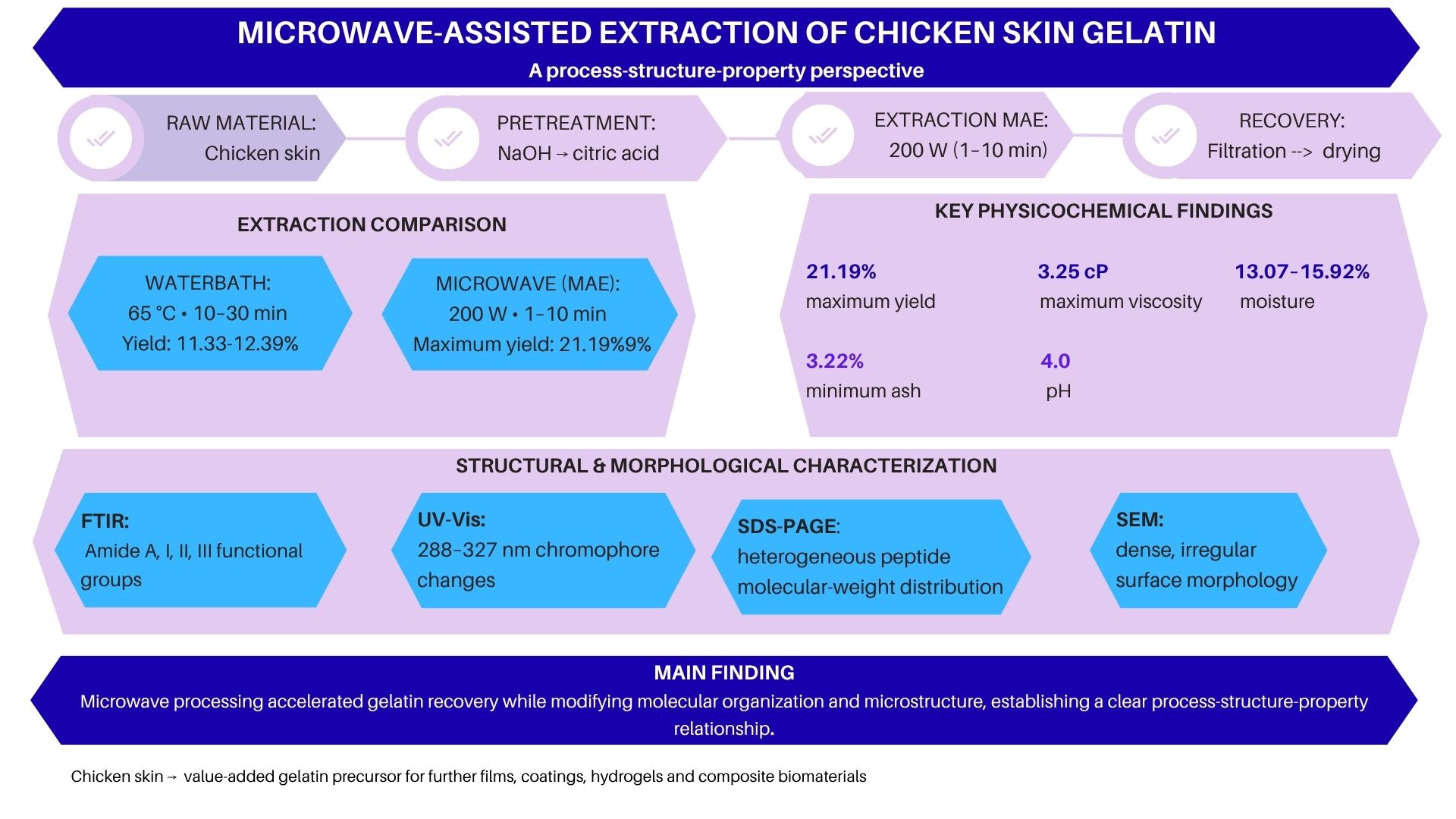
Gelatin, a collagen-derived biopolymer, has attracted increasing interest as a sustainable material for advanced engineering applications owing to its biodegradability, biocompatibility, and tunable physicochemical properties. However, understanding of how microwave-assisted extraction (MAE) influences the structural evolution and material characteristics of chicken skin-derived gelatin remains limited. This study investigates the effect of MAE on the physicochemical, structural, and morphological properties of chicken skin gelatin in comparison with conventional waterbath extraction. Gelatin samples were produced under different extraction conditions and characterized in terms of yield, moisture content, ash content, pH, viscosity, Fourier Transform Infrared Spectroscopy (FTIR), UV–Visible spectroscopy, Sodium Dodecyl Sulfate–Polyacrylamide Gel Electrophoresis (SDS-PAGE), and Scanning Electron Microscopy (SEM). The highest gelatin yield obtained by MAE reached 21.19% at 200 W for 10 min, compared with 12.39% obtained by conventional waterbath extraction under the optimum condition. Microwave treatment also produced observable differences in molecular structure and surface morphology compared with conventional extraction. FTIR and UV–Vis analyses indicated changes in molecular organization, while SDS-PAGE suggested broader peptide distribution following microwave treatment. SEM observations revealed a denser and more compact microstructure in the microwave-extracted gelatin. These findings suggest that microwave-assisted extraction may provide an energy-efficient approach for producing chicken skin-derived gelatin while influencing its structural and physicochemical characteristics. The study contributes to understanding the process–structure–property relationship of gelatin biopolymers and provides useful information for future development of sustainable biomaterials and advanced material processing technologies.
Downloads
References
[1] S. Bhatia et al., “Gallic acid crosslinked gelatin and casein based composite films for food packaging applications,” Polymers, vol. 14, no. 19, Art. no. 4065, Sep. 2022, doi: 10.3390/polym14194065.
[2] R. Sangkatip, K. Jongwuttanaruk, and W. Sriseubsai, “Gelatin/Na₂Ti₃O₇ nanocomposite scaffolds: Mechanical properties and characteriza-tion for tissue engineering applications,” Polymers, vol. 15, no. 10, Art. no. 2322, 2023, doi: 10.3390/polym15102322.
[3] S. Mohammadnezhad and J. Farmani, “Rheological and functional characterization of gelatin and fat extracted from chicken skin for applica-tion in food technology,” Food Sci. Nutr., vol. 10, no. 6, pp. 1908–1920, 2022, doi: 10.1002/fsn3.2807.
[4] A. Prokopová, P. Mokrejš, R. Gál, J. Pavlačková, and A. Hurajová, “Characterization of poultry gelatins prepared by a biotechnological method for targeted changes at the molecular level,” Int. J. Mol. Sci., vol. 25, no. 2, Art. no. 916, Jan. 2024, doi: 10.3390/ijms25020916.
[5] P. Bhargavi et al., “Sustainable gelatin extraction from poultry skin-head-feet blend: An ultrasound-assisted approach,” Poult. Sci., vol. 104, no. 4, Art. no. 104975, 2025, doi: 10.1016/j.psj.2025.104975.
[6] H. Esmaeili-Kaliji, R. Farahmandfar, A. Motamedzadegan, and M. Asnaashari, “Comparison of the physicochemical, rheological and function-al properties of chicken feet gelatin extracted by acidic and microwave methods and commercial bovine gelatin,” Food Sci. Nutr., vol. 13, no. 7, Art. no. e70651, 2025, doi: 10.1002/fsn3.70651.
[7] Ç. Işık et al., “Gelatin extraction from chicken skin by conventional and ohmic heating methods and comparison with commercial halal gela-tins,” Food Hydrocoll., vol. 150, Art. no. 109694, May 2024, doi: 10.1016/j.foodhyd.2023.109694.
[8] J. A. Rather et al., “Extraction of gelatin from poultry byproduct: Influence of drying method on structural, thermal, functional, and rheological characteristics of the dried gelatin powder,” Front. Nutr., vol. 9, Art. no. 895197, 2022, doi: 10.3389/fnut.2022.895197.
[9] M. Usman, A. Sahar, R. M. Aadil, and M. Shahid, “Extraction and physicochemical characterization of native and broiler chicken feet gelatin,” J. Sci. Food Agric., vol. 104, no. 14, pp. 8939–8944, 2024, doi: 10.1002/jsfa.13720.
[10] O. Aidat, L. Belkacemi, M. Belalia, and M. K. Zainol, “Optimisation of gelatine extraction from chicken feet-heads blend using Taguchi design and response surface methodology,” Int. Food Res. J., vol. 30, no. 5, pp. 1201–1211, 2023, doi: 10.47836/ifrj.30.5.09.
[11] A. L. Alves et al., “Characterization of codfish gelatin: A comparative study of fresh and salted skins and different extraction methods,” Food Hydrocoll., vol. 124, Art. no. 107238, Mar. 2022, doi: 10.1016/j.foodhyd.2021.107238.
[12] P. Mrázek, R. Gál, P. Mokrejš, J. Orsavová, and D. Janáčová, “Biotechnological preparation of chicken skin gelatine using factorial design of experiments,” Food Biosci., vol. 47, Art. no. 101702, Jun. 2022, doi: 10.1016/j.fbio.2022.101702.
[13] T. Chang, A. Du, L. Bian, L. Pan, and C. Zhang, “Effects of bacterial cellulose on mechanical and barrier properties of gelatin-based film and its application to strawberry preservation,” Food Sci. Biotechnol., vol. 34, no. 12, pp. 2763–2773, Aug. 2025, doi: 10.1007/s10068-025-01911-1.
[14] S. Fatima et al., “The optimization of gelatin extraction from chicken feet and the development of gelatin based active packaging for the shelf-life extension of fresh grapes,” Sustainability, vol. 14, no. 13, Art. no. 7881, 2022, doi: 10.3390/su14137881.
[15] S. Chand et al., “Gelatine extraction from chicken skin as influenced by NaOH pretreatment,” J. Meat Sci., vol. 16, nos. 1–2, pp. 37–42, 2021, doi: 10.5958/2581-6616.2021.00012.8.
[16] T. Kim et al., “Extraction of crude gelatin from duck skin: Effects of heating methods on gelatin yield,” Poult. Sci., vol. 99, no. 1, pp. 590–596, Jan. 2020, doi: 10.3382/ps/pez519.
[17] Badan Standardisasi Nasional, SNI 01-3735-1995: Mutu dan Cara Uji Gelatin. Jakarta, Indonesia: Badan Standardisasi Nasional, 1995. [Online]. Available: https://pesta.bsn.go.id/produk/detail/4137-sni01-3735-1995
[18] Badan Standardisasi Nasional, SNI 01-2891-1992: Cara Uji Makanan dan Minuman. Jakarta, Indonesia: Badan Standardisasi Nasional, 1992. [Online]. Available: https://pesta.bsn.go.id/produk/detail/3258-sni01-2891-1992
[19] Gelatin Manufacturers Institute of America, Standard Methods for the Testing of Edible Gelatin. New York, NY, USA: Gelatin Manufacturers Institute of America, 2013.
[20] T. Liu, “Structure of Hyla rabbit skin gelatin as affected by microwave-assisted extraction,” Int. J. Food Prop., vol. 22, no. 1, pp. 1594–1607, 2019, doi: 10.1080/10942912.2019.1663871.
[21] A. Kurt et al., “Textural, rheological, and structural properties of turkey and chicken gelatins from mechanical deboning residues,” Food Sci. Nutr., vol. 12, no. 7, pp. 4952–4965, 2024, doi: 10.1002/fsn3.4143.
[22] P. Mokrejš, R. Gál, J. Pavlačková, and D. Janáčová, “Valorization of a by-product from the production of mechanically deboned chicken meat for preparation of gelatins,” Molecules, vol. 26, no. 2, Art. no. 349, Jan. 2021, doi: 10.3390/molecules26020349.
[23] Q. Zhou, Z. Zhang, Y. Huang, L. Niu, J. Miao, and K. Lai, “Effects of acidulants on the rheological properties of gelatin extracted from the skin of tilapia (Oreochromis mossambicus),” Foods, vol. 11, no. 18, Art. no. 2812, 2022, doi: 10.3390/foods11182812.
[24] D. D. Yapinski, Y. S. Mak, S. S. Lim, and C. L. Hii, “Impact of microwave heat treatment on the dehydration kinetics and properties of gelatin membranes,” Chem. Eng. Technol., vol. 46, no. 4, pp. 731–737, 2023, doi: 10.1002/ceat.202200432.
[25] S. R. P. Putri, D. Haryati, U. Santoso, A. Ningrum, A. Nugrahini, and M. Manikharda, “Rabbit bone gelatin edible films: Impact of glycerol con-centration on properties and application in soybean oil packaging,” Sustain. Food Technol., vol. 3, pp. 2297–2307, 2025, doi: 10.1039/D5FB00316D.
Downloads
Published
How to Cite
Issue
Section
License
Copyright (c) 2026 Miftahul Khair, Shafira Dwinanda Jafandeva, Ardi, Edi Saputra

This work is licensed under a Creative Commons Attribution-ShareAlike 4.0 International License.