Finite Element-Based Design and Performance Evaluation of a Chain Conveyor Grid Feeder for Non-Value-Added Reduction in Battery Manufacturing
DOI:
https://doi.org/10.22441/ijimeam.v8i2.38756Keywords:
ANSYS, chain Conveyor, FEA, Line Balancing, NVA, SolidworksAbstract
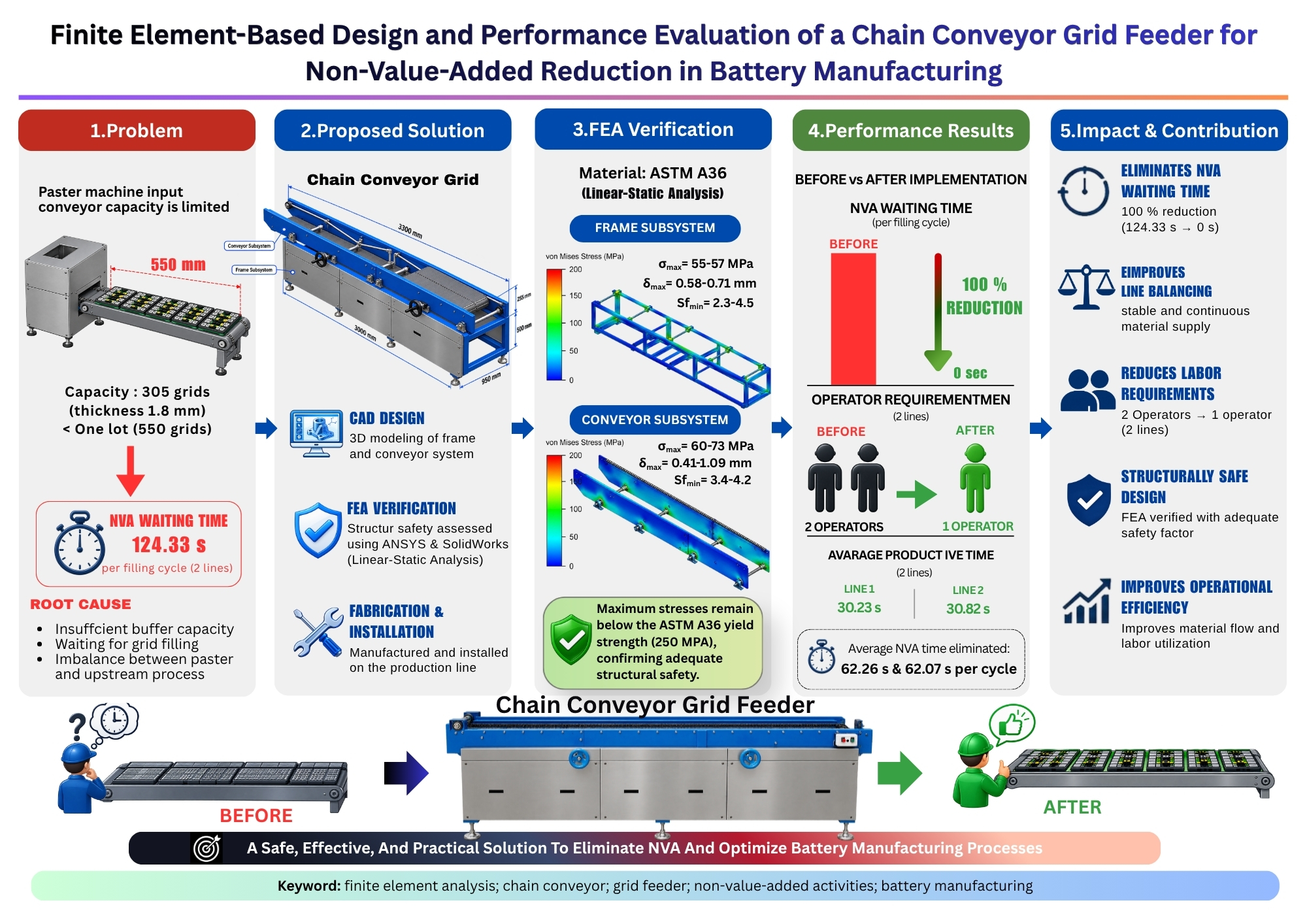
Non-value-added (NVA) waiting time in the grid-feeding process of battery manufacturing is caused by the limited capacity of the existing paster machine input conveyor, resulting in production flow interruptions and reduced operational efficiency. Although finite element analysis (FEA) has been widely applied for structural verification of industrial equipment, limited studies have integrated structural validation with operational performance evaluation to address production inefficiencies in battery manufacturing. To address this gap, this study proposes a chain conveyor grid feeder and introduces a cross-platform FEA approach by combining ANSYS Workbench and SolidWorks Simulation with in-situ industrial validation, thereby providing both numerical verification and practical evidence of production performance improvement. This study proposes and evaluates a chain conveyor grid feeder by integrating cross-platform FEA using ANSYS Workbench and SolidWorks Simulation with in-situ operational validation. The methodology includes CAD-based design, linear-static structural analysis under the maximum loading condition using ASTM A36 material properties, followed by fabrication, production-line implementation, and before–after performance evaluation. The FEA results indicate maximum von Mises stresses of 55–57 MPa for the frame subsystem and 60–73 MPa for the conveyor subsystem, both remaining below the ASTM A36 yield strength (250 MPa). The corresponding maximum deflection ranges from 0.41 to 1.09 mm, with minimum safety factors ranging from 2.30 to 4.54, confirming adequate structural reliability. Operational validation further demonstrates that NVA waiting time was reduced from 124.33 s to 0 s, while operator requirements decreased from two to one across two production lines. These findings demonstrate that integrating cross-platform FEA with industrial implementation provides an effective framework for achieving both structural reliability and measurable improvements in production efficiency.
Downloads
References
[1] S. Chaudhary and M. Choudhary, “Productivity improvement in a small-scale industry using time study,” International Research Journal of Engineering and Technology, vol. 12, no. 1, pp. 524–527, Jan. 2025. [Online]. Available: https://www.irjet.net/archives/V12/i1/IRJET-V12I179.pdf
[2] M. Boudribila and M. Id Machiche, “Optimizing financial profitability by eliminating waste in industrial processes: A PRISMA sys-tematic review for a profitable company,” International Journal for Multidisciplinary Research (IJFMR), vol. 7, no. 4, 2025, doi: 10.36948/ijfmr.2025.v07i04.51555.
[3] D. A. Lubis, S. Pujangkoro, and J. Hidayati, “Lean approach to minimize waste in biscuit production process using value stream mapping method at PT. XYZ,” J. Sist. Tek. Ind., vol. 26, no. 2, pp. 120–127, Jul. 2024, doi: 10.32734/jsti.v26i2.13544.
[4] F. Achmadi, B. Harsanto, and A. Yunani, “Improvement of assembly manufacturing process through value stream mapping and ranked positional weight: An empirical evidence from the defense industry,” Processes, vol. 11, no. 5, Art. no. 1334, May 2023, doi: 10.3390/pr11051334.
[5] C. M. Díaz-Estela, J. D. Atao-Carrasco, and W. D. Calderón-Gonzales, “Lean logistics-based warehouse management model to reduce non-conforming orders in a metal-mechanic SME: A case study in Peru,” International Research Journal of Economics and Manage-ment Studies, vol. 4, no. 4, pp. 173–186, Apr. 2025, doi: 10.56472/25835238/irjems-v4i4p118.
[6] F. P. Kristianto, Z. Amarta, N. Hutasoit, N. Fariz, and F. P. Herinda, “Finite element analysis method as an alternative for furniture prototyping process and product testing,” Int. J. Reconfig. Embedded Syst., vol. 14, no. 1, pp. 231–242, Mar. 2025, doi: 10.11591/ijres.v14.i1.pp231-242.
[7] A. M. Ibrahim, A. M. Ali, and H. Kamel, “Design optimization and production of a small-scale semi-trailer chassis for testing,” J. Eng. Appl. Sci., vol. 70, Art. no. 35, 2023, doi: 10.1186/s44147-023-00201-z.
[8] M. Y. Zhang, H. D. Zhu, and W. Zhang, “Finite element analysis of belt conveyor bracket,” J. Phys.: Conf. Ser., vol. 1748, no. 6, Art. no. 062047, 2021, doi: 10.1088/1742-6596/1748/6/062047.
[9] N. V. Dhandapani, P. Venkateshwaran, J. Ganesh Murali, and V. S. Thangarasu, “A study on linear static structural FEA of a convey-or stand for different stress distribution and shearing deformation,” International Research Journal of Automotive Technology (IR-JAT), vol. 1, no. 1, pp. 35–38, 2018. [Online]. Available: https://www.mapletreejournals.com/index.php/IRJAT
[10] R. K. A. S. Abdrian, A. Q. Al Jailani, and M. Tauviqirrahman, “Generative design effectivity on belt conveyor for additive manufac-turing using finite element method,” International Communication in Computational Mechanics, vol. 1, no. 1, pp. 14–43, 2025, doi: 10.37934/iccm.1.1.1443.
[11] E. S. Habib and E. Shamso, “A validated workflow for the design and certification of below-the-hook lifting devices integrating finite element analysis and physical proof testing,” Sci. Rep., vol. 15, Art. no. 44058, 2025, doi: 10.1038/s41598-025-31175-y.
[12] S. Zhang and G. Guan, “Deep learning-based mesh quality prediction for CAD model defeaturing,” in Mechanical and Aerospace Engineering: Proceedings of the 16th International Conference (ICMAE 2025), X. Lei, Ed. Amsterdam, The Netherlands: IOS Press, 2026, pp. 565–573, doi: 10.3233/ATDE260079.
[13] W. D. Callister Jr. and D. G. Rethwisch, Materials Science and Engineering: An Introduction, 10th ed. Hoboken, NJ, USA: Wiley, 2018.
[14] ASTM International, ASTM A36/A36M-19: Standard Specification for Carbon Structural Steel. West Conshohocken, PA, USA: ASTM International, 2019, doi: 10.1520/A0036_A0036M-19.
[15] O. C. Zienkiewicz, R. L. Taylor, and J. Z. Zhu, The Finite Element Method: Its Basis and Fundamentals, 7th ed. Oxford, U.K.: Butter-worth-Heinemann, 2013.
[16] R. G. Budynas and J. K. Nisbett, Shigley’s Mechanical Engineering Design, 11th ed. New York, NY, USA: McGraw-Hill Education, 2020.
[17] Y. Liu, S. Wang, S. Shi, and J. Tan, “Finite element analysis and optimization of automotive disk brakes using ANSYS,” Symmetry, vol. 18, no. 2, Art. no. 349, 2026, doi: 10.3390/sym18020349.
[18] A. G. Al-labani, R. L. Taner, O. Özdiler, and K. M. Dinçer, “The optimal initial displacement in rotated maxillary incisor teeth with clear aligner in different periodontal conditions: A finite element analysis,” Appl. Sci., vol. 15, no. 19, Art. no. 10502, Oct. 2025, doi: 10.3390/app151910502.
[19] P. Bedar and A. C. R., “Design, 3D modelling, and study on L-bracket rib strength through FEM analysis: A comparative study using SolidWorks and ANSYS software,” International Journal of Scientific Research in Science, Engineering and Technology, vol. 2, no. 1, pp. 677–686, 2016, doi: 10.32628/IJSRSET173391.
[20] R. L. Norton, Machine Design: An Integrated Approach, 5th ed. Boston, MA, USA: Pearson Education, 2013.
[21] H. Ma et al., “Finite element analysis and optimization for structure of dry ice cleaning machine frame,” Semarak International Journal of Mechanical Precision Engineering, vol. 2, no. 1, pp. 11–23, Mar. 2025, doi: 10.37934/sijmpe.2.1.1123a.
[22] T. A. Kristiawan, A. D. Alisyafa’at, P. Yanuar, and T. Setiyawan, “Analisa penggunaan support frame lama pada desain baru screw conveyor machine menggunakan metode elemen hingga,” Jurnal Mesin Nusantara, vol. 6, no. 1, pp. 35–46, Jul. 2023, doi: 10.29407/jmn.v6i1.18847.
[23] Adin and A. A. Saputra, “Design of conveyor using finite element method and finite element analysis,” JTTM: Jurnal Terapan Teknik Mesin, vol. 6, no. 2, pp. 252–259, Oct. 2025, doi: 10.37373/jttm.v6i2.1633.
[24] W. Wang and X. X. Sun, “Design of automatic deflection correction device and control system for storage belt bin of retractable belt conveyor,” J. Eng. Appl. Sci., vol. 72, Art. no. 267, 2025, doi: 10.1186/s44147-025-00807-5.
[25] A. Khoryanton, K. Purbono, P. Yanuar, T. K. Anggit, and C. W. Setiawan, “Design and construction of Atlas Copco bracket set type LE/LT series LT 5-30 to support train Railbus compressor module,” Journal of Engineering Science and Technology, Special Issue, vol. 18, no. 4, pp. 167–178, 2023. [Online]. Available: https://jestec.taylors.edu.my/
[26] O. Sim, B. C. Jeong, and C. Lee, “Verification, validation, and uncertainty quantification of finite element analysis results for pedicle screw assemblies under ASTM F1717 flexion and extension testing,” Front. Bioeng. Biotechnol., vol. 13, Art. no. 1623336, 2025, doi: 10.3389/fbioe.2025.1623336.
[27] A. B. Prasetiyo and K. A. Sekarjati, “Finite element simulation of power weeder machine frame,” Indonesian Journal of Computing, Engineering, and Design (IJoCED), vol. 4, no. 2, pp. 25–34, 2022, doi: 10.35806/ijoced.v4i2.291.
[28] T. Nakano and X. Liu, “Guaranteed local error estimation for finite element solutions of boundary value problems,” J. Comput. Appl. Math., vol. 425, Art. no. 115061, Jun. 2023, doi: 10.1016/j.cam.2023.115061.
[29] S. S. Rahman, A. Baten, M. Hoque, and Md. I. Mahmud, “Impact of lean manufacturing on productivity and layout design in sewing section of a garment industry,” International Journal of Industrial Management, vol. 17, no. 3, pp. 152–161, Sep. 2023, doi: 10.15282/ijim.17.3.2023.8955.
[30] J. Bonari, M. Paggi, and D. Dini, “A new finite element paradigm to solve contact problems with roughness,” Int. J. Solids Struct., vol. 253, Art. no. 111643, Oct. 2022, doi: 10.1016/j.ijsolstr.2022.111643.
[31] C. Xie, Z. Liu, and M. Xie, “Dynamic response analysis of scraper conveyor under the condition of chain broken,” J. Vibroeng., vol. 25, no. 6, pp. 1053–1067, 2023, doi: 10.21595/jve.2023.23192.
[32] D. Patil, “FEA stress determination for weld fatigue using hot-spot stress method: Benchmarking and rail application,” Internation-al Journal of Computational Methods and Experimental Measurements, vol. 12, no. 3, pp. 191–201, Sep. 2024, doi: 10.18280/ijcmem.120301.
[33] H. M. Dara, A. Raut, M. Adamu, Y. E. Ibrahim, and P. V. Ingle, “Reducing non-value added (NVA) activities through lean tools for the precast industry,” Heliyon, vol. 10, no. 7, Art. no. e29148, Apr. 2024, doi: 10.1016/j.heliyon.2024.e29148.
Downloads
Published
How to Cite
Issue
Section
License
Copyright (c) 2026 Timotius Anggit Kristiawan, Rosyadul Muzzaqi, Farika Tono Putri, Mochammad Ariyanto

This work is licensed under a Creative Commons Attribution-ShareAlike 4.0 International License.