Effect of Natural Gas Composition on Thermal Performance and NOx Emission Characteristics in Boiler Combustion Systems
DOI:
https://doi.org/10.22441/ijimeam.v8i2.38913Keywords:
natural gas, combustion, boiler, fuel composition, computational fluid dynamics (CFD)Abstract
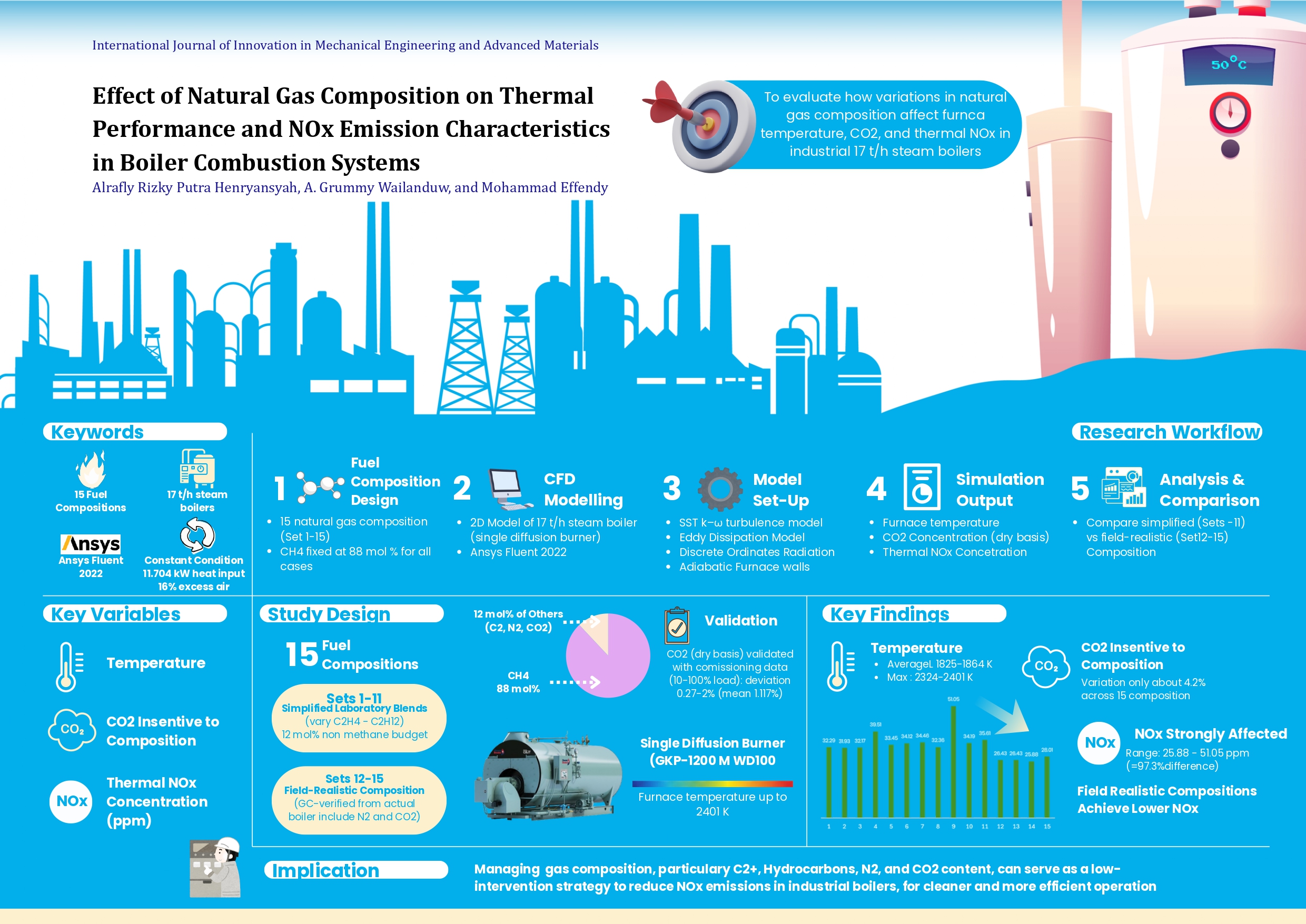
The composition of natural gas supplied to industrial boilers varies significantly depending on source origin and upstream processing, particularly in the proportions of heavier alkane fractions (C₂–C₆), nitrogen (N₂), and carbon dioxide (CO₂). While prior studies have predominantly treated fuel composition as a fixed parameter or post-combustion control technologies, the systematic influence of multi-component natural gas composition specifically the C₂+alkane fraction distribution on combustion thermal performance and NOx formation in medium-capacity industrial boilers remains insufficiently characterized. This study addresses this gap through computational fluid dynamics (CFD) simulations of a 17 ton/hour steam boiler under fifteen systematically designed fuel composition scenarios, maintaining a constant heat input of 11,704 kW and an excess air ratio of 16% across all cases. Simulations were performed using Ansys Fluent 2022 with the shear stress transport k-ω turbulence model, Eddy Dissipation combustion model, and Discrete Ordinates radiation model. The analyzed parameters include furnace temperature distribution, CO₂ mole fraction in flue gas, and thermal NOx concentration. Results reveal that fuel composition exerts a near-twofold variation in NOx emissions, from a minimum of 25.88 ppm (Set 14: 88% CH₄ + 12% C₂–C₅ N2+CO2 blend) to a maximum of 51.05 ppm (Set 9: CH₄ + C₂–C₅ blend), representing a 97.3% difference attributable solely to compositional variation under identical thermal load conditions. Field-realistic multi-component compositions (Sets 12–15) consistently yield the lowest NOx emissions (25.88–28.01 ppm), approximately 30–49% lower than simplified laboratory compositions (Sets 1–11: 31.93–51.05 ppm), demonstrating that fuel composition management alone without any hardware modification or flue gas treatment can achieve NOx reductions comparable to conventional emission control strategies. These findings provide quantitative evidence that natural gas composition is a viable and underutilized primary variable for emission control in industrial boiler operations, with direct implications for fuel procurement specifications and supply chain quality management in manufacturing sectors.
Downloads
References
[1] International Energy Agency, World Energy Outlook 2023. Paris, France: IEA, 2023. [Online]. Available: https://www.iea.org/reports/world-energy-outlook-2023. Accessed: Aug. 10, 2026.
[2] H. D. R. Nuryanto, “CO2 capture using dissolved ammonia (NH4OH)—Article review,” Rekayasa Mesin, vol. 16, no. 3, pp. 1155–1168, 2025, doi: 10.21776/jrm.v16i3.2135.
[3] T. Wang, H. Zhang, Y. Zhang, H. Wang, J. Lyu, and G. Yue, “Efficiency and emissions of gas-fired industrial boiler fueled with hy-drogen-enriched natural gas: A case study of 108 t/h steam boiler,” Int. J. Hydrogen Energy, vol. 47, no. 65, pp. 28188–28203, Jul. 2022, doi: 10.1016/j.ijhydene.2022.06.121.
[4] M. S. Cellek and A. Pınarbaşı, “Investigations on performance and emission characteristics of an industrial low swirl burner while burning natural gas, methane, hydrogen-enriched natural gas and hydrogen as fuels,” Int. J. Hydrogen Energy, vol. 43, no. 2, pp. 1194–1207, Jan. 2018, doi: 10.1016/j.ijhydene.2017.05.107.
[5] A. Franco and M. Rocca, “Industrial decarbonization through blended combustion of natural gas and hydrogen,” Hydrogen, vol. 5, no. 3, pp. 519–539, Aug. 2024, doi: 10.3390/hydrogen5030029.
[6] M. L. Wright and A. C. Lewis, “Emissions of NOx from blending of hydrogen and natural gas in space heating boilers,” Elementa Sci. Anthropocene, vol. 10, no. 1, Art. no. 00114, May 2022, doi: 10.1525/elementa.2021.00114.
[7] B. Zhu, B. Shang, X. Guo, C. Wu, X. Chen, and L. Zhao, “Study on combustion characteristics and NOx formation in 600 MW coal-fired boiler based on numerical simulation,” Energies, vol. 16, no. 1, Art. no. 262, Dec. 2023, doi: 10.3390/en16010262.
[8] C. Min, S. Xu, Y. Yang, and P. Wang, “Effect of different flue gas recirculation rates on low-NOx combustion characteristics: A nu-merical simulation based on the combustion process of a gas boiler,” Can. J. Chem. Eng., vol. 104, no. 8, pp. 3970–3983, 2026, doi: 10.1002/cjce.70286.
[9] S. Erne, G. Scheger, and W. Wiedemair, “Numerical and experimental investigation of surface-stabilized combustion in a gas-fired condensing boiler,” Results Eng., vol. 17, Art. no. 100738, Mar. 2023, doi: 10.1016/j.rineng.2022.100738.
[10] A. Alhashem, A. S. Almutairi, and S. F. Almokmesh, “Flue gas recirculation in steam boilers: A comprehensive assessment strategy for energy optimization and efficiency enhancement,” Processes, vol. 13, no. 2, Art. no. 395, Feb. 2025, doi: 10.3390/pr13020395.
[11] H. Jiang, L. Lu, X. Gong, Y. Tang, H. Qiu, and Q. Feng, “Influence of excess air coefficient variations on MILD combustion characteris-tics of CH4/H2 blends and associated NO/CO formation in industrial-scale furnace,” Int. J. Hydrogen Energy, vol. 204, Art. no. 153304, Jan. 2026, doi: 10.1016/j.ijhydene.2025.153304.
[12] S. Lee et al., “CFD study on combustion and emissions characteristics of methane-hydrogen co-firing in an EV burner,” Case Stud. Therm. Eng., vol. 73, Art. no. 106596, Sep. 2025, doi: 10.1016/j.csite.2025.106596.
[13] S. Xu, Z. Tian, Y. Chen, S. Liang, Y. Tu, and H. Liu, “Effect of hydrogen-blending ratio and wall temperature on establishment, NO formation, and heat transfer of hydrogen-enriched methane MILD combustion,” Fuel, vol. 369, Art. no. 131787, Aug. 2024, doi: 10.1016/j.fuel.2024.131787.
[14] R.-A. Li, R.-Y. Tsai, and Y.-H. Chan, “Thermal–mass transfer and flue gas characteristics of a steam boiler fueled with hydrogen carrier-blended natural gas,” Appl. Therm. Eng., vol. 297, Art. no. 130848, Jun. 2026, doi: 10.1016/j.applthermaleng.2026.130848.
[15] O. Salcı and S. Öztuna, “Modeling of hydrogen blending natural gas combustion characteristics and emission analyses in industrial burners,” Int. J. Hydrogen Energy, vol. 144, pp. 782–797, Jul. 2025, doi: 10.1016/j.ijhydene.2025.03.310.
[16] M. Z. Akram, F. Ma, M. Aziz, Y. Deng, and H. Wu, “H2 impact on combustion kinetics, soot formation, and NOx emission of hydrocar-bon fuel flames,” Fuel, vol. 338, Art. no. 127321, Apr. 2023, doi: 10.1016/j.fuel.2022.127321.
[17] A. Boretti, “Phased transition from methane to hydrogen in internal combustion engines: Utilizing hythane and direct injection jet ignition for enhanced efficiency and reduced emissions,” Int. J. Hydrogen Energy, vol. 80, pp. 1255–1265, Aug. 2024, doi: 10.1016/j.ijhydene.2024.07.251.
[18] M. Gore, K. Nonavinakere Vinod, and T. Fang, “Experimental investigation of gaseous mixtures of ethane, methane, and carbon dioxide as an alternative to conventional fuel in spark ignition engines,” J. Energy Resour. Technol., vol. 145, no. 3, Art. no. 032301, Mar. 2023, doi: 10.1115/1.4055201.
[19] Y. Kim, B. Y. Park, S. Woo, J. W. Jeong, S. Park, and K. Lee, “Fundamental study for applying a propane gas injection system in a small-ship engine,” Energies, vol. 16, no. 20, Art. no. 7036, Oct. 2023, doi: 10.3390/en16207036.
[20] A. T. Öztürk, D. Akal, and U. Akyol, “Investigation of the emission values of butane, methane and methane-hydrogen mixtures used in household stove burners,” Int. J. Hydrogen Energy, vol. 141, pp. 88–98, Jun. 2025, doi: 10.1016/j.ijhydene.2025.05.355.
[21] M. Elkelawy, H. Alm-Eldin Bastawissi, E. A. El Shenawy, M. Taha, H. Panchal, and K. K. Sadasivuni, “Study of performance, combus-tion, and emissions parameters of DI-diesel engine fueled with algae biodiesel/diesel/n-pentane blends,” Energy Convers. Manag. X, vol. 10, Art. no. 100058, Jun. 2021, doi: 10.1016/j.ecmx.2020.100058.
[22] M. Çelik, C. Bayındırlı, and R. Kuş, “Experimental investigation of effect of n-hexane addition in diesel and biodiesel fuels on per-formance and emissions characteristics,” Int. J. Automot. Sci. Technol., vol. 7, no. 2, pp. 118–124, Jun. 2023, doi: 10.30939/ijastech.1257614.
[23] K. Lee, J.-M. Kim, B. Yu, C.-E. Lee, and S. Lee, “Effect of various gas compositions on gas interchangeability and combustion charac-teristics for domestic appliances,” J. Mech. Sci. Technol., vol. 27, no. 4, pp. 1191–1201, Apr. 2013, doi: 10.1007/s12206-013-0225-5.
[24] G. Daurer, S. Schwarz, M. Demuth, C. Gaber, and C. Hochenauer, “Experimental and numerical analysis of industrial-type low-swirl combustion of hydrogen enriched natural gas including OH* chemiluminescence imaging,” Int. J. Hydrogen Energy, vol. 80, pp. 890–906, Aug. 2024, doi: 10.1016/j.ijhydene.2024.07.119.
[25] V. Patel and R. Shah, “Effect of hydrogen enrichment on combustion characteristics of methane swirling and non-swirling inverse diffusion flame,” Int. J. Hydrogen Energy, vol. 44, no. 52, pp. 28316–28329, Oct. 2019, doi: 10.1016/j.ijhydene.2019.09.076.
[26] Z. Zuo et al., “Combustion characteristics of low calorific value biogas and reaction path of NOx based on sensitivity analysis,” Front. Chem., vol. 9, Art. no. 830329, Feb. 2022, doi: 10.3389/fchem.2021.830329.
[27] E. H. Bani-Hani et al., “Optimization of adiabatic flame temperature of natural gas combustion under different conditions,” Envi-ron. Prog. Sustain. Energy, vol. 43, no. 3, Art. no. e14356, May 2024, doi: 10.1002/ep.14356.
[28] W. Dong, L. Xiang, J. Gao, B. Qiu, and H. Chu, “Effect of CO2 dilution on laminar burning velocities, combustion characteristics and NOx emissions of CH4/air mixtures,” Int. J. Coal Sci. Technol., vol. 10, no. 1, Art. no. 72, Dec. 2023, doi: 10.1007/s40789-023-00655-9.
[29] O. A. Marzouk, “Adiabatic flame temperatures for oxy-methane, oxy-hydrogen, air-methane, and air-hydrogen stoichiometric combustion using the NASA CEARUN tool, GRI-Mech 3.0 reaction mechanism, and Cantera Python package,” Eng. Technol. Appl. Sci. Res., vol. 13, no. 4, pp. 11437–11444, Aug. 2023, doi: 10.48084/etasr.6132.
[30] I. Yilmaz, Y. Cam, and B. Alabas, “Effect of N2 dilution on combustion instabilities and emissions in biogas flame,” Fuel, vol. 308, Art. no. 121943, Jan. 2022, doi: 10.1016/j.fuel.2021.121943.
[31] P. Wang et al., “Effects of operating parameters on combustion characteristics of hydrogen-doped natural gas,” Processes, vol. 13, no. 11, Art. no. 3477, Oct. 2025, doi: 10.3390/pr13113477.
[32] M. Mubashir, D. Shen, H. Kraiem, A. Flah, N. F. Alshammari, and M. M. Hanif, “Machine learning assisted CFD optimization of fuel-staging natural gas burners for enhanced combustion efficiency and reduced NOx emissions,” Sci. Rep., vol. 15, no. 1, Art. no. 23547, Jul. 2025, doi: 10.1038/s41598-025-05132-8.
[33] P. J. Swardhamana, N. Ruhyat, and S. Novianto, “Performance evaluation of a condenser at a combined cycle power plant using the LMTD method,” Int. J. Innov. Mech. Eng. Adv. Mater., vol. 6, no. 2, pp. 92–100, Sep. 2024, doi: 10.22441/ijimeam.v6i2.27450.
Downloads
Published
How to Cite
Issue
Section
License
Copyright (c) 2026 Alrafly Rizky Putra Henryansyah, A. Grummy Wailanduw, Mohammad Effendy

This work is licensed under a Creative Commons Attribution-ShareAlike 4.0 International License.