Comparative Assessment of Industrial Heat Pump Configurations for Spray Drying Dairy Manufacturing
DOI:
https://doi.org/10.22441/ijimeam.v8i3.39654Keywords:
cascade heat pump, Lorenz-limit validation, industrial heat pump, mechanical vapor recompression, spray-drying dairy manufacturingAbstract
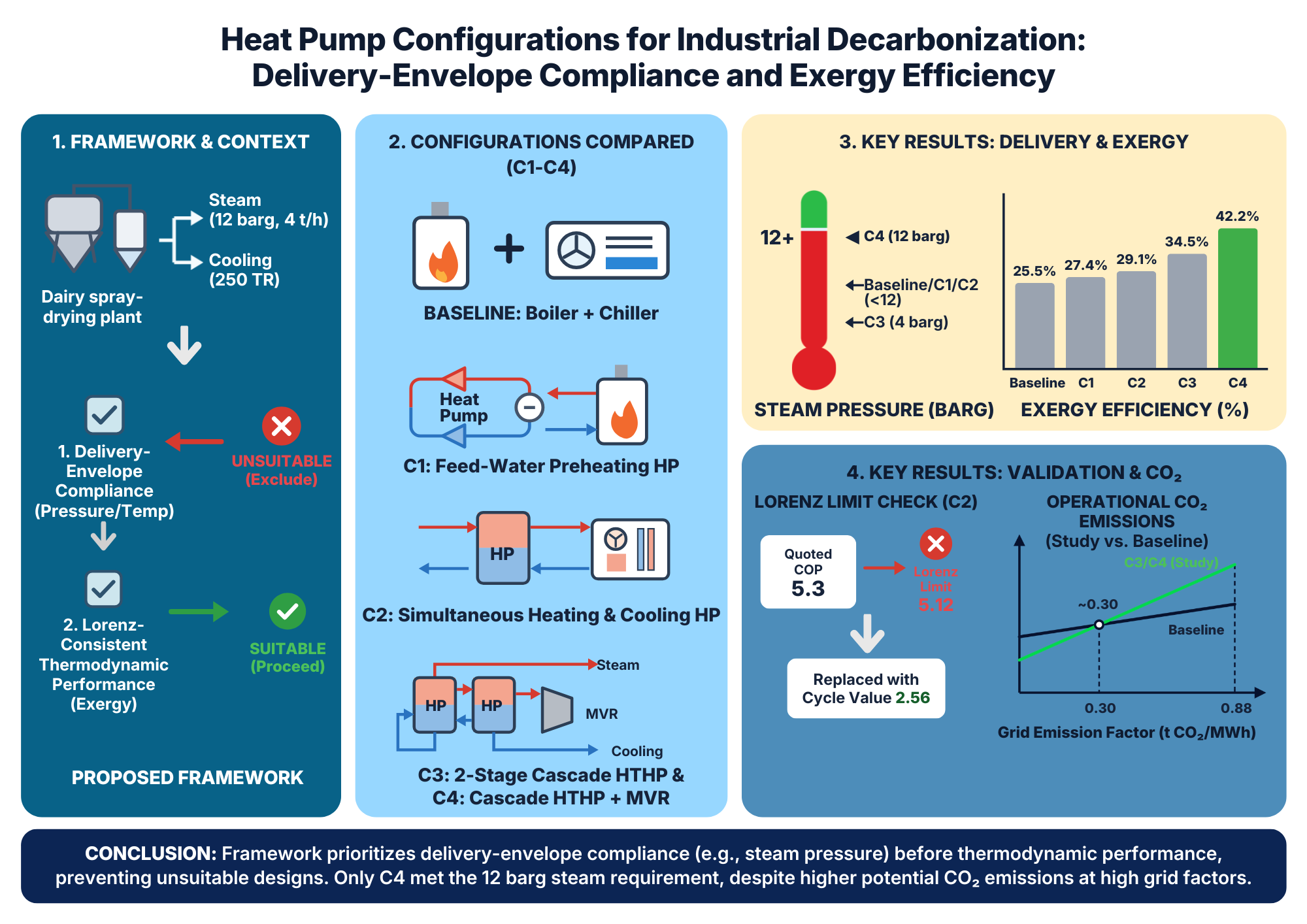
Heat pumps (HPs) are a key route to industrial decarbonization through electrification, but selecting a configuration requires more than maximizing thermodynamic performance: a highly efficient system may still be unable to supply the steam pressure and temperature that a process needs. Few studies evaluate HP configurations by combining thermodynamic performance with process delivery capability. This study compares four configurations of increasing complexity with a boiler–chiller baseline: (C1) boiler feedwater preheating, (C2) a simultaneous heating and cooling HP, (C3) a two-stage cascade high-temperature HP (HTHP), and (C4) a cascade HTHP with mechanical vapor recompression (MVR). The case is a dairy spray-drying plant that requires 12 barg steam (4 t/h) and 250 TR of cooling. Energy and exergy analyses used IAPWS-IF97 properties and the Gouy–Stodola formulation. Each COP was tested against its Lorenz limit and replaced by a cycle-based value where inadmissible, and C3 was modelled independently of C4. At the design point, exergy efficiency rose from 25.5% (baseline) to 27.4% (C1), 29.1% (C2), 34.5% (C3) and 42.2% (C4). Only C4 delivered 12 barg steam; C3 supplied saturated steam at 4 barg (152 °C). The vendor quoted COP of C2 (5.3) exceeded its Lorenz limit (5.12) and was replaced by a cycle-calculated value of 2.56. Operational CO₂ emissions of C3 and C4 exceed those of the baseline when the grid emission factor is above about 0.30 t CO₂/MWh (0.88 t CO₂/MWh was adopted). Delivery-envelope compliance and exergy efficiency are independent criteria: compliance is decided by the final steam pressure, whereas the exergy efficiency of C3 ranged from 31.6% to 60.0% across the sensitivity grid without changing its 4 barg limit. The proposed framework checks delivery-envelope compliance first and Lorenz-consistent thermodynamic performance second, allowing unsuitable configurations to be excluded before detailed techno-economic design.
Downloads
References
[1] International Energy Agency, “Can low-temperature heat in factories be electrified competitively?” Paris, France: IEA, 2025. [Online]. Available: https://www.iea.org/commentaries/can-low-temperature-heat-in-factories-be-electrified-competitively
[2] F. Faraldo and P. Byrne, “A review of energy-efficient technologies and decarbonating solutions for process heat in the food in-dustry,” Energies, vol. 17, no. 12, Art. no. 3051, 2024, doi: 10.3390/en17123051.
[3] E. Vieren et al., “The potential of vapor compression heat pumps supplying process heat between 100 and 200 °C in the chemical industry,” Energies, vol. 16, no. 18, Art. no. 6473, 2023, doi: 10.3390/en16186473.
[4] J. Zuberi, A. Hasanbeigi, and W. R. Morrow III, “Bottom-up assessment of industrial heat pump applications in U.S. food manufac-turing,” Energy Convers. Manage., vol. 272, Art. no. 116349, 2022, doi: 10.1016/j.enconman.2022.116349.
[5] T. G. Walmsley, M. J. Atkins, M. R. W. Walmsley, M. Philipp, and R.-H. Peesel, “Process and utility systems integration and optimisa-tion for ultra-low energy milk powder production,” Energy, vol. 146, pp. 67–81, 2018, doi: 10.1016/j.energy.2017.04.142.
[6] F. Schlosser, S. Zysk, T. G. Walmsley, L. Kong, B. Zühlsdorf, and H. Meschede, “Break-even of high-temperature heat pump integra-tion for milk spray drying,” Energy Convers. Manage., vol. 291, Art. no. 117304, 2023, doi: 10.1016/j.enconman.2023.117304.
[7] A. Marina, S. Spoelstra, H. Zondag, and A. Wemmers, “An estimation of the European industrial heat pump market potential,” Re-new. Sustain. Energy Rev., vol. 139, Art. no. 110545, 2021, doi: 10.1016/j.rser.2020.110545.
[8] M. U. Ahrens, S. S. Foslie, O. M. Moen, M. Bantle, and T. M. Eikevik, “Integrated high-temperature heat pumps and thermal storage tanks for combined heating and cooling in the industry,” Appl. Therm. Eng., vol. 189, Art. no. 116731, 2021, doi: 10.1016/j.applthermaleng.2021.116731.
[9] International Energy Agency, Net Zero by 2050: A Roadmap for the Global Energy Sector. Paris, France: IEA, 2021. [Online]. Availa-ble: https://www.iea.org/reports/net-zero-by-2050
[10] X. Ma, Y. Du, B. Lei, and Y. Wu, “Energy, exergy, economic, and environmental analysis of a high-temperature heat pump steam system,” Int. J. Refrig., vol. 160, pp. 423–436, 2024, doi: 10.1016/j.ijrefrig.2024.01.020.
[11] M. Ramirez, F. Trebilcock-Kelly, J. L. Corrales-Ciganda, J. Payá, and A. H. Hassan, “Experimental and numerical investigation of a novel high-temperature heat pump for sensible and latent heat delivery,” Appl. Therm. Eng., vol. 247, Art. no. 122961, 2024, doi: 10.1016/j.applthermaleng.2024.122961.
[12] E. Bellos, D. Gonidaki, A. Nazos, and J. K. Kaldellis, “Feasibility analysis of industrial high-temperature heat pumps in Greece,” Appl. Sci., vol. 15, no. 9, Art. no. 5171, 2025, doi: 10.3390/app15095171.
[13] K. M. Adamson et al., “High-temperature and transcritical heat pump cycles and advancements: A review,” Renew. Sustain. Energy Rev., vol. 167, Art. no. 112798, 2022, doi: 10.1016/j.rser.2022.112798.
[14] X. Hu, Y. Liu, S. Dong, G. Li, Z. Sun, and Y. Liu, “Comparison study of conventional and advanced exergy analysis on cascade high-temperature heat pump system based on experiment,” Case Stud. Therm. Eng., vol. 40, Art. no. 102552, 2022, doi: 10.1016/j.csite.2022.102552.
[15] J. Wu, S. Sun, Q. Song, D. Sun, D. Wang, and J. Li, “Energy, exergy, exergoeconomic and environmental (4E) analysis of cascade heat pump, recuperative heat pump and carbon dioxide heat pump with different temperature lifts,” Renew. Energy, vol. 207, pp. 407–421, 2023, doi: 10.1016/j.renene.2023.03.028.
[16] X. Hu, C. Shi, Y. Liu, X. Fu, T. Ma, and M. Jin, “Advanced exergy and exergoeconomic analysis of cascade high-temperature heat pump system for recovery of low-temperature waste heat,” Energies, vol. 17, no. 5, Art. no. 1027, 2024, doi: 10.3390/en17051027.
[17] Y. Dong and R. Wang, “When and how to use cascade high-temperature heat pump—its multi-criteria evaluation,” Energy Convers. Manage., vol. 309, Art. no. 118435, 2024, doi: 10.1016/j.enconman.2024.118435.
[18] W. Wagner et al., “The IAPWS industrial formulation 1997 for the thermodynamic properties of water and steam,” J. Eng. Gas Tur-bines Power, vol. 122, no. 1, pp. 150–184, 2000, doi: 10.1115/1.483186.
[19] I. H. Bell, J. Wronski, S. Quoilin, and V. Lemort, “Pure and pseudo-pure fluid thermophysical property evaluation and the open-source thermophysical property library CoolProp,” Ind. Eng. Chem. Res., vol. 53, no. 6, pp. 2498–2508, 2014, doi: 10.1021/ie4033999.
[20] R. Span and W. Wagner, “A new equation of state for carbon dioxide covering the fluid region from the triple-point temperature to 1100 K at pressures up to 800 MPa,” J. Phys. Chem. Ref. Data, vol. 25, no. 6, pp. 1509–1596, 1996, doi: 10.1063/1.555991.
[21] R. Tillner-Roth and H. D. Baehr, “An international standard formulation for the thermodynamic properties of 1,1,1,2-tetrafluoroethane (HFC-134a) for temperatures from 170 K to 455 K and pressures up to 70 MPa,” J. Phys. Chem. Ref. Data, vol. 23, no. 5, pp. 657–729, 1994, doi: 10.1063/1.555958.
[22] M. E. Mondéjar, M. O. McLinden, and E. W. Lemmon, “Thermodynamic properties of trans-1-chloro-3,3,3-trifluoropropene (R1233zd(E)): Vapor pressure, (p, ρ, T) behavior, and speed of sound measurements, and equation of state,” J. Chem. Eng. Data, vol. 60, no. 8, pp. 2477–2489, 2015, doi: 10.1021/acs.jced.5b00348.
[23] M. O. McLinden and R. Akasaka, “Thermodynamic properties of cis-1,1,1,4,4,4-hexafluorobutene [R-1336mzz(Z)]: Vapor pressure, (p, ρ, T) behavior, and speed of sound measurements and equation of state,” J. Chem. Eng. Data, vol. 65, no. 9, pp. 4201–4214, 2020, doi: 10.1021/acs.jced.9b01198.
[24] T. J. Kotas, The Exergy Method of Thermal Plant Analysis. London, U.K.: Butterworths, 1985.
[25] B. Zühlsdorf, J. K. Jensen, S. Cignitti, C. Madsen, and B. Elmegaard, “Analysis of temperature glide matching of heat pumps with zeotropic working fluid mixtures for different temperature glides,” Energy, vol. 153, pp. 650–660, 2018, doi: 10.1016/j.energy.2018.04.048.
[26] M. Gambini, M. Manno, and M. Vellini, “Energy and exergy analysis of transcritical CO2 cycles for heat pump applications,” Sus-tainability, vol. 16, no. 17, Art. no. 7511, 2024, doi: 10.3390/su16177511.
[27] L. Kong et al., “Transcritical–transcritical cascade CO2 heat pump cycles for high-temperature heating: A numerical evaluation,” Appl. Therm. Eng., vol. 238, Art. no. 122005, 2024, doi: 10.1016/j.applthermaleng.2023.122005.
[28] E. Vieren, T. Demeester, W. Beyne, A. Arteconi, M. De Paepe, and S. Lecompte, “The thermodynamic potential of high-temperature transcritical heat pump cycles for industrial processes with large temperature glides,” Appl. Therm. Eng., vol. 234, Art. no. 121197, 2023, doi: 10.1016/j.applthermaleng.2023.121197.
[29] S. Koochakinia, A. Ebrahimi-Moghadam, and M. Deymi-Dashtebayaz, “Techno-environmental analyses and optimization of a utility boiler based on real data,” Sustainability, vol. 14, no. 5, Art. no. 2592, 2022, doi: 10.3390/su14052592.
[30] Y. Huang, G. Li, X. Tang, K. Huang, W. Zhao, and J. Zhang, “Thermodynamic analysis of a modified cascade high-temperature heat pump with zeotropic mixtures for heating production up to 200 °C,” Energy Convers. Manage., vol. 324, Art. no. 119307, 2025, doi: 10.1016/j.enconman.2025.119307.
[31] J. Spale, A. J. Hoess, I. H. Bell, and D. Ziviani, “Exploratory study on low-GWP working fluid mixtures for industrial high-temperature heat pump with 200 °C supply temperature,” Energy, vol. 308, Art. no. 132677, 2024, doi: 10.1016/j.energy.2024.132677.
[32] J. Feng, J. Gao, B. Hu, R. Wang, and Z. Xu, “A mass-coupled hybrid absorption–compression heat pump with output temperature of 200 °C,” Energy, vol. 312, Art. no. 133608, 2024, doi: 10.1016/j.energy.2024.133608.
Downloads
Additional Files
Published
How to Cite
Issue
Section
License
Copyright (c) 2026 International Journal of Innovation in Mechanical Engineering and Advanced Materials

This work is licensed under a Creative Commons Attribution-ShareAlike 4.0 International License.
This work is licensed under CC BY-SA

A Creative Commons Attribution-ShareAlike (CC BY-SA) license allows you to use, share, and build upon a creator's work for any purpose—including commercial use—as long as you follow specific rules.