Design and Performance Evaluation of a Low-Cost Portable Rotary Cutting Machine for Sugar Palm Inflorescence Stalk Trimming
DOI:
https://doi.org/10.22441/ijimeam.v8i2.38641Keywords:
Rotary cutting machine, sugar palm (Arenga pinnata), low-cost design, additive manufacturing, sustainable agriculture, biomass processingAbstract
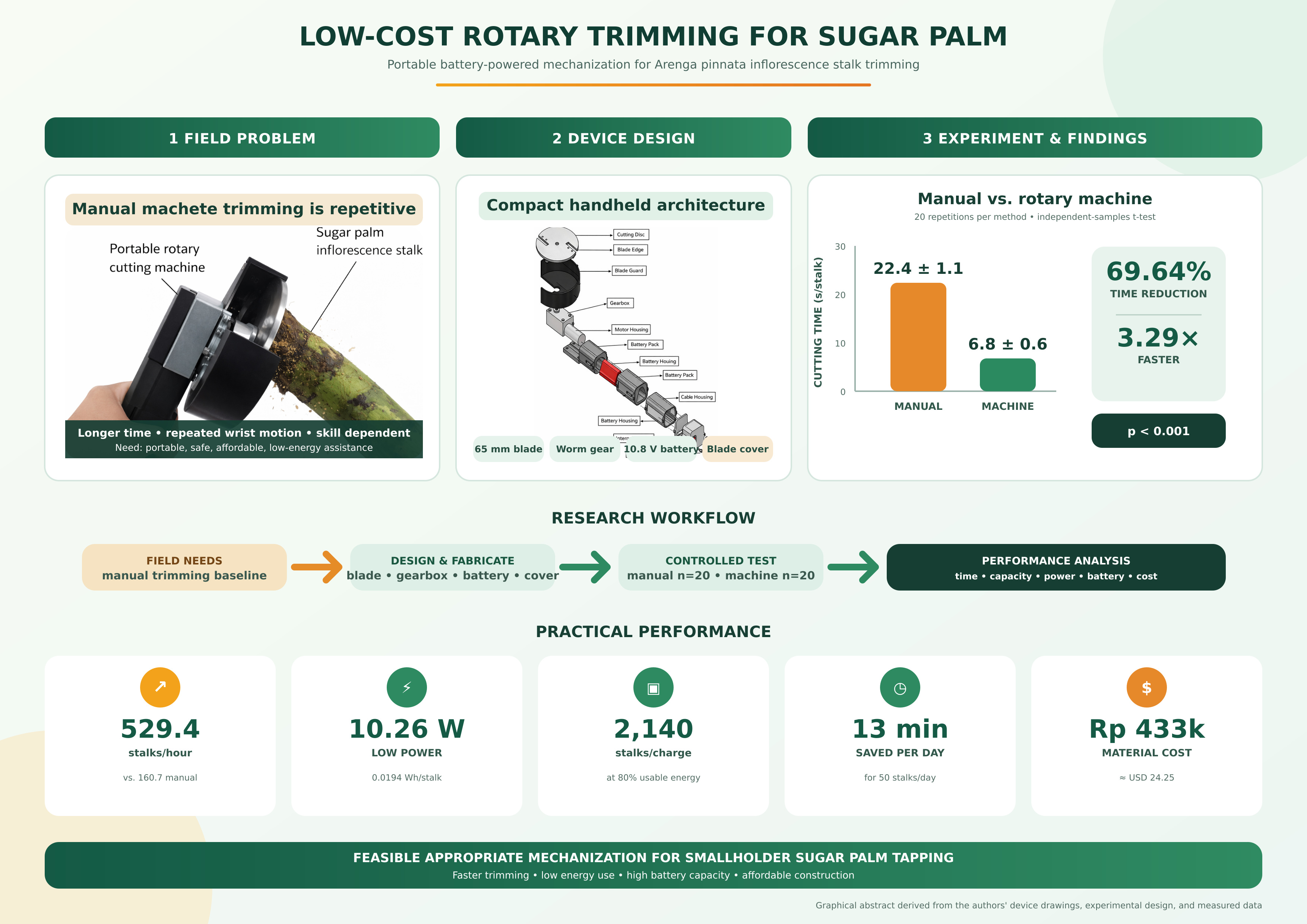
Sugar palm (Arenga pinnata) sap tapping still relies on manual trimming of the inflorescence stalk surface using a machete. Although rotary cutting devices have been studied for several agricultural materials, quantitative evidence for a low-cost handheld machine specifically designed for sugar palm inflorescence stalk trimming is still limited. This study designed, fabricated, and evaluated a portable low-energy rotary cutting machine that integrates a rotary disc blade, DC worm gear motor, worm gearbox, rechargeable lithium battery, and protective blade cover. The novelty of the study is the task-specific evaluation of cutting time, operational capacity, energy consumption, battery-based trimming capacity, and prototype cost for smallholder sap tapping. Manual and machine-assisted trimming were compared using 20 repetitions for each method. The average cutting time decreased from 22.4 ± 1.1 to 6.8 ± 0.6 s/stalk, corresponding to a 69.64% reduction and 3.29 times faster operation than manual trimming. Operational capacity increased from 160.7 to 529.4 stalks/hour. The machine operated at 10.8 V and 0.95 A, requiring 10.26 W and 0.0194 Wh/stalk. A fully charged 10.8 V, 4.8 Ah battery can theoretically support approximately 2675 trimming operations before complete drainage. The prototype material cost was Rp 433,000, equivalent to approximately USD 24.25 using an exchange rate of Rp 17,856/USD. The results indicate that the developed device is a feasible low-cost and low-energy mechanization option for repetitive sugar palm inflorescence stalk trimming.
Downloads
References
[1] Syahidah, S. M. F. Rayu, M. I. Akbar, and A. S. Rahma, “Production process and its influence on the quality of palm sugar from var-ious regions in South Sulawesi,” IOP Conf. Ser. Earth Environ. Sci., vol. 1230, no. 1, Art. no. 012168, 2023, doi: 10.1088/1755-1315/1230/1/012168.
[2] T. Anggraini, A. Anwar, D. Hervani, D. Suhendra, M. P. Wisnubroto, Noflindawati, and I. H. Nasution, “Quality of sugar palm sap (Arenga pinnata) from various production centers in West Sumatra, Indonesia,” Biodiversitas J. Biol. Divers., vol. 26, no. 2, pp. 859-860, 2025, doi: 10.13057/biodiv/d260234.
[3] Hawanis, H.S.N., Shamimimraphay, S.H.R., Ilyas, R.A., Rajeshkumar, L., Abotbina, W., Haron, S., Samsudin, S.A., Shamjuddin, A., Ran-gappa, S.M., Siengchin, S. and Mahardika, M, “The potential of biomass sugar palm (Arenga pinnata) in papermaking and their po-tential industrial applications: A review”, CBEN, 12: e70030, 2025, https://doi.org/10.1002/cben.70030.
[4] T. Daum, “Mechanization and sustainable agri-food system transformation in the Global South. A review,” Agron. Sustain. Dev., vol. 43, no. 1, Art. no. 16, 2023, doi: 10.1007/s13593-023-00868-x.
[5] Food and Agriculture Organization of the United Nations and African Union Commission, Sustainable Agricultural Mechanization: A Framework for Africa. Addis Ababa, Ethiopia: FAO and AUC, 2018.
[6] A. Adenle, K. Wedig, and H. Azadi, “Sustainable agriculture and food security in Africa: The role of innovative technologies and international organizations,” Technol. Soc., vol. 58, Art. no. 101143, 2019, doi: 10.1016/j.techsoc.2019.05.007.
[7] K. Winarno, J. Sustiyo, A. A. Aziz, and R. Permani, “Unlocking agricultural mechanisation potential in Indonesia: Barriers, drivers, and pathways for sustainable agri-food systems,” Agric. Syst., vol. 226, Art. no. 104305, 2025, doi: 10.1016/j.agsy.2025.104305.
[8] T. Madzivanzira, B. M. Mvumi, R. M. Nazare, E. Nyakudya, F. Mtambanengwe, and P. Mapfumo, “A review of appropriate mechani-sation systems for sustainable traditional grain production by smallholder farmers in sub-Saharan Africa with particular refer-ence to Zimbabwe,” Heliyon, vol. 10, no. 17, Art. no. e36695, 2024, doi: 10.1016/j.heliyon.2024.e36695.
[9] D. S. Khatawkar, P. S. James, and D. Dhalin, “Modern trends in farm machinery-electric drives: A review,” Int. J. Curr. Microbiol. Appl. Sci., vol. 8, no. 1, pp. 83-98, 2019, doi: 10.20546/ijcmas.2019.801.011.
[10] Y. Shen, H. Zhang, X. Liu, and J. Wang, “Advances and future trends in electrified agricultural machinery for sustainable agricul-ture,” Agriculture, vol. 15, no. 22, Art. no. 2367, 2025, doi: 10.3390/agriculture15222367.
[11] K. S. Erokhin, A. V. Erofeeva, and V. P. Ananikov, “Additive manufacturing in agriculture,” Russ. Chem. Rev., vol. 94, no. 12, Art. no. RCR5187, 2025, doi: 10.59761/RCR5187.
[12] D. Wilczyński, K. Talaśka, D. Wojtkowiak, J. Górecki, and K. Wałęsa, “Energy consumption of the biomass cutting process preceding the biofuel production,” Biosyst. Eng., vol. 237, pp. 142-156, 2024, doi: 10.1016/j.biosystemseng.2023.12.007.
[13] H. Gan, S. Mathanker, A. Momin, B. Kuhns, N. Stoffel, A. Hansen, and T. Grift, “Effects of three cutting blade designs on energy con-sumption during mowing-conditioning of Miscanthus giganteus,” Biomass Bioenergy, vol. 109, pp. 166-171, 2018, doi: 10.1016/j.biombioe.2017.12.033.
[14] G. Moiceanu, G. Paraschiv, G. Voicu, M. Dincă, O. Negoită, M. Chitoiu, and P. Tudor, “Energy consumption at size reduction of ligno-cellulose biomass for bioenergy,” Sustainability, vol. 11, no. 9, Art. no. 2477, 2019, doi: 10.3390/su11092477.
[15] V. D. Vu, T. T. Nguyen, T. D. Nguyen, and T. H. Nguyen, “Multiresponse optimization of cutting force and cutting power in chopping agricultural residues using grey-based Taguchi method,” Agriculture, vol. 10, no. 3, Art. no. 51, 2020, doi: 10.3390/agriculture10030051.
[16] Jyoti, K. Karthirvel, and C. D. Durairaj, “Effect of blade angles and thickness on specific cutting energy and cutting index of cassava stem,” J. AgriSearch, vol. 5, no. 2, pp. 126-129, 2018, doi: 10.21921/jas.5.2.9.
[17] T. Archbold and J. K. Carson, “Optimisation of a grass cutting blade using design of experiments with qualitative and quantitative performance metrics,” Biosyst. Eng., vol. 234, pp. 66-80, 2023, doi: 10.1016/j.biosystemseng.2023.08.013.
[18] L. Xie, Y. Gao, Z. Lin, F. He, W. Duan, and D. Ye, “Design and test analysis of a rotary cutter device for root cutting of golden needle mushroom,” Sci. Rep., vol. 15, Art. no. 37219, 2025, doi: 10.1038/s41598-025-21155-7.
[19] Chen, Q. Yao, F. Ding, K. Li, and B. Ma, “Design and optimization of a negative pressure rotary cutting safflower filaments harvest-ing device,” Sci. Rep., vol. 15, Art. no. 9693, 2025, doi: 10.1038/s41598-025-94307-4.
[20] U. Ganesh, Z. M. Ripin, W. M. A. W. M. Ali, and M. I. Z. Ridzwan, “Effects of saw blade geometry on oil palm frond cutting,” Jordan J. Mech. Ind. Eng., vol. 19, no. 3, pp. 657-668, 2025, doi: 10.59038/jjmie/190317.
[21] H. Zhu, X. Zhang, J. Liu, and Y. Zhang, “Study on plant crushing and soil throwing performance of a bionic rotary blade based on mole cricket claw toe,” Machines, vol. 10, no. 7, Art. no. 562, 2022, doi: 10.3390/machines10070562.
Downloads
Published
How to Cite
Issue
Section
License
Copyright (c) 2026 Riza Muhida, Muhammad Riza, Erry Y. T. Adesta, Mochamad Ibnu Safari, Maman Abdurohman, Rifki Muhida, Ari Legowo

This work is licensed under a Creative Commons Attribution-ShareAlike 4.0 International License.