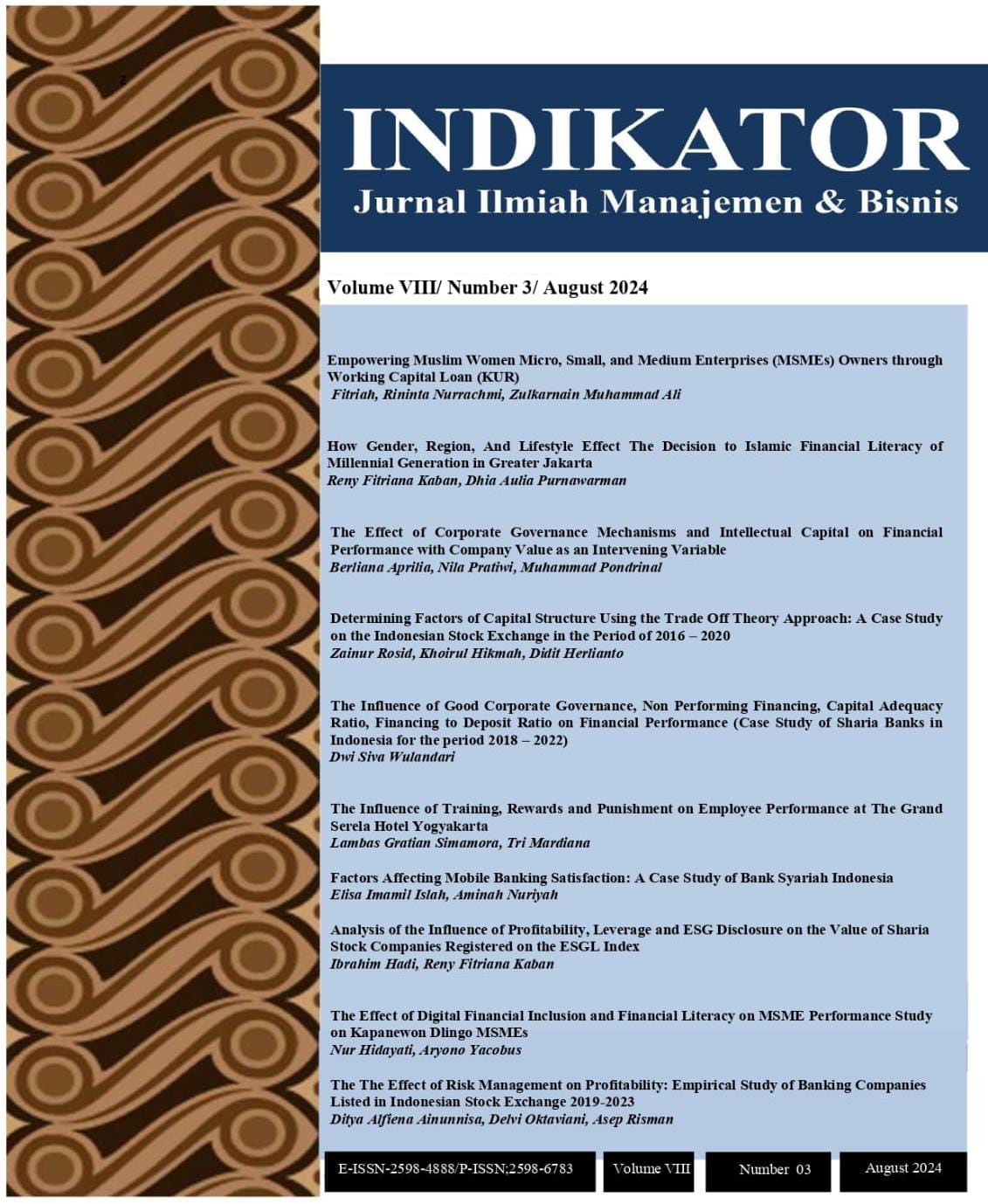
Determining Factors of Capital Structure Using the Trade Off Theory: A Case Study on the Indonesian Stock Exchange in the Period of 2016 - 2020
DOI:
https://doi.org/10.22441/indikator.v8i3.27377Keywords:
Profitability, Asset structure, Liquidity, Sales Growth, Company size,Abstract
This research is quantitative research which aims to cognize and analyze the determining factors of capital structure, namely profitability, asset structure, liquidity, sales growth and company size in issuers listed on the Indonesia Stock Exchange (BEI). This research is correlative research that uses secondary data from the Indonesian Stock Exchange. The sampling technique used is the purposive sampling method. The object of this research is issuers listed on the Indonesia Stock Exchange in the period 2016 to 2020, with the exception of issuers included in the financial sector. The analysis technique used in this research is linear regression using the IBM SPSS program. The results of this research are 1) Profitability has a significant negative effect on capital structure. 2) asset structure, liquidity and company size have no effect on capital structure, 3) sales growth has a significant positive effect on capital structure.References
Kanita, N. R., & Hendryadi, H. (2017). Determinant Factors Forming Capital Structure in Pharmaceutical Sector Companies for the Period 2012 - 2016. Journal of Management and Business Research (JRMB) Faculty of Economics UNIAT 2(September), 241–250. https://doi.org/10.36226/jrmb.v2is1.57
Kholifah, S., Sumani, S., & Puspitasari, N. (2019). Determinants of Capital Structure in the Pecking Order Theory Perspective in Food and Beverage Sub-Sector Companies Listed on BEI. Bhishma, 13(1), 60. https://doi.org/10.19184/bisma.v13i1.10020
Kyissima, K. H., Xue, G. Z., Yapatake Kossele, T. P., & Abeid, A. R. (2020). Analysis of capital structure stability of listed firms in China. China Finance Review International, 10(2), 213–228. https://doi.org/10.1108/CFRI-05-2018-0044
Muslimah, D. N., Suhendro, S., & Masitoh, E. (2020). Factors that Influence the Capital Structure of Property and Real Estate Companies Listed on the IDX. Scientific Journal of Batanghari University Jambi, 20(1), 195. https://doi.org/10.33087/jiubj.v20i1.821
Novitayanti, C. I. D., & Rahyuda, H. (2018). Determinants of capital structure based on pecking order theory in consumer goods sector companies on the IDX. E-Journal Management Unud, 7(8), 4475–4507.
Santika, R. B., & Sudiyatno, B. (2011). Determining the capital structure of manufacturing companies on the Indonesian stock exchange. Financial and Banking Dynamics, 3(2), 172–182.
Umdiana, N., & Claudia, H. (2020). Capital Structure Through Trade Off Theory. Accounting Journal for Scientific Accounting Studies (JAK), 7(1), 52. https://doi.org/10.30656/jak.v7i1.1930
Yuliani, Y. Y. (2017). Analysis of the Capital Structure of Food and Beverage Industry Companies on the Indonesian Stock Exchange. Ekspektra: Journal of Business and Management, 1(2), 81–88. https://doi.org/10.25139/ekt.v0i0.135
Brigham, E. F., & Houston, J. (2011). Basics of Financial Management. Jakarta Selatan: Salemba Empat.
Gujarati, D. N., & Porter, D. C. (2010). Fundamentals of Econometrics. Jakarta Selatan: Salemba Empat.
Sekaran, Uma. & Bougie, R. (2017). Research Methods For Business. Jakarta Selatan: Salemba Empat.
Sugiyono. (2015). Management Research Methods. Bandung:Alfabeta
Downloads
Published
How to Cite
Issue
Section
License
The copyright to this article is transferred to Universitas Mercu Buana (UMB) if and when the article is accepted for publication. The undersigned hereby transfers any and all rights in and to the paper including without limitation all copyrights to UMB. The undersigned hereby represents and warrants that the paper is original and that he/she is the author of the paper, except for material that is clearly identified as to its original source, with permission notices from the copyright owners where required. The undersigned represents that he/she has the power and authority to make and execute this assignment.
We declare that:
1. This paper has not been published in the same form elsewhere.
2. It will not be submitted anywhere else for publication prior to acceptance/rejection by this Journal.
3. A copyright permission is obtained for materials published elsewhere and which require this permission for reproduction.
Furthermore, I/We hereby transfer the unlimited rights of publication of the above mentioned paper in whole to UMB. The copyright transfer covers the exclusive right to reproduce and distribute the article, including reprints, translations, photographic reproductions, microform, electronic form (offline, online) or any other reproductions of similar nature.
The corresponding author signs for and accepts responsibility for releasing this material on behalf of any and all co-authors. This agreement is to be signed by at least one of the authors who have obtained the assent of the co-author(s) where applicable. After submission of this agreement signed by the corresponding author, changes of authorship or in the order of the authors listed will not be accepted.
Retained Rights/Terms and Conditions
1. Authors retain all proprietary rights in any process, procedure, or article of manufacture described in the Work.
2. Authors may reproduce or authorize others to reproduce the Work or derivative works for the authors personal use or for company use, provided that the source and the UMB copyright notice are indicated, the copies are not used in any way that implies UMB endorsement of a product or service of any employer, and the copies themselves are not offered for sale.
3. Although authors are permitted to re-use all or portions of the Work in other works, this does not include granting third-party requests for reprinting, republishing, or other types of re-use.
This work is also licensed under a Creative Commons Attribution-NonCommercial 4.0 International License.









