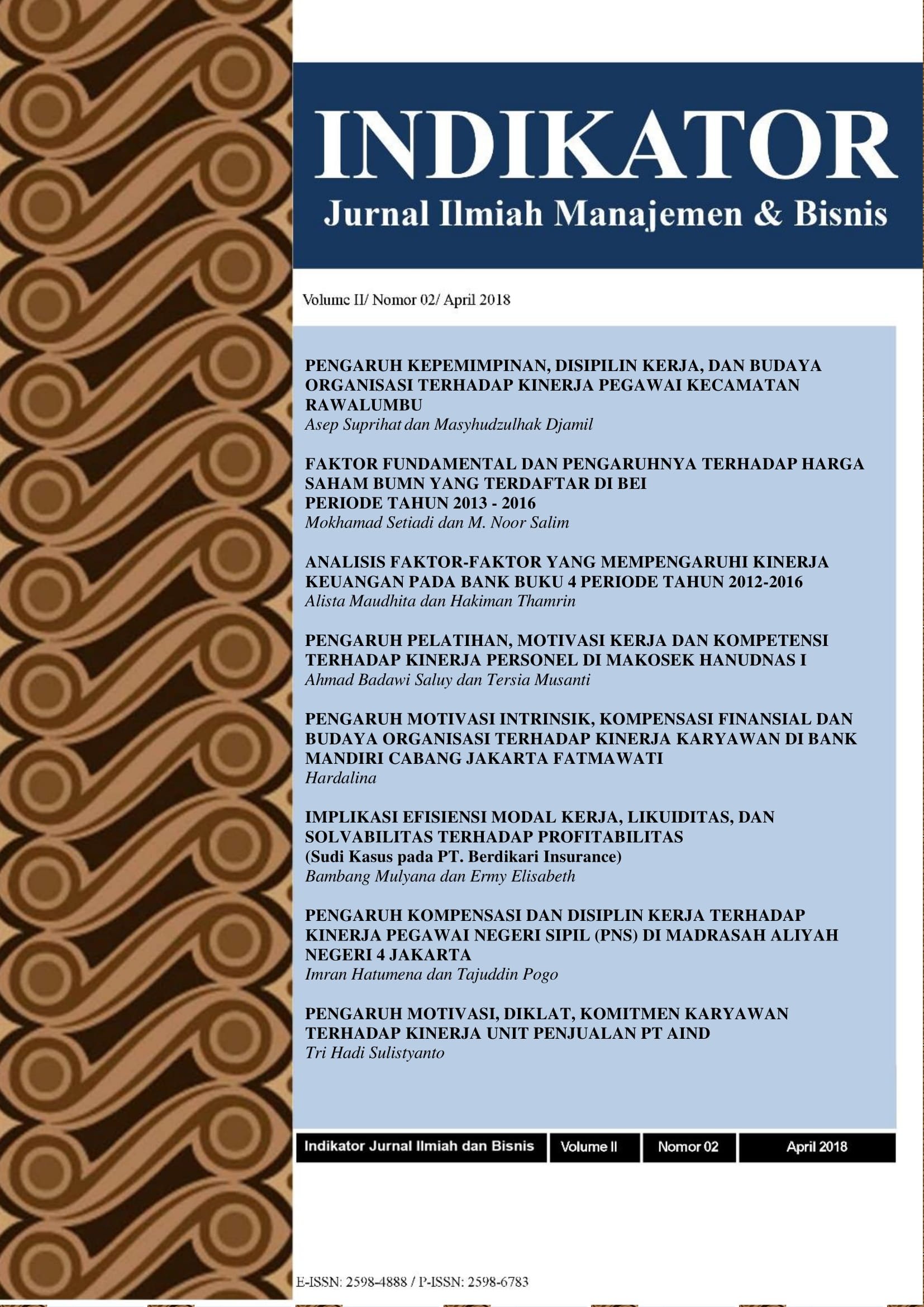
ANALISIS FAKTOR-FAKTOR YANG MEMPENGARUHI KINERJA KEUANGAN PADA BANK BUKU 4 PERIODE TAHUN 2012-2016
DOI:
https://doi.org/10.22441/indikator.v2i2.3271Keywords:
Capital Adequacy Ratio (CAR), Non Performing Loans (NPL), Net Interest Margin (NIM), Beban Operasional dan Pendapatan Operasional (BOPO), Loan to Deposit Ratio (LDR), Return on Asset (ROA), Common Effect, Fixed EffectAbstract
Penelitian ini bertujuan menguji dan menganalisis pengaruh rasio keuangan Capital Adequacy Ratio (CAR), Non Performing Loans (NPL), Net Interest Margin (NIM), Beban Operasional dan Pendapatan Operasional (BOPO), dan Loan to Deposit Ratio (LDR) terhadap kinerja bank yang diukur dengan rasio profitabilitas yaitu Return on Asset (ROA). Obyek penelitian adalah seluruh bank BUKU 4 yang tersedia data laporan keuangan triwulannya di Otoritas Jasa Keuangan (OJK) dalam kurun waktu penelitian yaitu Maret 2012 sampai dengan Desember 2016. Metode sampling yang digunakan adalah sampling jenuh, yaitu semua anggota populasi dijadikan sebagai sampel. Jumlah sampel adalah 4 bank. Metode analisis yang digunakan dalam penelitian ini adalah regresi data panel. Model yang digunakan adalah Fixed Effect. Uji asumsi klasik yang digunakan adalah uji autokorelasi, uji multikolinearitas, dan uji heteroskedastisitas. Dari hasil uji F didapat nilai F hitung atau prob (F-statistic) sebesar 0,000 untuk ROA. Hal ini berarti nilai F hitung kurang dari 0,05 yang menunjukkan bahwa variabel CAR, NPL, NIM, BOPO dan LDR secara bersama-sama mempunyai pengaruh signifikan terhadap ROA. Berdasarkan uji t disimpulkan bahwa CAR tidak berpengaruh terhadap ROA, sedangkan NPL, BOPO dan LDR secara parsial berpengaruh negatif signifikan terhadap ROA dan NIM berpengaruh positif signifikan terhadap ROA.
References
Adeyele, J.S dan Yusuff, Y.S. (2012). “Effect of Teaching Method, Choice of Discipline and Student-Lecturer Relationship on Academic Performance “. Journal of Economics and Sustainable Development, Vol.3, No.7, pp.1-7.
Alper, Deger and Adem Anbar. (2011). “Bank Specific and Macroeconomic Determinants of Commercial Bank Profitability: Empirical Evidence from Turkey”. Business and Economics Research Journal, Volume 2, Number 2, 2011, Halaman 139-152.
Ali, Khizer, Muhammad Farhan Akhtar, and Hafiz Zafar Ahmed. (2011). “Bank Specific and Macroeconomic Indicators of Profitability Empirical Evidence from the Commercial Bank of Pakistan”. International Journal of Business and Social Science, Vol.2, No.6, April 2011.
Al-Karim, Rashed and Tamima Alam. (2013). “An Evaluation of Financial Performance of Private Commercial Banks in Bangladesh: Ratio Analysis”. Journal of Business Studies Quarterly, Vol.5, No.2, 2013.
Al-Tamimi, Khaled Abdalla Moh’d and Samer Fakhri Obeidat. (2013). “Determinants of Capital Adequacy in Commercial Banks of Jordan an Empirical Study”. International Journal of Academic Research in Economics and Management Sciences, July 2013, Vol. 2, No. 4.
Ayaydin, Hasan and Aykut Karakaya. (2014). “The Effect of Bank Capital on Profitability and Risk in Turkish Banking”. International Journal of Business and Social Science, Vol. 5, No. 1, January 2014, 252.
Bilal, Muhammad, Asif Saeed, Ammar Ali Gull, dan Toquer Akram. (2013). “Influence of Bank Specific and Macroeconomic Factors on Profitability of Commercial Banks, A Case Study of Pakistan”. Research Journal of Finance and Accounting, Vol.4, No.2, pp 117-126.
Eng, Tan Sau. (2013). “Pengaruh NIM, BOPO, LDR, NPL, dan CAR terhadap ROA Bank Internasional dan Bank Nasional Go Public Periode 2007-2011”. Jurnal Dinamika Manajemen, Vol.1. No.3, Juli-September 2013.
Francis, Munyambonera Ezra. (2013). “Determinants of Commercial Bank Profitability in Sub-Sahara Africa”. International Journal of Economic and Fianance, Vol.5, No.9, pp 134-147.
Fransisca, Septiani. (2015). “Analisis Perhitungan Rasio-Rasio Keuangan terhadap Kinerja Bank Konvensional Di BEI”. Jurnal Ilmiah MBIA, Vol.14, No.2, hal. 117-126.
Ghozali, Imam. (2009). Ekonometrika. Badan Penerbit Universitas Diponegoro. Semarang.
____________. (2013). Aplikasi Analisis Multivariate dengan Program SPSS. Edisi Ketujuh. Badan Penerbit Universitas Diponegoro. Semarang.
Gizaw, Million, Matewos Kebede, dan Sujata Selvaraj. (2015). “The Impact of Credit Risk on Profitability Performance of Commercial Banks in Ethiopia”. African Journal of Business Managemen, Vol. 9, pp 59-66, 28 January, 2015.
Guisse, Mamadou Lamarana. (2012). “Financial Performance of the Malaysian Banking Industry, Domestic vs Foreign Banks”. Thesis. Master of Science in Banking and Finance. Eastern Mediterranean University. Gazimagusa, North Cyprus.
Husnan, Suad dan Pudjiastuti, Enny. (2006). Dasar-Dasar Manajemen Keuangan. Edisi Kelima. UPP STIM YKPN. Yogyakarta.
____________. (2012). Dasar-Dasar Manajemen Keuangan. Edisi Keenam. UPP STIM YKPN. Yogyakarta.
Hutagalung, Esther Novalina, Djumahir dan Kusuma Ratnawati. (2011). “Analisa Rasio Keuangan terhadap Kinerja Bank Umum di Indonesia”. Jurnal Aplikasi Manajemen, Vol.11, No.1, Maret 2013, Hal 122-130, ISSN: 1693-5241.
Ibrahim, Sardar Shaker. (2017). “The Impacts of Liquidity on Profitability in Banking Sectors of Iraq: A Case of Iraqi Commercial Banks”. Journal of Finance & Banking Studies, Vol. 6, No. 1, hal. 113-121, 2017.
Kasmir. (2008). Bank dan Lembaga Keuangan Lainnya. Edisi Revisi. PT. Raja Grafindo Persada. Jakarta.
____________. (2010). Manajemen Perbankan. Edisi Kesembilan. Rajawali Pers. Jakarta.
____________. (2015). Analisis Laporan Keuangan. Rajawali Pers. Jakarta.
Khan, Rizwan Ali and Mutahhar Ali. (2016). “Impact of Liquidity on Profitability of Commercial Banks in Pakistan: An Analysis on Banking Sector in Pakistan”. Global Journal of Management and Business Research, C Finance, Vol.16, Issue 1, 2016.
M. Sabir, Muhammad, Muhammad Ali, Abd. Hamid Habbe. (2012). “Pengaruh Rasio Kesehatan Bank terhadap Kinerja Keuangan Bank Umum Syariah dan Bank Konvensional di Indonesia”. Jurnal Analisis, Vol.1, No.1, Halaman 79-86, Juni 2012.
Mahardian, Pandu, ST. (2008). Analisis Pengaruh Rasio CAR, BOPO, NPL, NIM dan LDR terhadap Kinerja Keuangan Perbankan (Studi Kasus Perusahaan Perbankan yang Tercatat di BEJ Periode Juni 2002-Juni 2007)”. Tesis. Program Studi Magister Manajemen, Program Pascasarjana, Universitas Diponegoro. Semarang.
Margaretha, Farah dan Zai, Pingkan M. (2013). “Faktor-Faktor yang Mempengaruhi Kinerja Keuangan Perbankan Indonesia”. Universitas Trisakti. Jurnal Bisnis dan Akuntansi, Volume 15, Nomor 2, Desember 2013, Hal. 133-141.
N, Uum Sholikhah Fitria dan I Made Sudana. (2015). “Pengaruh Faktor Spesifik terhadap Profitabilitas Berdasarkan Kelompok Buku Bank di Indonesia”. Jurnal Manajemen Bisnis Indonesia, Vol. 2, Nomor 2, Feb 2015.
Novariani, Ius. (2014). “Analisis Pengaruh CAR, NPL, LDR, BOPO terhadap ROA (Studi Kasus pada Perusahaan Perbankan Bank Umum Swasta Nasional Non Devisa yang Terdaftar di Bank Indonesia tahun 2007-2011)”. Jurnal Dinamika Manajemen, Vol.1, No.3, Halaman 33-38.
Nusantara, Ahmad Buyung. (2009). “Analisis Pengaruh NPL, CAR, LDR dan BOPO terhadap Profitabilitas Bank pada Bank GO Public dan Bank Non Go Public di Indonesia periode Tahun 2005-2007”. Tesis. Program Studi Magister Manajemen, Program Pascasarjana, Universitas Diponegoro, Semarang.
Otoritas Jasa Keuangan. (2016). Statistik Perbankan Indonesia, Volume 13. No. 1 Desember 2016, www.ojk.go.id. (Diakses tanggal 10 Oktober 2017).
Olalekan, Asikhia and Sokefun Adeyinka. (2013). “Capital Adequacy And Banks' Profitability: An Empirical Evidence From Nigeria”. American International Journal of Contemporary Research, Volume 3, No. 10, October 2013, 87.
Prasnanugraha, Ponttie. (2007). “Analisis Pengaruh Rasio-Rasio Keuangan terhadap Kinerja Bank Umum di Indonesia (Studi Empiris Bank-Bank Umum yang beroperasi di Indonesia)”. Tesis. Program Studi Magister Manajemen. Program Pascasarjana Universitas Diponogoro, Semarang.
Purwoko, Didik dan Bambang Sudiyatno. (2013). “Faktor-Faktor yang Mempengaruhi Kinerja Bank (Studi Empirik Pada Industri Perbankan di Bursa Efek Indonesia)”. Jurnal Bisnis dan Ekonomi (Jbe), Maret 2013, Hal. 25 – 39 Vol. 20, No. 125.
Puspopranoto, Sawaldjo. (2014). Keuangan Perbankan dan Pasar Keuangan. Pustaka LP3ES. Jakarta.
Putra, Tengku Indra Pramana. (2017). “Analisis Faktor-Faktor yang Mempengaruhi Profitabilitas pada Bank Buku IV”. Tesis. Program Studi Magister Manajemen, Universitas Mercu Buana. Jakarta.
____________. (2012). Metode Penelitian Kuantitatif Kualitatif dan R&D. CV. Alfabeta. Bandung.
Sukma, Yoli Lara. (2013). “Pengaruh Dana Pihak Ketiga, Kecukupan Modal dan Risiko Kredit terhadap Profitabilitas pada Perusahaan Perbankan yang Terdaftar di BEI”. Tesis. Program Studi Magister Manajemen dan Bisnis, Universitas Negeri Padang. Padang.
Wasiuzzaman, S. and Tarmizi, H.A. (2010). “Profitability of Islamic Banks in Malaysia: an Empirical Analysis”. Journal of Islamic Economics, Banking and Finance, Volume 6, Number 4.
Downloads
Published
How to Cite
Issue
Section
License
The copyright to this article is transferred to Universitas Mercu Buana (UMB) if and when the article is accepted for publication. The undersigned hereby transfers any and all rights in and to the paper including without limitation all copyrights to UMB. The undersigned hereby represents and warrants that the paper is original and that he/she is the author of the paper, except for material that is clearly identified as to its original source, with permission notices from the copyright owners where required. The undersigned represents that he/she has the power and authority to make and execute this assignment.
We declare that:
1. This paper has not been published in the same form elsewhere.
2. It will not be submitted anywhere else for publication prior to acceptance/rejection by this Journal.
3. A copyright permission is obtained for materials published elsewhere and which require this permission for reproduction.
Furthermore, I/We hereby transfer the unlimited rights of publication of the above mentioned paper in whole to UMB. The copyright transfer covers the exclusive right to reproduce and distribute the article, including reprints, translations, photographic reproductions, microform, electronic form (offline, online) or any other reproductions of similar nature.
The corresponding author signs for and accepts responsibility for releasing this material on behalf of any and all co-authors. This agreement is to be signed by at least one of the authors who have obtained the assent of the co-author(s) where applicable. After submission of this agreement signed by the corresponding author, changes of authorship or in the order of the authors listed will not be accepted.
Retained Rights/Terms and Conditions
1. Authors retain all proprietary rights in any process, procedure, or article of manufacture described in the Work.
2. Authors may reproduce or authorize others to reproduce the Work or derivative works for the authors personal use or for company use, provided that the source and the UMB copyright notice are indicated, the copies are not used in any way that implies UMB endorsement of a product or service of any employer, and the copies themselves are not offered for sale.
3. Although authors are permitted to re-use all or portions of the Work in other works, this does not include granting third-party requests for reprinting, republishing, or other types of re-use.
This work is also licensed under a Creative Commons Attribution-NonCommercial 4.0 International License.









