
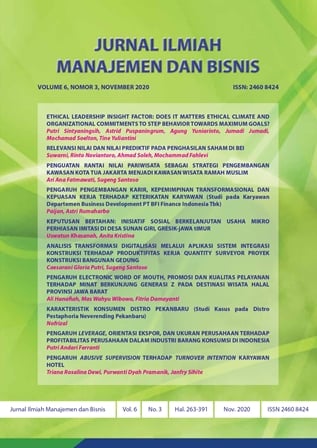
Penguatan Rantai Nilai Pariwisata Sebagai Strategi Pengembangan Kawasan Kota Tua Jakarta Menjadi Kawasan Wisata Ramah Muslim
DOI:
https://doi.org/10.22441/jimb.v6i3.9825Kata Kunci:
Kota Tua, Muslim-friendly, Strategy, Tourism, Value chainAbstrak
In order to make Indonesia the center of the world's Islamic economy, tourism is one of the potential sektors to be developed. The Ministry of Tourism and Creative Economy visited Indonesia as many as 6 million visitors until 2024. Kota Tua area is one of the priority tours that will be made Muslim-friendly tourism in DKI Jakarta. The purpose of this study is to provide recommendations for strategies in increasing visits to Kota Tua by 2000 visits / day where descriptive analysis is used as a research method (FGD, Deep Interview, Literature Study). The Tourism Value Chain (Accommodation, Food and Beverage and Tourism Assets) is based on the Standard Business Field Classification (KBLI) so that it becomes a reference in developing Muslim-friendly tourism activities. Recommended strategies used from the accommodation sektor are Rebranding conventional hotels to halal / Sharia hotels, especially three-star hotels, accelerating halal hotel certification, synergies with the Islamic capital sektor, synergies with Islamic boarding schools, and synergies with creative fields of Architecture / Interior Design. From the food and beverage sektor, it is proposed that the acceleration of halal certification, changes to healthy and halal food brands, and promotion by selecting a culinary ambassador to introduce local food. From the tourism asset sektor, Digital Tourism is one of the leading strategies, arranging museum collections, door-to-door promotions, increasing the intensity of performances held at museums, and increasing museum service programs as an institution that serves the community
Unduhan
Referensi
Abdul Hamid, I. 2010. Islamic compliance in hotel and restaurant business. Paper presented at the Asia-Euro Conference: Transformation and modernisation in tourism, hospitality and gastronomy.
Adhianti, Anisa Aprilia & Herlinda. 2020. Strategi Komunikasi Pemasaran 7P Pengelola Museum Sejarah Jakarta Dalam Upaya Meningkatkan Daya Tarik Wisatawan Mancanegara. Jurnal Scriptura, Vol. 10, No. 1, Juli 2020, 34-42
Arby, I. 2017. Apa itu Wisata Syariah atau Halal Tourism?. Diakses Oktober 2020 pada http://muhaiminzul.lecture.ub.ac.id/files/2017/02/10.Wisata_Syariah_Halal_Tourism.pdf.
Asazuma, Takumi. 2015. Halal Tourism Activates Japanese Tourism Market. Plus I, 11, 27- 30. Retrieved June 11, 2017 from http:// human.kanagawa-u.ac.jp/gakkai/student/pdf/ i11/110320.pdf
Ashley, C. Mitchell, J. 2007. Assessing How Tourism Revenues Reach The Poor. ODI Briefing Paper. Overseas Development Institute. United Kingdom.
COMCEC. 2016. Muslim Friendly Tourism (MFT): Understanding the Supply and Demand Sides in tne OIC Member Countries. Retrieved November 17, 2017 from http://www.comcec.org/wp- content/uploads/2016/05/7-TUR-AN.pdf
Damanik, J. Weber, H. 2006. Perencanaan Ekowisata dari Teori ke Aplikasi. Yogyakarta: PUSPAR UGM dan Andi
Dinar standard. 2012. Global muslim lifestyle tourism market 2012: Landscape & consumer needs study. Retrieved from http://www.dinarstandard.com/travel-study/#top, Diakses 25 September 2020
Gereffi, G dan John H. 2003. The Governance of Global Value Chains. Review of International Political Economy. Sturgeon, Timothy
I Gede Pitana & Putu G. Gayatri. 2005. Sosiologi Pariwisata. Andi. Yogyakarta
Jaelani, Aan. 2017. Halal Tourism Industry in Indonesia: Potential and Prospects. International Review of Management and Marketing, 2017, 7(3), 25-34
Kemmis and Taggart. 1990. The Action Research Planner. Victorio. Deakin. Univ Press.
Khan, F, dan Callanan, M. 2017. The “Halalification” of Tourism. Journal of Islamic Marketing. 8(4): 558- 577.
Kotler, P., & Pfoertsch, W. 2008. In B2B Brand Management. Jakarta: PT. Bhuana Ilmu Populer.
Mao, Nara, et al., 2013. Local Livelihoods and Tourism Value Chain: a case study in Siem Reap-Angkor Region, Cambodia. International Journal of Environment and Rural Development (IJERD), Vol. 4, No. 2. Available at: URL: http://iserd.net/ijerd42/42020.pdf. Acessed on Oktober, 1,2020.
Master Plan Ekonomi Syariah Indonesia 2019-2024
Nuraeni, B. S. 2014. Analisis Faktor-Faktor yang Mempengaruhi Minat Kunjung Ulang Wisatawan Museum Ranggawarsita. Jurnal Bisnis Strategi, 23(1), 1-20.
Pemerintah Provinsi DKI Jakarta. 2019. Data Pariwisata DKI Jakarta, diakses pada 6 Oktober 2020, http://data.jakarta.go.id/dataset?groups=pariwisata-kebudayaan
Prakosa, Wahyu. 2020. Kota Tua Jakarta. Revitalisasi Menyeluruh Atau Menghilang?. PESAT Vol 4 Oktober 2019
Rahmanto, Andre Novie & Hartini, Sri . 2020. Branding Hotel Syariah Dalam Mendukung Halal Tourism Di Kota Solo. Nivedana –Jurnal Komunikasi & Bahasa Volume 1, No 1, Oktober 2020
Rijali, Ahmad. 2018. Analisis Data Kualitatif. Journal Alhadharah. Vol. 17 No. 33 . Acessed on September, 17, 2020
Satriana, Eka dewi & Faridah , Hayyun Durrotul. 2018. Wisata Halal: Perkembangan, Peluang, Dan Tantangan . Journal of Halal Product and Research (JHPR) Vol. 01 No.02, Mei-November 2018 Satriana ED, Faridah HD
Sitio, Reka penta. 2017. Pemetaan Rantai Nilai Pada Pengembangan Kawasan Agrowisata Gunung Mas. Journal of Economics and Business Aseanomics (JEBA) Volume 2 No. 2, Juli- Desember 2017
Sofyan, R. 2011. Bisnis Syariah Mengapa Tidak? Pengalaman Penerapan Pada Bisnis Hotel. Jakarta: PT. Gramedia Pustaka Utama
Sumpeno, dkk. 2015. Ragam Teknologi Informasi Untuk Revitalisasi Museum. Seminar Nasional Otomasi Industri dan Teknologi Informasi 2015 (SNOITI 2015)
Woodward, Kathryn. 1997. Identity and Difference. London: Sage Pulication,Ltd
Unduhan
Diterbitkan
Cara Mengutip
Terbitan
Bagian
Lisensi
The copyright of this article was transferred to Universitas Mercu Buana if and when the article was accepted for publication. The undersigned below transfers all and all rights in and to paper including without limitation all copyright to UMB. The undersigned states and guarantees that the paper is genuine and that he is the author of the paper, except material that is clearly identified as the original source, with the notification of the permission of the copyright owner if necessary and has the power and authority to make and carry out this assignment. We state that this paper has not been published in the same form elsewhere.
Furthermore, I / We hereby transfer unlimited publicity rights to the above mentioned papers as a whole to Universitas Mercu Buana. Copyright transfers include the right to reproduce and distribute articles, including reprints, translations, photo reproductions, microforms, electronic forms (offline, online) or other reproductions that have similar properties. The appropriate author signs and accepts the responsibility for releasing this material on behalf of each and all co-authors. This agreement must be signed by at least one of the authors who has obtained approval from the co-author (s) where applicable.
After the submission of this agreement is signed by the appropriate author, changes in authorship or in the order of the registered author will not be accepted. Retained Rights / Provisions and Conditions Although the author is permitted to reuse all or part of the Work in another work, this does not include giving a third party request for reprinting, republishing, or any other type of reuse.









