Biomechanical Performance of Orthodontic Mini-Implant Materials under Different Orthodontic Loads: A Finite Element Analysis
DOI:
https://doi.org/10.22441/ijimeam.v8i2.39139Keywords:
orthodontic mini-implant, Finite Element Analysis, CPTi, SS316L, Ti6Al4VAbstract
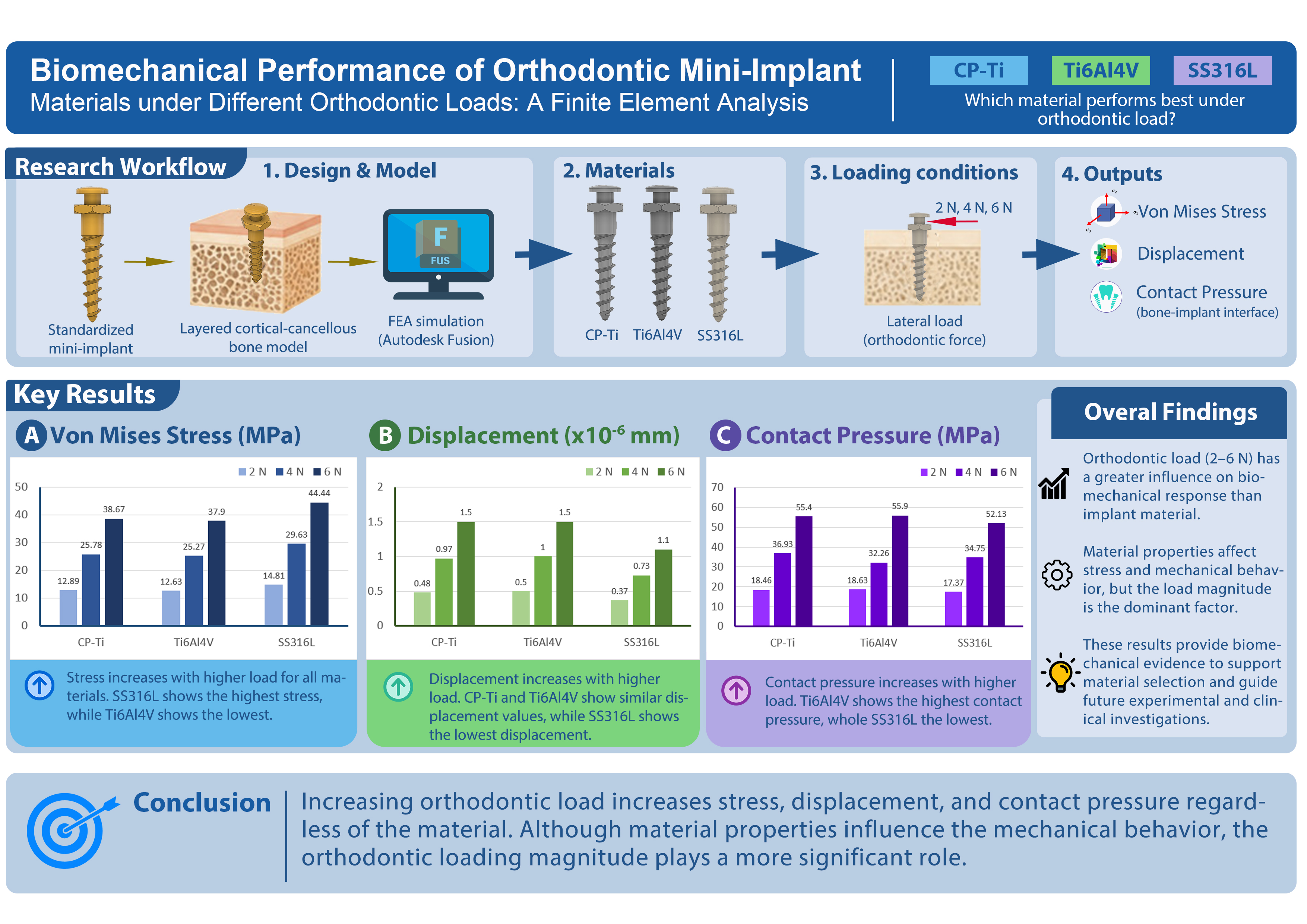
Orthodontic mini-implants are widely used as temporary anchorage devices, and their biomechanical performance is influenced by implant material and applied orthodontic load. This study aimed to provide a standardized biomechanical comparison of commercially pure titanium (CP-Ti), Ti6Al4V alloy, and stainless steel 316L orthodontic mini-implants under different orthodontic loads using three-dimensional FEA. A standardized mini-implant was modelled and inserted into layered cortical-cancellous bone model. Simulations were performed in Autodesk Fusion version 2702.1.58. All materials were assumed to be homogeneous, isotropic, and linearly elastic. Lateral load of 2 N, 4 N, 6 N were applied to simulate orthodontic force. Von Mises stress, displacement, and contact pressure at the bone-implant interface were evaluated. Increasing the applied load from 2 N to 6 N produced a proportional increase in all evaluated mechanical parameters. At the maximum load of 6 N, the maximum Von Mises stress reached 38.67 MPa for CP-Ti, 37.90 MPa for Ti6Al4V, and 44.44 MPa for SS316L. The corresponding maximum displacement values were 1.5x10⁻⁵ mm, 1.5x10⁻⁵ mm, and 1.1x10⁻⁵ mm, respectively. Maximum contact pressure at the bone implant interface reached 55 MPa, 56 MPa and 52 MPa, respectively. Increasing orthodontic load increased stress, displacement and contact pressure regardless of the material. The results indicate that orthodontic loading magnitude has a greater influence on biomechanical response than implant material, although material properties affect stress and mechanical behavior. This study provides biomechanical evidence that may support material selection for orthodontic mini-implants and guide future experimental and clinical investigations.
Downloads
References
[1] G. Johns, “Orthodontics mini implants—A brief review,” Int. Dent. J. Student’s Res., vol. 9, no. 4, pp. 176–180, 2021, doi: 10.18231/j.idjsr.2021.033.
[2] S. M. Hameed and A. M. Rauf, “Knowledge, attitudes, and perceptions regarding mini implants among orthodontic practitioners in the Kurdistan Region: Cross-sectional study,” Online J. Public Health Inform., vol. 18, Art. no. e86896, 2026, doi: 10.2196/86896.
[3] T. C. Bungău, A. Radu, and G. Ciavoi, “Clinical applications of orthodontic mini-implants in orthodontic and esthetic practice: A case series exploring biomechanical versatility,” Dent. J., vol. 14, no. 3, Art. no. 132, 2026, doi: 10.3390/dj14030132.
[4] Y. Liu et al., “Comparison of anchorage efficiency of orthodontic mini-implant and conventional anchorage reinforcement in pa-tients requiring maximum orthodontic anchorage: A systematic review and meta-analysis,” J. Evid. Based Dent. Pract., vol. 20, no. 2, Art. no. 101401, Jun. 2020, doi: 10.1016/j.jebdp.2020.101401.
[5] F. Malik, F. Khan, S. Ali, F. Rana, H. Haq, and M. Hussain, “Factors affecting success and failure of orthodontic mini-implants: A ret-rospective review,” Prof. Med. J., vol. 30, no. 2, pp. 285–291, 2023, doi: 10.29309/TPMJ/2023.30.02.7068.
[6] I. Qamaruddin, M. Nazir, M. T. Khalid, M. Alam, and F. Shahid, “Factors that contribute to the failure of orthodontic mini-implants: A literature review,” Pakistan Orthod. J., vol. 2, no. 2, pp. 76–81, 2010.
[7] E. Marin and A. Lanzutti, “Biomedical applications of titanium alloys: A comprehensive review,” Materials, vol. 17, no. 1, Art. no. 114, 2024, doi: 10.3390/ma17010114.
[8] T. Panaite et al., “The effect of biomechanical loading parameters on the stress and strain behavior of orthodontic mini-implants: A finite element study,” J. Funct. Biomater., vol. 17, no. 3, Art. no. 114, 2026, doi: 10.3390/jfb17030114.
[9] M. Ceddia et al., “Effect of crestal position on bone–implant stress interface of three-implant splinted prostheses: A finite element analysis,” Materials, vol. 18, no. 14, Art. no. 3344, 2025, doi: 10.3390/ma18143344.
[10] H. Rahimi, S. Khosroshahian, and F. Vjihi, “Effect of variations in mini-screw diameter, length, tapering, and thread depth on stress-strain distribution and displacement in alveolar bone: A three-dimensional finite element analysis,” Int. Orthod., vol. 24, no. 1, Art. no. 101068, 2026, doi: 10.1016/j.ortho.2025.101068.
[11] A. Shinya, Y. Ishida, D. Miura, and A. Shinya, “The effect of implant length and diameter on stress distribution around single im-plant placement in 3D posterior mandibular FE model directly constructed form in vivo CT,” Materials, vol. 14, no. 23, Art. no. 7344, 2021, doi: 10.3390/ma14237344.
[12] S.-D. Yun et al., “Effects of recycling on the biomechanical characteristics of retrieved orthodontic miniscrews,” Korean J. Orthod., vol. 47, no. 4, pp. 238–247, Jul. 2017, doi: 10.4041/kjod.2017.47.4.238.
[13] S. Tada, R. Stegaroiu, E. Kitamura, O. Miyakawa, and H. Kusakari, “Influence of implant design and bone quality on stress/strain distribution in bone around implants: A 3-dimensional finite element analysis,” Int. J. Oral Maxillofac. Implants, vol. 18, no. 3, pp. 357–368, May–Jun. 2003.
[14] Y. Chen, H.-M. Kyung, W.-T. Zhao, and W.-J. Yu, “Critical factors for the success of orthodontic mini-implants: A systematic review,” Am. J. Orthod. Dentofacial Orthop., vol. 135, no. 3, pp. 284–291, Mar. 2009, doi: 10.1016/j.ajodo.2007.08.017.
[15] R. Huiskes, H. Weinans, and B. van Rietbergen, “The relationship between stress shielding and bone resorption around total hip stems and the effects of flexible materials,” Clin. Orthop. Relat. Res., no. 274, pp. 124–134, Jan. 1992, doi: 10.1097/00003086-199201000-00014.
[16] I. Gonzalez Landeros, C. Navarrete Contreras, M. Zura, A. Celis, and M. A. Michea Rivera, “Finite element analysis in orthodontic biomechanics for patients with reduced periodontium: A scoping review,” J. Dent. Health Oral Disord. Ther., vol. 16, pp. 139–145, 2025, doi: 10.15406/jdhodt.2025.16.00657.
Downloads
Published
How to Cite
Issue
Section
License
Copyright (c) 2026 Rini Dharmastiti, Eko Budiyanto, Kusmono, Maria Goreti Widiastuti

This work is licensed under a Creative Commons Attribution-ShareAlike 4.0 International License.