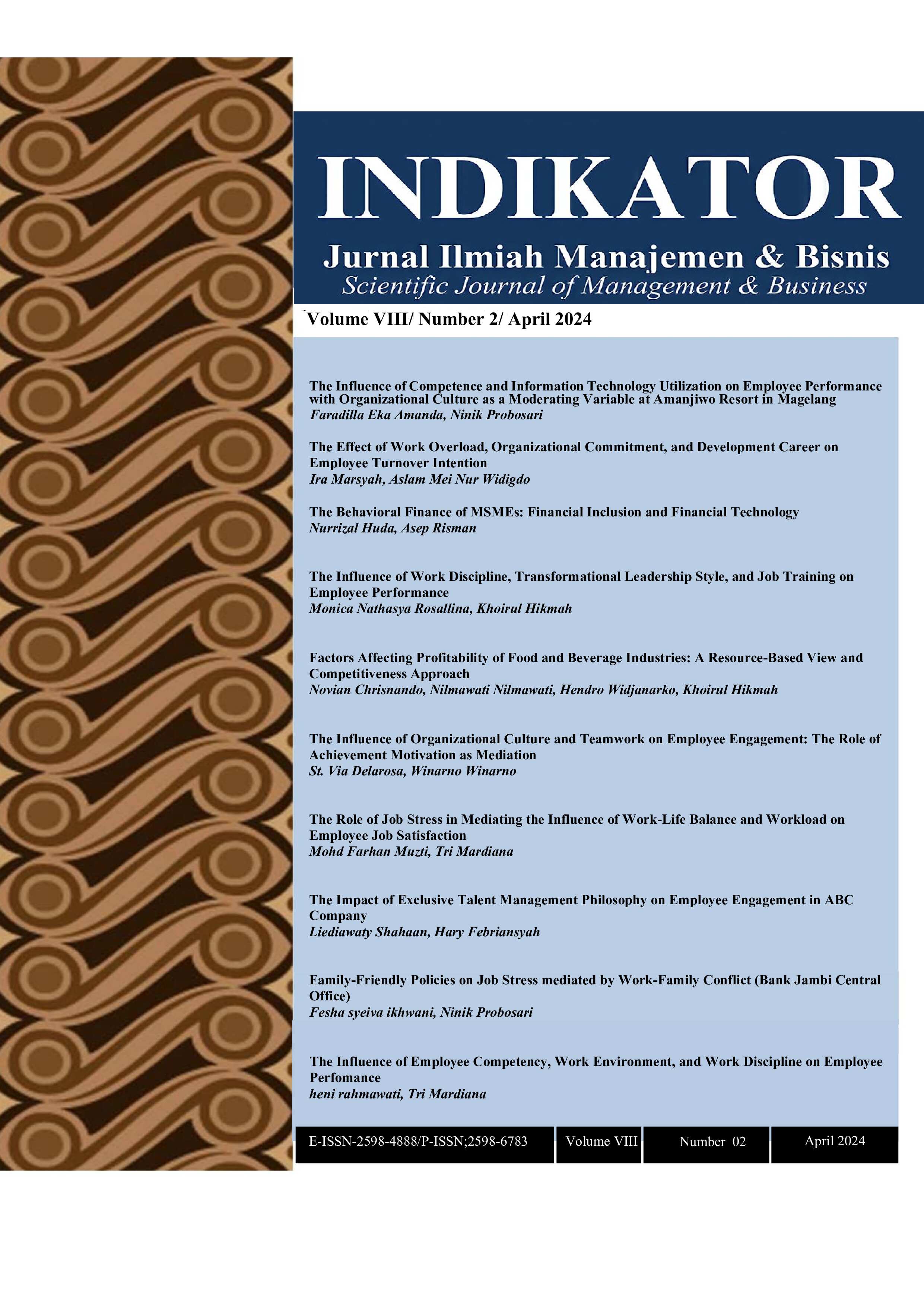
The Effect of Work Overload, Organizational Commitment, and Development Career on Employee Turnover Intention
DOI:
https://doi.org/10.22441/indikator.v8i2.23939Keywords:
work overload, organizational commitment, development career, turnover intentionAbstract
This study's goal is to ascertain and examine the impact of work overload, organizational commitment, and career development on turnover intention, using all PT Sarana Global employees as the objects. This study employed 35 respondents and a causal model in a quantitative manner. Multiple linear regression statistical analysis was also used in this study, and the data were processed using IBM SPSS 25. This study comes to the conclusion that job overload is the reason for the positive influence, which also significantly affects the intention to leave. In the meantime, organizational commitment has a major detrimental impact on turnover intentions. Aside from that, turnover intention is unaffected by career development.References
Aima, D. M. H, & widyastuti E. T. (2019). The Impact of Compensation and Career Development on the Organizational Commitment and the Implication on employees Turnover Intention of PT Serasi Autoraya Head Office.
Amadi, Jam’an. (2019). Pengaruh Job Embeddedness dan Komitmen Organisasi Terhadap Turnover Intention Pada PT Sinar Surya Kencana Abadi Tanjung Mora. Jurnal Ekonomika Universitas Almuslim Bireuen- Aceh, Vol. XI, No. 1,Maret 2019, pp. 29- 34.
Ambarwati. (2019) Pengaruh Koimtmen Organisasi, Kepuasan Kerja dan Pengembangan Karir Terhadap Turnover Intention (Studi pada PT. Bank Mayora). S1 thesis, Universitas Mercu Buana Jakarta.
Ansori. (2021). Pengaruh Kepuasan Kerja dan Komitmen Organisasi terhadap Turnover Intention Pegawai Dinas Komunikasi dan Informatika Kota Bandar Lampung. Jurnal SOLMA. 10 (01), pp. 16.
Ariyati, Y., & Mahera, A. (2018). Pengaruh Kompensasi, Penempatan Kerja Dan Beban Kerja Terhadap Turnover Intention Karyawan PT. Matahari Departement Store Nagoya Hill Batam. BENING, 5(1), 1-13.
Batarliene, N., Ciziuniene, K., Vaiciute, K., Sapalaite, I., & Jarasuniene, A. (2017). The Impact of Human Resource Management on the Competitiveness of Transport Companies. Procedia Engineering, 187, 110 – 116.
Budiyanto, A. (2022). Pengaruh Stres Kerja, Lingkungan Kerja, Kompensasi Dan Pengembangan Karier Terhadap Turnover Intention Karyawan Pada PT. Nesitor. ESENSI: Jurnal Manajemen Bisnis, 25(2), 104-118.
Busro, D. M. (2018). Teori-teori Manajemen Sumber Daya Manusia . Jakarta: Prenamedia Group.
Dayona, G., & Nur, R. (2016). Pengaruh Pelatihan Dan Pengembangan Karir Terhadap Employee Engagement di PT Andalan Finance Indonesia. Jurnal Indonesia Membangun,15(2), 39–61.
Ekhsan, M. (2019). The influence job satisfaction and organizational commitment on employee turnover intention. Journal of Business, Management, & Accounting, 1(1).
Elmi, F. (2018). Telisik Manajemen Sumber Daya Manusia. Jakarta: Mitra Wacana Media.
Fachrozi, I. (2017). Pengaruh Kompensasi dan Lingkungan Kerja terhadap Turnover Intention Karyawan (Studi Kasus Pada Karyawan Bagian Produksi di CV. Wirautama Garment Manufacture.
Halim, L., & Antolis, K. (2021). Analisis faktor-faktor yang mempengaruhi turnover intention agent di PT AIA cabang x Malang. Ekonomi, Keuangan, Investasi Dan Syariah (EKUITAS), 2(2), 177-186.Cimahi –Jawa Barat).
Hardi, B., Suriono, H., & Manurung, H. P. (2019). Pengaruh Konflik, Stres Kerja, Kepuasan Kerja, Dan Beban Kerja Terhadap Turnover Intention Karyawan Pada CV Honda Karya Utama Kisaran. Jurnal Manajemen, Ekonomi Sains, 1(1), 39-48.
Hati, S. W. (2020). Analisis Faktor-faktor yang Mempengaruhi turnover intention karyawan di PT. ABC Batam. Journal of Applied Business Administration, 4(1), 23-30.
Istiyani, A., Wulan, H. S., & Diana, P. (2018). The Effect Of Compensation, Work Stress And Career Development On Turnover Intention With Work Leadership As An Intervening Variable (Case Study At PT. Rajawali Nusindo 2013-2017 Period). Journal of Management, 4(4).
Kartono. (2017). Personality, Employee Engagement, Emotional Intelligence, Job Burnout sebuah Pendekatan Dalam Melihat Turnover intention. Yogyakarta: CV BUDI UTAMA.
Kumbara, V. B. (2018). Pengaruh Kepuasan Kerja, Kompensasi Dan Pengembangan Karir Terhadap Turnover Intention Karyawan Bank Syariah Mandiri Cabang Padang. Jurnal Ekobistek, 43-50.
Komaruddin. (2007). Manajemen Sumber Daya Manusia untuk Keunggulan Bersaing Organisasi. Yogyakarta: Graha Ilmu.
Lubis, N., & Onsardi, O. (2021). Pengaruh Kompensasi, Komitmen Organisasi Dan Kepuasan Kerja Terhadap Turnover Intention Pada PT. Bukit Angkasa Makmur Bengkulu (Studi Kasus Karyawan Produksi PT. BAM Bengkulu). (JEMS) Jurnal Entrepreneur dan Manajemen Sains, 2(2), 196- 208.
Mahawati, E., Yuniwati, E., Ferinia, R., Rahayu, P.J., Fan, T., Sari, A.P.,…….Bahri, S. (2021). Analisis Beban Kerja dan Produktivitas Kerja. Yayasan Kita Menulis.
Marwansyah. (2014). Manajemen Sumber Daya Manusia. Edisi Kedua. Bandung: Alfabeta. Mathis, Robert. L dan Jackson, John. H. 1998. Manajemen Sumber Daya Manusia. Jakarta: Penerbit Salemba Empat.
Maulana, M. F., & Widigdo, A. M. N. (2020). The Influence of Compensation, Workload and Career Advancement on Employees Turnover Intention at HR Consultant Company in Indonesia. International Journal of Innovative Science and Research Technology, 5(3), 214-219.
Maulidah, K., Ali, S., & Pangestuti, D. C. (2022). Pengaruh Beban Kerja dan Kepuasan Kerja terhadap Turnover Intention Karyawan RSU “ABC” Jakarta Selatan. Jurnal Akuntansi, Keuangan, dan Manajemen, 3(2), 159- 176.
Mobley et al. (1978) dalam Vidya Frischa Alfresia (2016). (2016). Skripsi. Yogyakarta. Universitas Negeri Yogyakarta.
Pramudika, C. A. R., Yulianeu, Y., Fathoni, A., & Rakanita, A. M. (2017). Pengaruh Kepuasan Kerja, Pengembangan Karir Dan Komitmen Organisasi Terhadap Turnover Intention (Studi Empiris Pada Karyawan Belle View Hotel Semarang). Journal of Management, 3(3).
Pratama, E. N., Suwarni, E., & Handayani, M. A. (2022). The Effect Of Job Satisfaction And Organizational Commitment On Turnover Intention With Person Organization Fit As Moderator Variable. Aptisi Transactions on Management (ATM), 6(1), 74-82.
Putri, N. D., & Islamuddin, I. (2022). Pengaruh Kompensasi, Lingkungan Kerja Dan Pengembangan Karir Terhadap Turnover Intention Pada Karyawan Pt. Karya Sawitindo Mas. Jurnal Manajemen Modal Insani Dan Bisnis (Jmmib), 3(1), 87-98.
Rahman, A., & Syahrizal, S. (2019, April). Effect of compensation and career development on turnover intention: Job satisfaction as a mediation variable. In 2nd Padang International Conference on Education, Economics, Business and Accounting (PICEEBA-2 2018) (pp. 187-193). Atlantis Press.
Rahmizal, M., & Lasmi, N. (2021). Pengaruh Budaya Organisasi, Komitmen Organisasi Dan Stres Kerja Terhadap Turnover Intention Karyawan PT. Brahma Bina Bakti Mill Jambi. Jurnal Pundi, 5(1).
Ramasari, Putri Febrian, and Ratri Wahyuningtyas. (2014). “Analisis Faktor-Faktor Yang Mempengaruhi Turnover Intention Karyawan Outsourcing Kisel Di PT. Telkomsel Regional Jawa Barat.” EProceedings of Management 1(3).
Risman, A., Subhani, M., & Ushakov, D. (2021). Nexus between Financial Fundamentals and Automotive (Car) Industry. ARDL approach. E3S Web of Conferences, 244.
Sugiyono. (2013). Metode Penelitian Kuantitatif, Kualitatif dan R&D. Bandung: Alfabeta.
Tirtasari, Ratna (2021) Pengaruh Kompensasi, Pengembangan Karir, Dan Rotasi Kerja Terhadap Turnover Intention (Studi Pegawai Operation Officer. S2 thesis, Universitas Mercu Buana Jakarta-Menteng.
Published
How to Cite
Issue
Section
License
The copyright to this article is transferred to Universitas Mercu Buana (UMB) if and when the article is accepted for publication. The undersigned hereby transfers any and all rights in and to the paper including without limitation all copyrights to UMB. The undersigned hereby represents and warrants that the paper is original and that he/she is the author of the paper, except for material that is clearly identified as to its original source, with permission notices from the copyright owners where required. The undersigned represents that he/she has the power and authority to make and execute this assignment.
We declare that:
1. This paper has not been published in the same form elsewhere.
2. It will not be submitted anywhere else for publication prior to acceptance/rejection by this Journal.
3. A copyright permission is obtained for materials published elsewhere and which require this permission for reproduction.
Furthermore, I/We hereby transfer the unlimited rights of publication of the above mentioned paper in whole to UMB. The copyright transfer covers the exclusive right to reproduce and distribute the article, including reprints, translations, photographic reproductions, microform, electronic form (offline, online) or any other reproductions of similar nature.
The corresponding author signs for and accepts responsibility for releasing this material on behalf of any and all co-authors. This agreement is to be signed by at least one of the authors who have obtained the assent of the co-author(s) where applicable. After submission of this agreement signed by the corresponding author, changes of authorship or in the order of the authors listed will not be accepted.
Retained Rights/Terms and Conditions
1. Authors retain all proprietary rights in any process, procedure, or article of manufacture described in the Work.
2. Authors may reproduce or authorize others to reproduce the Work or derivative works for the authors personal use or for company use, provided that the source and the UMB copyright notice are indicated, the copies are not used in any way that implies UMB endorsement of a product or service of any employer, and the copies themselves are not offered for sale.
3. Although authors are permitted to re-use all or portions of the Work in other works, this does not include granting third-party requests for reprinting, republishing, or other types of re-use.
This work is also licensed under a Creative Commons Attribution-NonCommercial 4.0 International License.









