PENGARUH KOMPETENSI GURU BUDAYA ORGANISASI DAN IKLIM KERJA TERHADAP KINERJA GURU
DOI:
https://doi.org/10.22441/indikator.v2i3.3286Keywords:
Kompetensi Guru, Budaya Organisasi, Iklim Kerja, Kinerja GuruAbstract
Penelitian ini bertujuan menguji dan menganalisis Pengaruh Kompetensi Guru, Budaya Organisasi dan Iklim Kerja terhadap Kinerja Guru. Penelitian dilaksanakan mulai tanggal 20 Februari sampai dengan tanggal 4 Maret 2017 di SMK Sandikta Kota Bekasi. Metode sampling yang digunakan adalah Non Probability sampling, cara pengambilan sampel yaitu Purposive Sampling. Dari populasi 60 orang guru, 33 orang guru memenuhi keriteria sebagai sempel. Metode analisis yang digunakan dalam penelitian ini adalah analisa regresi linier berganda. Hasil penelitian menunjukkan variabel kompetensi guru, variabel budaya organisasi dan variabel iklim kerja secara bersama-sama mempunyai pengaruh yang signifikan terhadap variabel kinerja guru. Secara parsial variabel kompetensi guru berpengaruh secara signifikan terhadap variabel kinerja guru dan variabel budaya organisasi berpengaruh signifikan terhadap variabel kinerja guru, sedangkan variabel iklim kerja tidak berpengaruh secara signifikan terhadap variabel kinerja guru. Kompetensi guru merupakan variabel independen yang paling besar pengaruhnya terhadap variabel kinerja guru.References
Bahri, Saiful. 2010. Optimalisasi Kinerja Kepala Sekolah. Gibon Books. Jakarta.
Brahmasari dan Suprayetno. 2008. Tesis. Pengaruh Motivasi Kerja, Kepemimpinan dan Budaya Organisasi Terhadap Kepuasan Kerja Karyawan Serta Dampaknya Pada Kinerja Perusahaan (Study Kasus Pada PT. Pei Hai Internasional Wiratama Indonesia.
Desi Nurhikmahyanti. 2014. “Pengaruh Motivasi dan Kompetensi Profesional Guru Yang Bersertifikasi Terhadap Kinerja Guru”. Jurnal Inspirasi Manajemen Pendidikan. Volume 3. No. 3, 114–123.
Khairul Umam. 2010. Perilaku Organisasi. CV. Pustaka Setia. Bandung.
Khoirinnisa Hsb. 2013. “Analisis Kinerja Guru Kimia SMA Berdasarkan Kompetensinya Pasca Sertifikasi di Kabupaten Labuhan Batu”. Jurnal Tabularasa PPs UNIMED. Vol. 8. No.2.
Keith Davis, John W Newstrom. 2007. Organizational Behavior Human Behavior at Work Mc Graw Hill, Inc. Manila.
Masyhudzulhak. 2016. Manajemen Strategi.Lembaga Pengkajian dan Pengembangan Sumber Daya (LP2S). Bengkulu.
Mulyasa. 2015. Manajemen dan Kepemimpinan Kepala Sekolah. Bumi Aksara. Jakarta.
Permendikbud No. 57 Tahun 2012 Tentang Uji Kompetensi Guru.
Robbin S. 2008. Perilaku Organisasi. Erlangga. Jakarta.
Robbin, Stephen dan Timothy A. Judge. 2013. Organizational Behavior. 15th Ediation. Pearson Education. Boston.
Robertson Khan Tengeh. 2013. “Teacher Job Satifaction and Learner Perfomance in Sout Africa”. Published in Journal of Economic and Social Behavoural Studies. Vol. 5. No. 17.
Sugiyono. 2016. Metode Penelitian Kuantitatif, Kualitatif dan R & D. Alfabeta. Bandung.
Sutrisno, Edy. 2013. Manajemen Sumber Daya Manusia. Kencana Prenada Media Group. Jakarta.
Tika Moh. Pabundu. 2014. Budaya Organisasi Dan Peningkatan Kinerja Perusahaan Bhumi Aksara Jakarta.
Tobari. 2014. Membangun Budaya Organisasi Pada Instansi Pemerintah. Deeppublish. Yogyakarta.
Undang-undang No. 14 tahun 2005. Tentang Guru dan Dosen.
Undang-undang No. 23 tahun 2005. Tentang Sistem Pendidikan Nasional.
Usman Uzer, M. 2010. Menjadi Guru Profesional. Remaja Rosdakarya. Bandung.
Wirawan. 2007. .Evaluasi Kinerja Sumber Daya Manusia: teori, Aplikasi dan Penelitian. Salemba Empat. Jakarta.
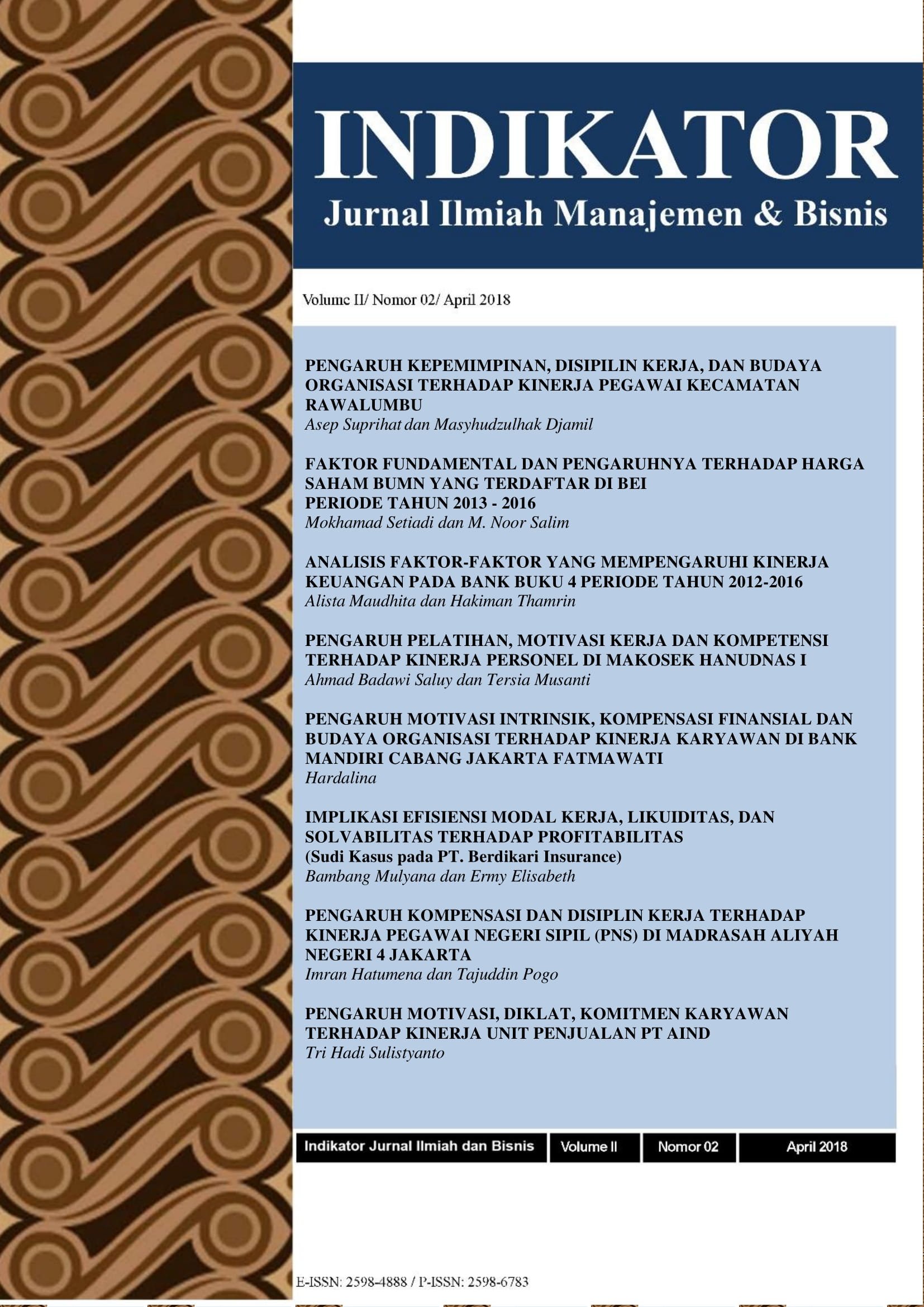
Downloads
Published
How to Cite
Issue
Section
License
The copyright to this article is transferred to Universitas Mercu Buana (UMB) if and when the article is accepted for publication. The undersigned hereby transfers any and all rights in and to the paper including without limitation all copyrights to UMB. The undersigned hereby represents and warrants that the paper is original and that he/she is the author of the paper, except for material that is clearly identified as to its original source, with permission notices from the copyright owners where required. The undersigned represents that he/she has the power and authority to make and execute this assignment.
We declare that:
1. This paper has not been published in the same form elsewhere.
2. It will not be submitted anywhere else for publication prior to acceptance/rejection by this Journal.
3. A copyright permission is obtained for materials published elsewhere and which require this permission for reproduction.
Furthermore, I/We hereby transfer the unlimited rights of publication of the above mentioned paper in whole to UMB. The copyright transfer covers the exclusive right to reproduce and distribute the article, including reprints, translations, photographic reproductions, microform, electronic form (offline, online) or any other reproductions of similar nature.
The corresponding author signs for and accepts responsibility for releasing this material on behalf of any and all co-authors. This agreement is to be signed by at least one of the authors who have obtained the assent of the co-author(s) where applicable. After submission of this agreement signed by the corresponding author, changes of authorship or in the order of the authors listed will not be accepted.
Retained Rights/Terms and Conditions
1. Authors retain all proprietary rights in any process, procedure, or article of manufacture described in the Work.
2. Authors may reproduce or authorize others to reproduce the Work or derivative works for the authors personal use or for company use, provided that the source and the UMB copyright notice are indicated, the copies are not used in any way that implies UMB endorsement of a product or service of any employer, and the copies themselves are not offered for sale.
3. Although authors are permitted to re-use all or portions of the Work in other works, this does not include granting third-party requests for reprinting, republishing, or other types of re-use.
This work is also licensed under a Creative Commons Attribution-NonCommercial 4.0 International License.









