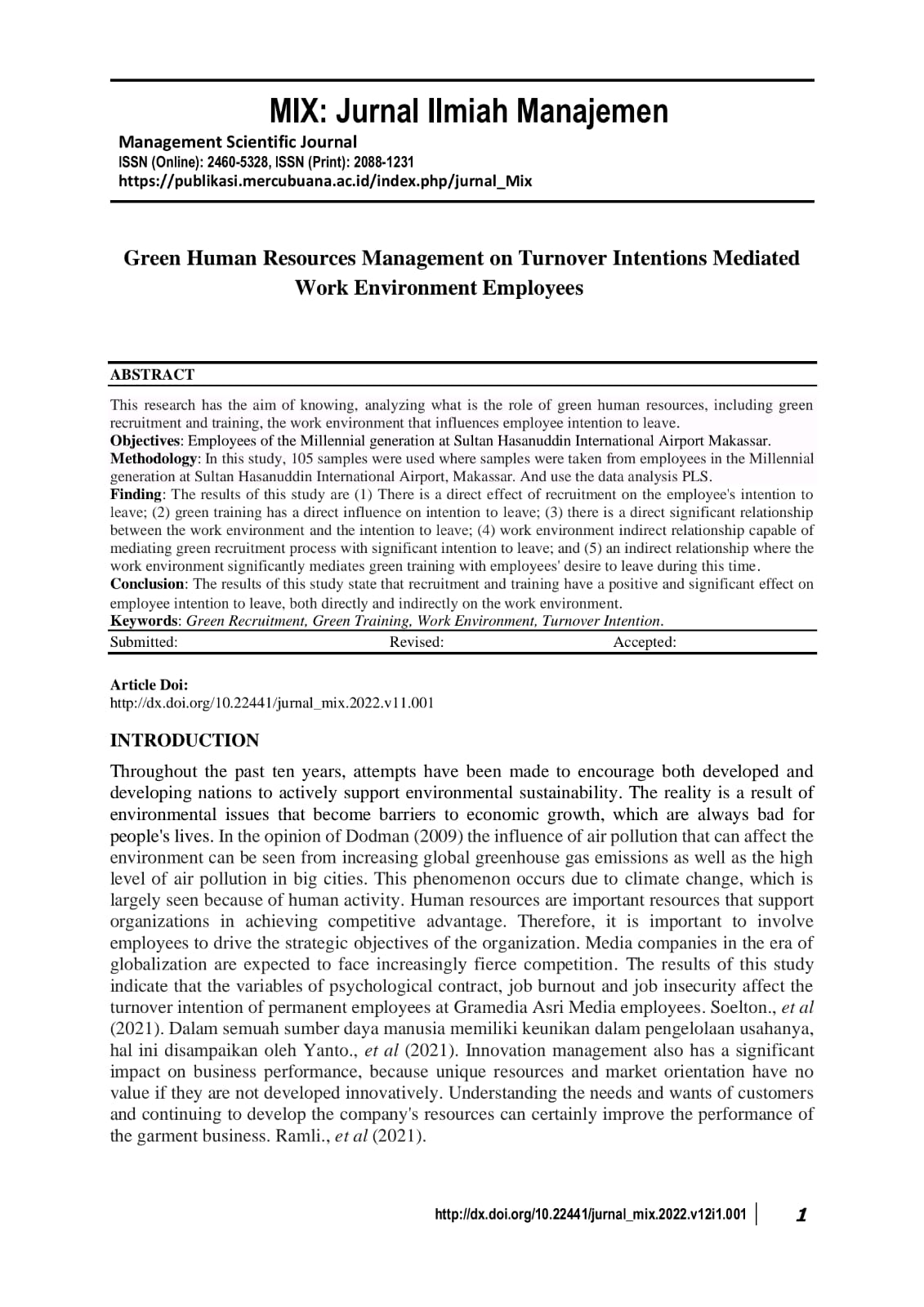
Green Human Resources Management on Turnover Intentions Mediated by Work Environment Employees
Kata Kunci:
Green Recruitment, Green Training, Work Environment, Turnover IntentionAbstrak
Objectives: This research has the aim of knowing and analyzing the role of green human resources, including green recruitment and training, and the work environment that influences employee intention to leave. Employees at Sultan Hasanuddin International Airport Makassar.
Methodology: In this study, 105 samples were used and samples were taken from employees at Sultan Hasanuddin International Airport, Makassar. PLS was the data analysis tool used.
Finding: The results of this study are (1) There is a direct effect of recruitment on the employee's intention to leave; (2) green training has a direct influence on intention to leave; (3) there is a direct significant relationship between the work environment and the intention to leave; (4) work environment indirect relationship is capable of mediating green recruitment process with a significant intention to leave; and (5) an indirect relationship where the work environment significantly mediates green training with employees' desire to leave during this time.
Conclusion: The results of this study state that recruitment and training have a positive and significant effect on employee intention to leave, both directly and indirectly on the work environment.
Referensi
Adi, I. N. R., Mulyadi, M., Wirsa, I. N., Astawa, I. N. D., & Setini, M. (2022). Trust is felt to be a Good Trigger in Marketing and Green Products in Generating Purchase Interest. MIX: Jurnal Ilmiah Manajemen, 12(2), 170-188. https://doi.org/10.22441/jurnal_mix.2022.v12i2.001
AlBattat, A. R., & MatSom, A. P. (2014). Emergency Planning and Disaster Recovery in Malaysian Hospitality Industry. Procedia - Social and Behavioral Sciences, 144, 45-53. https://doi.org/10.1016/j.sbspro.2014.07.272
Burbar, M. Y. (2021). The Impact of Work Environment on Employees’ Performance in Banking Sector in Palestine. International Business Research, 14(8), 85-99. https://doi.org/10.5539/ibr.v14n8p85
Chen, M.-F., Lin, C.-P., & Lien, G.-Y. (2011). Modelling job stress as a mediating role in predicting turnover intention. The Service Industries Journal, 31(8), 1327-1345. https://doi.org/10.1080/02642060903437543
De Clercq, D., Khan, M. A., & Haq, I. U. (2021). Perceived organizational politics and turnover intentions: critical roles of social adaptive behavior and emotional regulation skills. Journal of Management & Organization, 1-19. https://doi.org/10.1017/jmo.2021.26
Demus, A. W., Kindangen, P., & Tielung, M. V. J. (2015). The Impact Of Work Environment On Employee Performance (Case Study At Pt. Bank Artha Graha International Tbk, Manado Branch Calaca). Jurnal Berkala Ilmiah Efisiensi, 15(5), 818-827.
Dodman, D. (2009). Blaming cities for climate change? An analysis of urban greenhouse gas emissions inventories. Environment and Urbanization, 21(1), 185-201. https://doi.org/10.1177/0956247809103016
Dumont, J., Shen, J., & Deng, X. (2017). Effects of Green HRM Practices on Employee Workplace Green Behavior: The Role of Psychological Green Climate and Employee Green Values. Human Resource Management Advancing Human Resource Research and Practice, 56(4), 613-627. https://doi.org/10.1002/hrm.21792
Fiske, S. T., & Taylor, S. E. (1991). Social Cognition (2nd ed.). Mcgraw-Hill Book Company.
Genoveva, G., & Samukti, D. R. (2020). Green Marketing: Strengthen the Brand Image and Increase the Consumers’ Purchase Decision. Mix Jurnal Ilmiah Manajemen, 10(3), 367-384. https://doi.org/10.22441/mix.2020.v10i3.004
Gholami, H., Rezaei, G., Saman, M. Z. M., Sharif, S., & Zakuan, N. (2016). State-of-the-art Green HRM System: sustainability in the sports center in Malaysia using a multi-methods approach and opportunities for future research. Journal of Cleaner Production, 124, 142-163. https://doi.org/10.1016/j.jclepro.2016.02.105
Guerci, M., Longoni, A., & Luzzini, D. (2015). Translating stakeholder pressures into environmental performance – the mediating role of green HRM practices. The International Journal of Human Resource Management, 27(2), 262-289. https://doi.org/10.1080/09585192.2015.1065431
Han, J. W., Kok, S., & McClelland, R. (2020). Impact of Green Training on Employee Turnover and Customer Satisfaction. Proceedings of the 17th International Conference on Intellectual Capital, Knowledge Management & Organisational Learning (ICICKM 2020),
Hewett, R., Shantz, A., Mundy, J., & Alfes, K. (2017). Attribution theories in Human Resource Management research: a review and research agenda. The International Journal of Human Resource Management, 1-40. https://doi.org/10.1080/09585192.2017.1380062
Hong, J.-W., Cruz, I., & Williams, D. (2021). AI, you can drive my car: How we evaluate human drivers vs. self-driving cars. Computers in Human Behavior, 125, 106944. https://doi.org/10.1016/j.chb.2021.106944
Islam, M. A., Jantan, A. H., Yusoff, Y. M., Chong, C. W., & Hossain, M. S. (2020). Green Human Resource Management (GHRM) Practices and Millennial Employees’ Turnover Intentions in Tourism Industry in Malaysia: Moderating Role of Work Environment. Global Business Review, 1-21. https://doi.org/10.1177/0972150920907000
Jabbour, C. J. C., & Jabbour, A. B. L. d. S. (2016). Green Human Resource Management and Green Supply Chain Management: linking two emerging agendas. Journal of Cleaner Production, 112, 1824-1833. https://doi.org/10.1016/j.jclepro.2015.01.052
Jepsen, D. M., & Grob, S. (2015). Sustainability in Recruitment and Selection: Building a Framework of Practices. Journal of Education for Sustainable Development, 9(2), 160-178. https://doi.org/10.1177/0973408215588250
Jumady, E., & Lilla, L. (2021). Antecedent and Consequence the Human Resources Management Factors on Civil Servant Performance. Golden Ratio of Human Resource Management, 1(2), 104-116. https://doi.org/10.52970/grhrm.v1i2.101
Kurniawaty, K., Ramly, M., & Ramlawati, R. (2019). The effect of work environment, stress, and job satisfaction on employee turnover intention. Management Science Letters, 9, 877-886. https://doi.org/10.5267/j.msl.2019.3.001
Nawangsari, L. C., & Sutawidjaya, A. H. (2018). How the Green Human Resources Management (GHRM) Process Can Be Adopted for the Organization Business? Advances in Economics, Business and Management Research, 65, 463-465.
Nejati, M., Rabiei, S., & Jabbour, C. J. C. (2017). Envisioning the invisible: understanding the synergy between Green Human Resource Management and Green Supply Chain Management in Manufacturing Firms in Iran in light of the moderating effect of employees’ resistance to change. Journal of Cleaner Production, 168, 163-172. https://doi.org/10.1016/j.jclepro.2017.08.213
Nisar, Q. A., Haider, S., Ali, F., Gill, S. S., & Waqas, A. (2022). The Role of Green HRM on Environmental Performance of Hotels: Mediating Effect of Green Self-Efficacy & Employee Green Behaviors. Journal of Quality Assurance in Hospitality & Tourism, 1-34. https://doi.org/10.1080/1528008X.2022.2109235
Nitisemito, A. S. (2015). Manajemen Personalia. Ghalia Indonesia.
Obaid, T. F., & Alias, R. B. (2015). The Impact Of Green Recruitment, Green Training And Green Learning On The Firm Performance: Conceptual Paper. Internat ional Journal of Applied Research, 1(12), 951-953.
Ong, J. O., Djamil, M., Ariyanto, E., & Sugiyono. (2022). A Literature Review of Green Human Resource Management for Gaining a Competitive Advantage. MIX: Jurnal Ilmiah Manajemen, 12(3), 458-466. https://doi.org/10.22441/jurnal_mix.2022.v12i3.007
Pinzone, M., Guerci, M., Lettieri, E., & Redman, T. (2016). Progressing in the change journey towards sustainability in healthcare: the role of ‘Green’ HRM. Journal of Cleaner Production, 122, 201-211. https://doi.org/10.1016/j.jclepro.2016.02.031
Pratama, E. N., Suwarni, E., & Handayani, M. A. (2022). Effect Of Job Satisfaction And Organizational Commitment On Turnover Intention With Person Organization Fit As Moderator Variable. Aptisi Transactions on Management (ATM), 6(1), 74-82. https://doi.org/10.33050/atm.v6i1.1722
Purnomowati, N. H., & Asrihapsari, A. (2021). Green Community Empowerment Business Model to Recognize Solo Green City: A Case Study. MIX: Jurnal Ilmiah Manajemen, 11(1), 136-146. https://doi.org/10.22441/mix.2021.v11i1.010
Renwick, D. W. S., Redman, T., & Maguire, S. (2012). Green Human Resource Management: A Review and Research Agenda. International Journal of Management Reviews, 15(1), 1-14. https://doi.org/10.1111/j.1468-2370.2011.00328.x
Roscoe, S., Subramanian, N., Jabbour, C. J. C., & Chong, T. (2019). Green human resource management and the enablers of green organisational culture: Enhancing a firm's environmental performance for sustainable development. Business Strategy and the Environment, 28(5), 737-749. https://doi.org/10.1002/bse.2277
Rudolph, C. W., Allan, B., Clark, M., Hertel, G., Hirschi, A., Kunze, F., . . . Zacher, H. (2021). Pandemics: Implications for research and practice in industrial and organizational psychology. Industrial and Organizational Psychology, 14, 1-35. https://doi.org/10.1017/iop.2020.48
Saeidi, P., Saeidi, S. P., Sofian, S., Saeidi, S. P., Nilashi, M., & Mardani, A. (2019). The impact of enterprise risk management on competitive advantage by moderating role of information technology. Computer Standards & Interfaces, 63, 67-82. https://doi.org/10.1016/j.csi.2018.11.009
Safitri, I., & Ibrahem, M. S. (2021). Analisis Stres Kerja, Burnout Dan Komitmen Organisasi Terhadap Turnover Intention. TEROPONG: Jurnal Ilmiah Manajemen dan Bisnis, 10(2), 84-95. https://doi.org/10.22441/teropong.v10i2.16143
Santhanam, N., T.J, K., Dyaram, L., & Ziegler, H. (2017). Impact of human resource management practices on employee turnover intentions. Journal of Indian Business Research, 9(3), 212-228. https://doi.org/10.1108/jibr-10-2016-0116
Sekaran, U., & Bougie, R. (2016). Research Methods For Business : A Skill Building Approach (Seventh ed.). John Wiley & Sons.
Singh, S. K., Chen, J., Del Giudice, M., & El-Kassar, A.-N. (2019). Environmental ethics, environmental performance, and competitive advantage: Role of environmental training. Technological Forecasting and Social Change, 146, 203-211. https://doi.org/10.1016/j.techfore.2019.05.032
Sinniah, S., & Kamil, N. M. (2017). The Influence of Human Resource Practices on Turnover Intention: The Case of a Telecommunication Company in Malaysia. Malaysian Management Review, 52(1), 45-61.
Siyambalapitiya, J., Zhang, X., & Liu, X. (2018). Green human resource management: A proposed model in the context of Sri Lanka’s tourism industry. Journal of Cleaner Production, 201, 542-555. https://doi.org/10.1016/j.jclepro.2018.07.305
Soelton, M., & Hardiati, S. M. (2017). Pengaruh Standard Pelatihan Kerja Dan Organizational Citizenship Behavior Terhadap Kinerja Pegawai Pada Panti Sosial Bina Netra “Tan Miyat” Bekasi. Jurnal Ilmiah Manajemen Bisnis, 3(1), 1-18. https://doi.org/10.22441/jimb.v3i1.3543
Soelton, M., Hokroh, M., Sadiq, M., Setini, M., Saratian, E. T. P., Arijanto, A., & Wulandari, R. (2021). Multidimensional Factors That Influence The Turnover Intention To Practice Segregation Psychological Contract, Burnout And Job Insecurity. Jurnal Ilmiah Manajemen Dan Bisnis, 7(2), 174-188. https://doi.org/10.22441/jimb.v7i2.10221
Soelton, M., Ramli, Y., Ali, A. J., Arief, H., Saratian, E. T. P., & Pasaribu, E. (2020). To Imply The Organizational Citizenship Behavior In The Work Place To Improve Employee Performance. International Journal of Business, Economics and Law, 21(5), 70-82.
Sugiyono. (2016). Metode Penelitian Kuantitatif, Kualitatif dan R & D. CV. Alfabeta.
Suharti, L., & Sugiarto, A. (2020). A Qualitative Study of Green Hrm Practices and Their Benefits in the Organization: An Indonesian Company Experience. BUSINESS: THEORY AND PRACTICE, 21(1), 200-211. https://doi.org/10.3846/btp.2020.11386
Sulistyan, R. B. (2017). Contribution Of Leadership And Environmental Work In Improving Employee Motivation. Jurnal Ilmu Manajemen Advantage, 1(2), 166-177. https://doi.org/10.30741/adv.v1i2.196
Sulistyan, R. B. (2020). Lecturer E-learning Training: The Role of Social Exchange Theory. Empowerment Society, 3(2), 50-56. https://doi.org/10.30741/eps.v3i2.589
Sulistyan, R. B., & Budiyanto. (2019). The Mediating Role Of Satisfaction On The Relationship Between Perceived Institutional And Functional Image On Student Retention. Proceeding Book 7th Asian Academic Society International Conference 2019, 377-381.
Sulistyan, R. B., Carito, D. W., Cahyaningati, R., Taufik, M., Kasno, K., & Samsuranto, S. (2022). Identification of Human Resources in the Application of SME Technology. Wiga : Jurnal Penelitian Ilmu Ekonomi, 22(1), 70-76. https://doi.org/10.30741/wiga.v12i1.799
Sulistyan, R. B., Ermawati, E., & Ariyono, K. Y. (2019). Manajemen Retensi dalam Upaya Mempertahankan Karyawan melalui Dorongan Kepuasan dan Komitmen. Wiga : Jurnal Penelitian Ilmu Ekonomi, 9(2), 87-98. https://doi.org/10.30741/wiga.v9i2.464
Sulistyan, R. B., Ermawati, E., Hidayat, Z., Lukiana, N., & Kasno. (2019). Retention Management as an Effort to Overcome the Intention of Account Officers to Stop the Company. Journal of Advanced Research in Dynamical and Control Systems, 11(12), 17-25. https://doi.org/10.5373/jardcs/v11i12/20193207
Tang, G., Chen, Y., Jiang, Y., Paillé, P., & Jia, J. (2018). Green human resource management practices: scale development and validity. Asia Pacific Journal of Human Resources, 56(1), 31-55. https://doi.org/10.1111/1744-7941.12147
Urrutia Pereira, G., de Lara Machado, W., & Ziebell de Oliveira, M. (2021). Organizational learning culture in industry 4.0: relationships with work engagement and turnover intention. Human Resource Development International, 25(5), 557-577. https://doi.org/10.1080/13678868.2021.1976020
Wisantyo, N. I., & Madiistriyatno, H. (2015). Pengaruh Stres Kerja, Disiplin Kerja Dan Kepuasan Kerja Terhadap Intensi Turnover (Studi padaLembagaPengelola Dana Bergulir Koperasi danUsaha Mikro, Kecil dan Menengah ). MIX: Jurnal Ilmiah Manajemen, 5(1), 54-69.
Yusoff, Y. M., & Nejati, M. (2018). A conceptual model of green HRM adoption towards sustainability in hospitality industry. IGI Global. https://doi.org/10.4018/978-1-5225-6192-7.ch022
Zaeni, N., Arfah, A., & Semmaila, B. (2022). The Effect of Compensation and Work Environment on Employee Performance. Point of View Research Management, 3(2), 161-173.
Zeebaree, S. R. M., Shukur, H. M., & Hussan, B. K. (2019). Human resource management systems for enterprise organizations: A review. Periodicals of Engineering and Natural Sciences, 7(2), 660-669. https://doi.org/10.21533/pen.v7i2.428
Zhang, Y., Luo, Y., Zhang, X., & Zhao, J. (2019). How Green Human Resource Management Can Promote Green Employee Behavior in China: A Technology Acceptance Model Perspective. Sustainability, 11(19), 5408. https://doi.org/10.3390/su11195408
Zoogah, D. B. (2011). The Dynamics of Green HRM Behaviors: A Cognitive Social Information Processing Approach. Zeitschrift für Personalforschun, 25(2), 117-139. https://doi.org/0.1688/1862-0000_ZfP_2011_02_Zoogah
Unduhan
Diterbitkan
Cara Mengutip
Terbitan
Bagian
Lisensi
The copyright to this article is transferred to Universitas Mercu Buana (UMB) if and when the article is accepted for publication. The undersigned hereby transfers any and all rights in and to the paper including without limitation all copyrights to UMB. The undersigned hereby represents and warrants that the paper is original and that he/she is the author of the paper, except for material that is clearly identified as to its original source, with permission notices from the copyright owners where required. The undersigned represents that he/she has the power and authority to make and execute this assignment.
We declare that this paper has not been published in the same form elsewhere.
Furthermore, I/We hereby transfer the unlimited rights of publication of the above mentioned paper in whole to UMB. The copyright transfer covers the right to reproduce and distribute the article, including reprints, translations, photographic reproductions, microform, electronic form (offline, online) or any other reproductions of similar nature.
The corresponding author signs for and accepts responsibility for releasing this material on behalf of any and all co-authors. This agreement is to be signed by at least one of the authors who have obtained the assent of the co-author(s) where applicable. After submission of this agreement signed by the corresponding author, changes of authorship or in the order of the authors listed will not be accepted.
Retained Rights/Terms and Conditions
Although authors are permitted to re-use all or portions of the Work in other works, this does not include granting third-party requests for reprinting, republishing, or other types of re-use.